
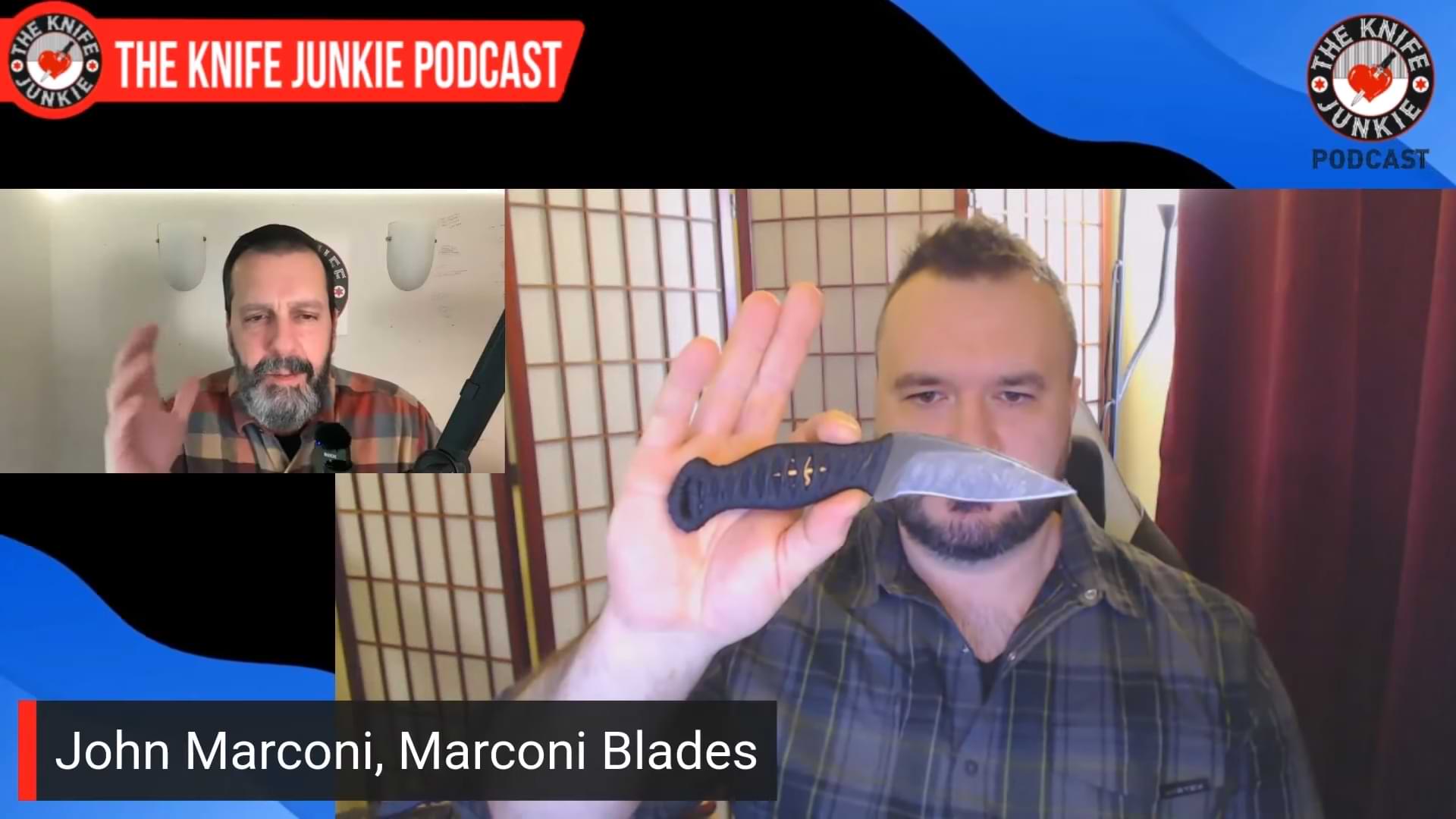
John Marconi, Marconi Blades: The Knife Junkie Podcast (Episode 650)
This week on The Knife Junkie Podcast, Bob DeMarco welcomes professional chef and custom knifemaker John Marconi of Marconi Blades to discuss how nearly two decades in restaurant kitchens shaped his approach to making purpose-driven fixed blade knives.
Marconi has spent 18 years working as a professional chef, starting as a dishwasher at age 16 and working his way up to executive chef positions in fine dining restaurants. His experience spans Italian cuisine, resort dining, and everything in between. But what makes John unique in the knifemaking world is how he applies the same precision and attention to detail from plating high-end dishes to grinding defensive fixed blades.
“I was in college initially to be a teacher and just could not stand going to classes, but I loved the chaos of the restaurant world,” John explains on the show. That love of controlled chaos now extends to his knife shop.
The Marconi Approach to Blade Design
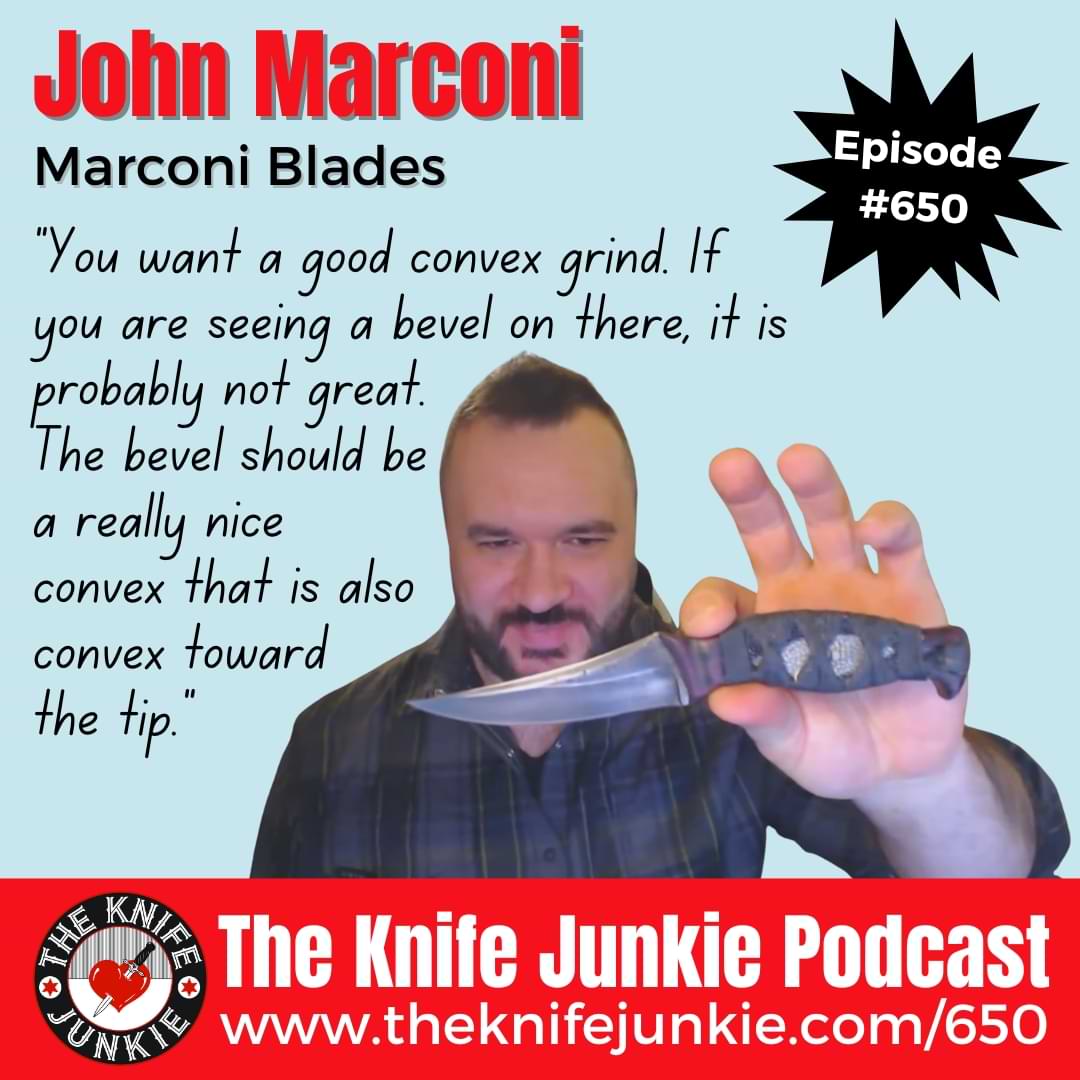
Marconi Blades specializes in everyday carry fixed blades with a focus on defensive applications. The Tuilm model, which John sent to Bob for review, showcases his design philosophy. Built from 1/8-inch CPM MagnaCut steel, the Tuilm works for both reverse grip and saber grip, with ergonomics that lock the knife into the hand.
John’s designs draw influence from makers including Frank Windle Jr. (Northman Blades), Brian Schultz, and Joe Watson. He offers ambidextrous sheath options, understanding that carry preferences vary among users. Each knife balances combat readiness with aesthetic appeal.
“There is no reason that a hard-use tool cannot also be an art piece,” John says, summing up his philosophy on the episode.
Looking Ahead
Marconi Blades continues to grow. John is currently working on a Northern Shrike collaboration and developing a recurve model that has the knife community excited. The business has become so successful that it could potentially transition into a full-time venture, though John remains committed to maintaining quality over rushing production.
His background in fine dining continues to influence his knife work. The same eye that evaluates a perfectly plated dish now judges the lines of a blade. The same hands that perform precise brunoise cuts now shape handles that fit perfectly in the palm.
You can follow John Marconi and see his latest work at Marconi Blades and on Instagram at @marconi_blades. Check out his current models and watch for news about upcoming releases.
Check out the full episode to hear more about John’s journey from professional kitchens to custom knifemaking, his thoughts on steel selection and grind geometry, and what drives his design decisions. The conversation covers everything from the best way to cook meatballs to what makes a defensive fixed blade truly functional.

Be sure to support The Knife Junkie and get in on the perks of being a Patron, including early access to the podcast and exclusive bonus content. You also can also support the Knife Junkie channel with your next knife purchase. Find our affiliate links at theknifejunkie.com/knives.
Chef-turned-knifemaker John Marconi brings 18 years of professional kitchen precision to defensive fixed blades. His philosophy? 'There is no reason that a hard-use tool can not also be an art piece.' Share on XThe Knife Junkie Podcast is the place for knife newbies and knife junkies to learn about knives and knife collecting. Twice per week Bob DeMarco talks knives. Email Bob at theknifejunkie@gmail.com; visit https://theknifejunkie.com.
©2025, Bob DeMarco
The Knife Junkie Podcast
https://theknifejunkie.com
Transcribe Your Podcasts and Videos: https://theknifejunkie.com/magic (affiliate link)
The Knife Junkie Podcast (Episode 650) featuring John Marconi of Marconi Blades.
Announcer: Welcome to The Knife Junkie Podcast, your weekly dose of knife news and information about knives and knife collecting. Here's your host, Bob "The Knife Junkie" DeMarco.
Bob DeMarco: Welcome to The Knife Junkie Podcast, I'm your host, Bob DeMarco. On this edition of the show, I'm speaking with John Marconi of Marconi Blades. I first heard of Marconi Blades from Thomas Alas, who knew I would love John's purpose-driven and beautifully made everyday carry fixed blade knives. John graciously sent me a knife and its trainer to check out, and I can say that having them in hand, Thomas was right. The Marconi Tuilm model is sweet. We'll meet John and find out about Marconi Blades, but first, be sure to like, comment, subscribe, hit the notification bell, and download the show to your favorite podcast app. Also, if you want to help support the show, you can do so by joining us right here on YouTube below my finger or going to Patreon, scanning that QR code and going to theknifejunkie.com/patreon, where if you sign up for an entire year at once, you save 12%. So, please do that. Go check it out. Theknifejunkie.com/patreon.
Announcer: Want to sell your custom knives online? With Launch Cart, you can easily create your own e-commerce store. No coding required. Launch Cart is designed for knifemakers like you with built-in tools to showcase your craftsmanship, manage orders, and grow your brand. It's fast, flexible, and even includes low-cost payment processing to help you keep more of your profits. Start your online knife store today at theknifejunkie.com/launch and turn your passion into a business.
Bob DeMarco: John, welcome to The Knife Junkie Podcast, sir.
John Marconi: Oh, my pleasure.
Bob DeMarco: Well, okay, so I mentioned it a little bit up front, but you are a chef. Or maybe I didn't mention it, but you're a chef, right?
John Marconi: I am indeed. It's the only thing I've ever done for a living, um, and still doing it.
Bob DeMarco: All right. So you make your living with a knife in hand. You know a lot about knives. Uh, before we get into your knife making and some of your blades and stuff, I want to ask you a little bit about cheffing and being in a professional kitchen. When I was in college, I worked in a kitchen and then later I was a waiter for a while. So, uh, restaurants are interesting environments. Uh, tell us a little bit about being a chef.
John Marconi: Yeah, so I started off as a dishwasher when I was 16 or 17. Um, and just kind of moved up through the ranks. Um, you know, we ended up losing a prep cook, so they asked me if I wanted to try my hand at prepping some stuff. Um, then we lost the line guy, so I ended up getting thrown on the line, actually cooking the orders that were coming in. Um, and I just really got hooked to it. Um, had the pleasure of working with some really talented people. Um, I was in college initially to be a teacher and just couldn't stand going to classes, but I loved the chaos of the, uh, the restaurant world. Um, it was just always an adrenaline rush and, uh, decided to make a career out of it. And doing it ever since going on 18, 19 years now.
Bob DeMarco: Wow. What do you specialize in making personally?
John Marconi: That's a loaded question. Um, I spend a lot of time in fine dining. Um, so it just really changes on the environment that I'm working in. So like I ran an Italian restaurant for a few years, so at that time I was just really trying to dial in, um, like pizzas and pastas and working with that. Um, I worked at a resort for a while and that was a lot of, um, like lamb and high-end seafood dishes and I don't know, it's just that whenever I'm asked that question, it just kind of really drives into what am I working with at that time and just trying to do the best possible job with it as possible.
Bob DeMarco: Because you have to form a menu within the format that you're, that you're finding yourself in, in the first place.
John Marconi: Yeah, exactly. So I mean if I'm writing a menu in an Italian restaurant, I'm trying to elevate everything that's going on. So how do I take all these different components to a pasta dish and just really bring it up, um, add different depths of like texture and, uh, just pop of acidity to go with the fat. And I don't know, it's a, it's a lot of fun coming up with stuff and been, been a really cool career.
Bob DeMarco: All right. One last food question before I start asking you about knives. Um, do you precook your meatballs or do you make them and put them right in the sauce?
John Marconi: Raw right in the sauce.
Bob DeMarco: Oh!
John Marconi: Because then the sauce takes on the flavor of the meatballs. The meatballs take on the flavor of the sauce. Give it like a good three-hour braise and yeah, you develop some good rich flavor.
Bob DeMarco: I'm a recent convert to that. A guy I worked with was, uh, claiming for years that his meatballs were superior and that was why, and, uh, I, I've actually come around to him. So I've, uh, you know, I still use my mom's recipe, but I don't, I don't cook them the same way. Don't tell her.
John Marconi: [Chuckles]
Bob DeMarco: All right. So you, like I said, you make your living every day with a knife in your hand. Uh, just in general, what do you expect out of a knife?
John Marconi: For a kitchen tool? I, it's got to be able to be strong, but also get some really precise cuts. Um, cause like I said, I spend a lot of time in fine dining, which you're doing a lot of like really fine brunoises, which is the, the smallest of dices. Um, and the tool that I'm always going for is going to be an eight-inch chef knife. Um, and I, you don't want the steel to be too thick. You want a good convex grind. Um, like if you're, when you're looking at the profile of a blade, if you're seeing a bevel on there, it's probably not great. Um, the bevel should, it should be a really nice convex that is also convex toward the tip. Um, and I'm really partial, partial to carbon steel in chef knives, uh, which would seem kind of counter, counter-intuitive because you're washing them a lot and they're exposed to a lot of acidity, but if that patina develops, you've just got a knife that'll last you forever. I don't have it here with me cause it's at work, but I've been using, um, the same first run of the Zwilling Bob Kramer line since they came out in 2012. And that thing has been absolutely abused, thrown around. Um, I have reground the tip maybe twice on it and it just, it's been a workhorse forever. It holds a great edge. It's just a big hunk of 52100.
Bob DeMarco: Uh, in the past couple of years, I've discovered, uh, custom kitchen knives and it has changed, uh, the game. Uh, my wife and I like to cook. You know, we're not rabid chefs or anything, but we do a lot, you know, a lot of subsistence cooking and a lot of like day-to-day kind of stuff. And, uh, we have a couple of, we have three super thin custom kitchen knives. I love them. Um, and I, I aim to, to widen that collection just because it's something you use every day. I have a lot of great combat knives, self-defense carry knives. That's my, that's the stuff I love to collect. That's my favorite stuff. Uh, but the knives I use the most are these kitchen knives. So, uh, I feel like it's almost, um, a responsibility to get a little deeper into them.
John Marconi: Oh, absolutely. And, uh, check out eatingtools.com. They've always got an insane collection from small batch makers. The, the pricing is kind of crazy, but phenomenal stuff. And, um, man, when I took over as executive chef of this, uh, high-end Italian restaurant, um, I treated myself to a custom piece by Greetham Knife Co. And he was pretty small at the time, but he has grown so much over the last couple of years. His work is stunning. And if you haven't seen his work, check him out. But I got that piece when he had maybe 400 followers and, um, big hunk of W2 with a hamon. And that thing, that's also been a workhorse. That's, other than the Bob Kramer, that's the first one I go for.
Bob DeMarco: That's Mike Cahill out of Texas. He's an awesome dude. Uh, he's been on this show and I met him at the Texas Custom Knife Show. And I walked up to him for his Bowies, but saw his, his kitchen knives. They are beautiful.
John Marconi: Yeah, the thing's crazy.
Bob DeMarco: All right. So, I'm holding in my hand your Tuilm model, and it's very different from the kind of knives we've just been talking about—kitchen knives. This to me is, um, meant for reverse grip or meant for a, um, uh, what do you call it? Uh, a saber grip with this, uh, with the puño like right nestled into the hand. Very different kind of knife. Tell us about this knife and the kind of knives you make.
John Marconi: So while I do chef work for a living, um, I have always been really passionate about, uh, combatives. Um, I trained in martial arts for a good chunk of my life pretty much until I started taking my career really seriously. And it was really hard to dedicate specific time to going to a gym. So, um, largely just kind of kept up with what I could myself and gaining knowledge wherever possible. If someone had something great to show me, I would fall into it. And, um, to compliment, um, handgun work, I really got into, uh, small fixed blade knives that you can carry every day. And, um, the, the Amtac Northman really changed everything that I carry. Got me completely away from folders. One of the most capable fixed blades I'd ever handled. Um, and really fell in love with that size. And I found that in everything that I'm doing every day with when shipments come in and you're opening boxes constantly, that was the thing that was in my hand all the time. I mean, it was in and out of the pocket like 40, 50 times a day easily. Um, and because of that, you also develop muscle memory with a tool that is meant for self-defense as well.
Bob DeMarco: Yep.
John Marconi: So, um, just something you're using constantly. It eventually just becomes an extension of your hand. You don't even really notice when you're drawing it or resheathing it. And there were some things about that blade that cause I have quite large hands. I wanted to, um, change up. I didn't really like Northman X because I like that three-finger grip. Um, but I wanted to develop a line, uh, a blade in my lineup once I was really comfortable doing stuff that would again suit that purpose. But, um, I wanted it to fit my hand a little bit better. And, uh, this was actually one of the first generation Tuilm. It's a little bit leaner than what you have. Um, but again, you've got that, uh, that three-finger grip where it nestles in your hand, but in the reverse grip, I can get all four of my fingers on there.
Bob DeMarco: Yeah.
John Marconi: And, uh, then with the latest iteration, um, I made the blade slightly longer because I always really liked, um, that like three and a half to four-inch blade length. Um, and I made the entire profile a little bit taller and, um, let me pop this guy back out again. If the puños are a little bit different, um, I always wanted to have that, uh, little bit of a 3D grip there for the draw.
Bob DeMarco: Yep.
John Marconi: With the original wraps I was doing, but I recently started tapering all of my tangs and, uh, flaring the puño underneath of the wrap. So you get that flat surface you normally only get on scales, but on a wrapped blade.
Bob DeMarco: I'm, I'm, you're talking about right, right here.
John Marconi: Yes, sir.
Bob DeMarco: Oh.
John Marconi: So it's a, there's a lot of work that goes into that. Um, but it, because generally, find actually a good example, I greatly respect. If you look at like this, uh, beautiful Joe Watson ETR here.
Bob DeMarco: Yeah.
John Marconi: It generally just get kind of that rounded cap at the end and my solution for that was the tapered tangs and bolstering underneath of the wrap, get that flat surface that you again generally just get on scales.
Bob DeMarco: But okay. I get the tapered tang part, but what's the bolstering under the wrap?
John Marconi: So I terminate the taper completely at the end here and there's actually steel inserts that I mount to the sides of the puño. Um, that way when I wrap it, it creates a little bit of flare and that flat surface back there. And I'm doing that on all my wrapped blades right now.
Bob DeMarco: So, uh, I'm a huge fan of, well, Joe Watson, but I'm a huge fan of, um, wrapped, this sort of tsukamaki handle wrap where you have the real high peaks and the real deep valleys. Uh, how did you learn that and, and why did you adopt that?
John Marconi: Uh, I handled a Gross Motor Gear Mamushi that my brother, um, who also makes blades when he can, um, he had picked one of those up and that was the first time I'd ever handled an epoxy sealed wrap and it just, I fell in love with the grip. So I still work with a lot of, um, G10 and composites, but, um, I do runs of just wrapped blades a lot because I find the grip to just be superior in a lot of ways, especially on the smaller blades. That was another reason I started doing the Tuilm. I am doing a scaled run in the future, um, with...
Bob DeMarco: What does that mean? Oh, oh, with scales?
John Marconi: Yeah, with handle scales. The grips change a little bit, but I wanted, um, that wrap to be on there because again, a small blade like that, uh, especially with thrusting, you want it to lock into your hand really well. So the geometry of the handle plus those deep peaks, I mean, it just locks the thing in.
Bob DeMarco: Yeah. It really does. And you've got great ergonomics on the handle and, and something interesting, uh, to me is that, well, like you mentioned, I can get a four-finger grip in reverse grip, but in, in that forward grip, it's more of a, um, you know, it, uh, the puño of the handle acts more as a, um, a brace against the palm in a thrust.
John Marconi: It connects right into the bones of your hand. So if you're, take that trainer and thrust it against some stuff, you'll be surprised at how much power you can get behind it.
Bob DeMarco: So what, you mentioned combatives and martial arts. What, uh, what martial arts and combatives did you train in that led to the Tuilm?
John Marconi: So I did a lot of Tang Soo Do when I was younger and, um, stopped that when I was maybe 16, got heavy into the restaurant work. And then my early college years, I was doing, um, a lot of boxing. And I was, my grandfather, um, got us really into, uh, firearms training. Not just picking up a pistol and shooting at some paper, but actually knowing how to use it. Um, and my uncle around that time was really into, uh, into Kali and that really changed the way that I looked at the way that, uh, a knife can be used. Um, and recently over the last couple of years, I got into a little bit of Libre. Um, you know, I've gone through the DVDs several times and I think that both, um, some like the Kali templates plus, uh, the Libre principles can mesh together pretty well. Um, and again, like augment use of a firearm.
Bob DeMarco: Yeah. When you say templates, were, were you looking at Sayoc? Were you training Sayoc stuff?
John Marconi: Yeah, like the, like three of nines is a great way to map out everything that you want to hit.
Bob DeMarco: I've never done Sayoc. I've done, uh, Inosanto LaCoste and Pekiti-Tirsia. And I know it's all different numbers, same concept, same body and same tool, but...
John Marconi: Timers and switches.
Bob DeMarco: What's that?
John Marconi: Timers and switches.
Bob DeMarco: Timers and switches. Yes. Uh, so how do you see Kali and Libre kind of, or what do you, okay, so explain Libre to people and, and how do you see those two coming together?
John Marconi: So a lot of the principles of Libre, it's like developing it for what's going to work for you. Um, and while what you see mostly is a lot of, um, like reverse edge stuff similar to, uh, like what you see like Shivworks doing. Um, the entire first half of the first run of curriculum is all forward grip stuff. Um, which is primarily what I train with. And, uh, there's while a lot of what you see with, um, Kali is really precise where you're hitting your targets, um, and just really focused on the draw. Libre really taps into some of that raw aggression that kind of feels a little bit more like, um, boxing if you will. And I don't know, I think there is, there's value in both of those systems that if you're working with a little bit of each, it just can really blend together to, um, get the job done of, you know, preserving human life. That's the end goal of what you're doing with a blade.
Bob DeMarco: Uh, the, Libre has been fascinating to me over the past couple of years because, uh, the natural, I, I always had sort of a, an aversion to Karambits. The movement of them always, and I did a little bit of training with them in my Kali classes and stuff like that, but never got too deep into them because they seemed a little counter-intuitive the way they move. But, uh, the, the Libre with the tip down and the edge in pikal style, uh, seemed to make more sense to me for a hooked blade, you know? It's more of the kind of natural motion you're going to use, seems.
John Marconi: Yeah. No, 100%. I, uh, never really liked ring blades to, to begin with much either. It's, uh, I once had someone say if you can peel a carrot with it, don't put your finger in it.
Bob DeMarco: Yeah, no kidding. Uh, so Jim is scrolling through your Instagram feed and, uh, you know, we've looked at the Tuilm, but there's this other one. It's a recurve. Tell us about that.
John Marconi: Might that be this guy?
Bob DeMarco: Yes.
John Marconi: So this is the Ionia. Um, this is a new model that I'm hoping to release, um, later in the winter. Things can be kind of volatile with the chef work on one of my days off fall. Um, but this is a canted blade, which indexes really, really nicely on both thrusts in both forward grip and reverse grip. And one of the reasons I wanted to do a recurve was, um, that I could get a really nice strong tip in there, but keep the belly thinner. Um, so it punches into anything really, really easily. Uh, but the, the grind tapers, and this is something I've been doing on all my blades, uh, recently anyway. Uh, the grind taper is much thinner right here. So if you thrust in and then cut straight down, I mean it'll puncture through leather and then just slice everything up on its way out. Um, but again, just, uh, it indexes pretty much where your finger would naturally end up. So it, it's very intuitive, um, surprisingly so. Uh, I got really turned on to canted blades, um, with, uh, Brian Schultz's Dexter and, uh, I've been trying to develop something to fall into my lineup and, um, this is what I came up with. I'll be doing four of them with wraps and then four of them with scales, uh, in the springtime.
Bob DeMarco: Hold, hold it up so we can look at it. Um, ordinarily, you know, when I'm, when I'm not, um, redoing this room, I have a bunch of Filipino swords on the wall behind me. And this reminds me of a small version of a Talibong with that, uh, downward, uh, angled recurve, but with a great point. Um, yeah. So, so on a, on a slash or a, uh, a swiping motion, you're going to get deep recurve cutting. Uh, but then on a thrust, you don't have to like change your wrist much to get it to go where you want it to go. It's a, I like that setup.
John Marconi: You're really intuitive and same thing as the Tuilm. You got the, the tapered tang. You can see the taper down there in the wrap and then flaring the puño for the draw. And then as with all my Kydex work, it's all ambidextrous so it kind of cants forward if you're wearing it other strong side and just makes the, the draw.
Bob DeMarco: So are these, um, I'm asking for a friend, but are these already all spots taken on this, uh?
John Marconi: A couple are and, um, there has been a ton of interest in them. So I'll definitely be doing more of them. Look at, I'm going to be doing a scaled run too, um, which I'm going to be doing in, uh, jigged G10 similar to this one's perimeter sculpting.
Bob DeMarco: What do you call that? Perimeter sculpting?
John Marconi: Yeah. So this is, um, well I have it out. I might as well go over it. Uh, this is, uh, my collaboration blade with another maker, uh, Northern Shrike. Um, he runs a Libre study group. Really, really cool guy. He's got some fantastic blades if you haven't checked him out yet. But, uh, when I say the perimeter sculpting, I mean the G10 isn't flat on the ends. So I take it and carve it down pretty deep before doing any of the texturing. So it fits really comfortably in the hand, gives a nice aggressive texture without it hurting your hand.
Bob DeMarco: Yeah. So this is, uh, kind of a, uh, send up of the Sgian-dubh, the Scottish, uh, sock knife.
John Marconi: Yeah. So this is, I, I love Sgian-dubhs. Um, this is an example of one that is kind of more traditional. This is, uh, the Curro by, um, Bob over at Amulet Blades. So you can see the ergonomics are kind of reversed. Um...
Bob DeMarco: Right.
John Marconi: With that. So again, he said he, uh, runs a Libre study group. Um...
Bob DeMarco: Yeah.
John Marconi: You get the forward grip feels excellent. Um, but if you are reverse grip edge in, it indexes beautifully.
Bob DeMarco: Yeah.
John Marconi: And, uh, yeah, this is, I find this to just be an excellent piece. It's about a four inch blade overall. Um, he did all the grind work and, uh, I did the handles in the Kydex and we're hoping to release these early in the year. Most of them have that G10 texture and I did two, um, with wraps.
Bob DeMarco: God, the wrap is just, man, it's beautiful.
John Marconi: Thank you.
Bob DeMarco: Yeah.
Bob DeMarco: So, uh, the sheaths on all of these are ambidextrous?
John Marconi: I primarily do just ambidextrous sheaths. Yeah, that was, uh, that was quite an endeavor to try to get those figured out. Um, I, it's what I always really liked carrying, um, and just one day decided to try to figure it out. Actually, I have the first example one here somewhere. That was the first experiment that I ever did with an ambidextrous palm drop. Oh, nice. That was about two and a half years ago. And, uh, become my staple ever since and, uh, also due to that, I do a huge amount of custom Kydex work. I've probably made four times as many sheaths as I've made knives.
Bob DeMarco: So, something I really like ab—I have a, I have the Northman and I have, uh, the, the, um, Fisher Brothers, uh, knives and, I love them all. Uh, something that I really love about this ambidextrous sheath is how you bring the G10 material all the way up to the same height as the clip. And when it goes in, it's still only that much presenting itself, but, but you have full protection against the leg, uh, with the Kydex. I like that.
John Marconi: Yeah. I mean, how many people have poked a hole in their pants trying to resheath something like a Northman? Um, or a lot of, uh, the other ambidextrous like friction fitted sheaths you see the riveting comes the whole way to the top. So you can really only just pinch that very end there.
Bob DeMarco: Yep.
John Marconi: And uh, have a solution where in your pocket, you just pop your ring finger underneath the puño there. You're getting most of your hand onto the blade and just when you draw it falls right into that three-finger grip.
Bob DeMarco: Cool. How, how does your custom sheathing work? Do people send you knives and you make, uh, ambidextrous sheaths for them? Or what's your, uh, recipe?
John Marconi: Yeah. I, people shoot me a message, "I've got this knife. Can you do a sheath for me?" I let them pick the Kydex material and it's, uh, about a four to five week turnaround time. Um, I let them pick between a, a deep sheath, um, or just your standard IWB belt sheath. So, it's an example of a deep sheath and then, it's an example of just like your, your standard sheath. Similar to what you see with, uh, like Tracker Dan blades.
Bob DeMarco: Okay. Love it. So what, what's your draw to the Deep Carry Concepts clip?
John Marconi: I think they're the best clips on the market. Um, you can, whether you have the longer clip around a belt or you're just clipping it straight to just a pair of gym shorts, that sheath's not going anywhere. It's what I run on holsters. It's they, they clip to anything. I mean, they, they will kind of eat up fabric after a while, but you know that your piece is secure.
Bob DeMarco: And you can, you can just pull on them so hard to get them off of you, uh, and they always return to true. They never, uh, they're so springy.
John Marconi: It's a heat-treated spring steel. I mean, you, you really can't beat it. And their new ones are all Cerakoted too, which, uh, just adds another layer of, um, durability to it.
Bob DeMarco: So, uh, tell us how you make these and what your process is from design to finished knife.
John Marconi: Oh man. So design work, I just want to make the stuff that I want to carry. Um, that makes any sense. I just, uh, you know, I'll get an idea in my head and I'll start working on some sketches of things and I'll generally make an aluminum training piece first and just give it a bunch of reps and see if it's a concept that, uh, works and then I'll start working on the live blades. Um, pull something else up here. My, uh, Hawker model here. This is, uh, I started off primarily making a lot of Persians, but, uh, I wanted that centerline tip, uh, for indexing on thrusts and this is kind of my hybrid of that.
Bob DeMarco: That is cool. That, that definitely has the spirit of the, uh, Persian with that upswept edge, but yeah, you can see the point is right centerline.
John Marconi: Yeah. And these have been very, very popular. They sell really well. Um, I just did a drop yesterday and, uh, those are all gone. Um, I have one Tuilm left, um, but yeah, those, uh, those definitely become a staple on my lineup. Um, yeah, they, they always move pretty quick. Very happy with that model.
Bob DeMarco: So how many designs do you have? And do you, do you design by hand or are you in the CAD world?
John Marconi: I initially started off designing, designing everything by hand, but once I got comfortable with, uh, with CAD, I mean, it's just, I'll just draw everything up in there now. It's just a, a faster process for me these days. Um, but models in my lineup, uh, six or seven. Um, some are more dormant like the, this five-inch that I brought out here, this is the Barton. It's a tribute to my late grandfather. Um, I did a run of these back last spring. I'll probably bring them back over the summer. Um, but the recent lineup has just been my wrapped blades.
Bob DeMarco: So this is a tribute to your grandfather?
John Marconi: Yeah, my late grandfather. He was, uh, Marine, um, law enforcement, firearms instructor, one who kind of got us into, me and my brothers into everything that we're into. Um, and just wanted to put out a nice strong blade for him. Um, and I did that.
Bob DeMarco: Did you have the chance to give that to him?
John Marconi: No, he passed three, four years ago.
Bob DeMarco: Beautiful tribute. Do you make that, uh, with any frequency?
John Marconi: I, I did the first run last May right around the time that my, uh, youngest brother got married. Um, and, um, said I'm hoping to pull them back out sometime over the summer, but I've got a lot of stuff planned before then.
Bob DeMarco: And you double edge it? Does that swedge get sharp?
John Marconi: No, that's just, just swedge there to assist with penetration, but that is not double-edged.
Bob DeMarco: Okay. All right. Maybe, maybe with, uh, a little palm greasing perhaps.
John Marconi: It would take an edge. You have a nice deep like axe edge up there on top, but definitely doable.
Bob DeMarco: Okay. So you, you, you draw these out in CAD now. Um, then, then what happens?
John Marconi: I get my blanks water jet these days. Um, I was originally just doing everything with bandsaws and angle grinders, but with being a chef, water jetting everything makes a lot of sense just cause my time is so limited. Um, so I mean it cuts days out of the process. Um, so I'll figure out what I want to do for a run. Um, cause I have all my designs saved these days and then I'll just, uh, order five or six of each and get them sent to me. Uh, just get on the grinds and figure out what I want to do handle work-wise. Um, the sheaths are always pretty standard for what I want to do for them. Um, and just, every time I do a run, I try to up my process a little bit, just try to make everything a little bit more refined. Um, and I mean, if you scroll back through my Instagram feed, the last run that I did, I didn't have any underwraps. Everything was Cerakoted. Um, and then this last run, I just wanted to bring a little bit more elegance to everything and, uh, do some interesting acid etching on stainless.
Bob DeMarco: You did some interesting acid etching right here on this. Uh, the blade you sent me, this is one of your carry models, right?
John Marconi: Yeah. I mean, this is a, a personal one that I carry this thing pretty much every day.
Bob DeMarco: So, uh, tell us about this acid etching. What are you, what are you doing there?
John Marconi: So I took that to a really high polish, uh, thousand grit on the belts. Um, and I use a mixture of ferric chloride and vinegar, pretty much a 50/50. And, um, my wife who is very into nail art, uh, showed me some dry brushing techniques. So I'll dry brush some nail polish on there, go into the acid, let it eat away at the steel a little bit, clean it off, and I'll do that three or four times to get some layered patina and then just hand sand it a little finely. Uh, like, uh, it's another example of one that I did that on. But this, uh, this most recent run was huge just with different etchings.
Bob DeMarco: So that one has jute wrap on it, it looks like.
John Marconi: No, this is, uh, actually 550 cord, um, with like a really, really fine tsukamaki wrap. Um, and it's over, uh, white ray skin.
Bob DeMarco: Oh, wow. That, yeah, to me that looked like a natural material.
John Marconi: No, I call that the, the rheumatoid wrap because it hurts your hands like crazy. I don't use any clamps or anything when I do my wraps and, uh, those things will leave your fingers numb. The, the end result's worth it.
Bob DeMarco: So how did you learn the whole wrapping process? It looks like you do, have a pretty good handle on the traditional style of wrap.
John Marconi: Um, I fell in love with it after handling the Mamushi and just really wanted to learn how to do that wrap. I loved how it felt, loved how it looked. And, uh, just a whole lot of trial and error. I found one YouTube video that Ironside Edged Works did quite a while ago. Um, and I mean, they're doing some crazy stuff with like the Hishigami underneath the wrap and everything. Um, but I, I gave that a try and, uh, just actually I have my first example here. This is a really early blade with a pretty terrible wrap on it, but that was my first one. Um, and just been trying to improve on it ever since. And I think I've got a pretty good grip on it these days.
Bob DeMarco: Pretty good grip on it. I saw what you did there. Very nice, very nice. Um, uh, do you think about ever doing chef's knives yourself?
John Marconi: I've done a couple. Um, honestly, I think that Bob Kramer's is the most perfect chef knife profile, um, with the grind and the way that it's shaped and, uh, just never really had a desire to make something, quote unquote, better than that. I mean, I've been using the thing forever and I just don't think you can beat it. Um, and I've made a couple for some, uh, cooks of mine that have wanted them. Um, but it's not something I do with any kind of frequency. They're, and like you were saying, like the high-end chef knife market is a whole other world and I mean, yeah, I could make something with, you know, beautiful carbon steel, but I mean, everybody out there is doing like ridiculous like copper Damascus and it's, uh, I don't know, it's just, it's a totally different market.
Bob DeMarco: Like a lot of those knives, it seems you wouldn't even want to bring into a kitchen.
John Marconi: Yeah. It means a lot of like jewelry pieces. That's why I like the, the carbon. Uh, the, the patina gets beautiful just from lots and lots of use with acidic foods.
Bob DeMarco: But the knives you make are definitely like daily carry self-defense fixed blade knives. Like, how, and you make trainers for them. How do you, uh, how do you carry yours and what do you expect or how do you expect that your, uh, clients carry and use their knives?
John Marconi: A lot of my clientele are, uh, law enforcement, military, and executive protection. And, um, I'll tailor it to how they carry. Um, I primarily carry one blade in my right pocket and that's the, my primary cutting tool. And then I carry something on my left side, which will be, uh, like a four or a five inch blade. Um, and you know, again, what, you don't have a weak hand, you have two strong hands and you should be trained equally. So the, the left side blade again, it's where I carry something larger, generally opposite a pistol. Um, but you can't carry a pistol everywhere. So you never really feel like you're, uh, under gunned if you will, um, if you're training like that. But again, it depends on my clientele. I have some guys that'll want a specific style of sheath so they can throw it on a plate carrier. Um, a lot of the executive protection guys, they'll want one of my larger blades, but they want a deep sheath because they'll carry it appendix in a deep sheath, so it's completely hidden. Um, so again, like I'll tailor that a little bit to the client, but generally the, the four inch blades will come in an ambidextrous sheath geared toward wearing in the waistband on the hip. Um, and then the smaller blades will come in a pocket sheath.
Bob DeMarco: So this is your more standard pocket sheath where you have the, uh, clip coming up above the top of the, um, the Kydex, right?
John Marconi: I do that for this model just cause it's a very pocket specific blade, but the, uh, I do these with a lot of frequency, um, which is kind of like your standard deep sheath. Again, it'll fit really well and work really well in the pocket, but, um, if you throw this on your waistband for some really deep concealment, it works very well too. Uh, it's part of the reason I scallop these sides down so you can get a little bit more of a grip on there than if the, uh, eyelets come the whole way to the top. Um, so again, like in the pocket, easier to grab, but if you're wearing it on the waistband, there's still enough of the handle to be able to grab and it's very discreet.
Bob DeMarco: I noticed the, uh, scalloping on this sheath too. It's really nice and, uh, smooth. It feels great there, even though on this, this is already, uh, buried deep in the pocket, but if you're kind of reaching in like this, uh, you've got a real, a great place to sort of make contact there.
John Marconi: Yeah. There's a, all that smoothness is hand sanding from 80 grit to 3000 grit. So you don't want any sharp corners on anything, whether it's the knife or the sheath.
Bob DeMarco: Yeah. Um, so how long did it take to get this sort of style of, uh, ambidextrous sheath dialed in?
John Marconi: About the two and a half years since I started them. Um, it really blew up when I started doing custom work. I, uh, I think it was my first ever drop of, um, knives that was more than just random pieces that I was putting together. Uh, my first drop of a few of each model, I really wanted to, uh, try to get that style of sheath down. And, um, after I did that drop, uh, there were a lot of people that took notice that I was making those and I started getting requests for custom orders and, um, I probably didn't put out a blade for six or eight months because I had such an influx of custom sheath orders coming in. But that really, um, improved the work on the sheaths because I had to figure out solutions for getting good positive retention in both directions on blades that I didn't make. And, uh, just because of that and all the trial and error process, it just really refined the, the sheath work and I'm still working on them constantly. Um, every time I'm doing a run of blades, I'm finding different detent points that work a little bit better, ways to eliminate the rattle and, um, yeah, just like anything, it's just constantly evolving. It, it takes about as long to make one of those sheaths as it would take to do a blade.
Bob DeMarco: Wow. You mentioned, uh, Gross Motor Gear before and I know that, uh, Shawn likes a very, uh, very tight grip in his Kydex, uh, because of the nature of the knife. Uh, you know, he doesn't want that falling out in a scuffle, in a mere scuffle, you know, where you don't need to draw the Mamushi or, or what have you. Um, so it's like a, it seems like a real fine balance between having, um, retention that is easily broken and, and, you know, leaves you with a knife in your hand pretty quickly. Um, but also one that where the blade is not just falling out.
John Marconi: Yeah. I mean it's, uh, that process alone might take 20 to 30 minutes per sheath. Just playing with a heat gun and a lighter, trying to dial that retention in. Um, cause I do two tests for every sheath. One I'll throw it where it's going to be carried and do multiple draws to make sure it's, uh, breaking detent easily, um, but not too easy. And then I'll just shake them like crazy to make sure they're not just going to fall out with, uh, some force. And yeah, that process can take a while and, uh, every once in a while it doesn't work out and you're starting over from scratch. Um, but it's, uh, I prefer that style of sheath and it's what I want to put out. So I will do whatever I can to make sure it's, um, the best I can do.
Bob DeMarco: So you make trainers for your knives. How important, if you're carrying for self-defense, do you think it is to be practicing with a trainer?
John Marconi: I think really important. I mean, if you, uh, buy a handgun, you don't just throw it on your hip and not ever take it to the range to get a feel for it. Um, so I think the same should be done with a blade. And, uh, if you're new, um, to a particular blade that you're carrying, practicing a lot of draws with a live blade might not be the safest thing if the edges are razor sharp. Um, so to have matching trainers is great. And then, um, not just for like doing drills and practicing the draws, but even just constantly feeling it and getting that muscle memory down so it's not just, you're not going to drop it accidentally is also important, which is why I like doing the, the hard trainers that are as close of a replica to the live blade as possible. Uh, cause like soft trainers have a great place because you can do much more aggressive force on force training with them. Uh, if you're doing that with an aluminum trainer, you might as well just be using a kubotan. Um, but for drawing it in the sheath and practicing strikes, um, to have something that feels identical to the live blade, I find to be very important.
Bob DeMarco: Yeah. And, and just, uh, getting used to carrying something that you're, well, let's face it, if you're carrying it for self-defense, it does ghastly work and, and, uh, you know, the more you have set to muscle memory, the better because, uh, if you actually need it to defend yourself and your mind gets in the way, uh, you're probably screwed.
John Marconi: It's another reason I really like, um, the model that I sent you, because if you are using it regularly as just a cutting tool, that's also reinforcing that muscle memory even more.
Bob DeMarco: Yeah. Yeah. So this, uh, these are your carry, uh, these are some of your carry models, right?
John Marconi: Yeah. Uh, that is the one that I run pretty much every day. They're, they're a couple others that make their way into the rotation, but, um, I put that model out the first time maybe about a year and a half ago, and it's undergone a couple of changes and I have it exactly where I want it right now. And, uh, again, I use it every day. It's a blade that I really believe in. Um, and yeah, that's pretty much it. I have a beautiful example of one that just sold yesterday actually, that was similar to this. This is in, um, imported, uh, Japanese silk.
Bob DeMarco: Wow. That is beautiful. I'm a huge sucker for that color. I love that burgundy color on a handle. Man, that's gorgeous.
John Marconi: Yeah. And the, the silk itself, it after the epoxy sets into it, it's got a very different feel than the synthetic cords in a really good way.
Bob DeMarco: So you mentioned that just sold yesterday. You also, uh, mentioned before you do things in small batches and drops. Uh, tell us about the business of, uh, knife making. Uh, what are your impressions of it? How, what do you need to know to run a knife business?
John Marconi: I am still figuring that out. Um, I mean, this is a, it's a runaway hobby. Um, my wife sent me to a forge maybe five years ago. My, uh, brothers took me to one for my bachelor party and that's when I really started to get a feel for it. And it went from just grinding stuff to make for fun to, uh, man, these are some designs I really believe in and there might be some other people out there that want them. And, uh, it's been growing and growing and growing. And, uh, right now it's just figuring out the workflow. Um, I do my workflow very similar to the way that I do things in the kitchen. I'll make a prep list for, um, the different steps that I want to do on different days and, uh, just scheduling things out and making sure that it fits into the free time that I have dedicated to it. Um, and just knowing your clientele, listening to feedback from them. Um, you know, I, when it comes to the Kydex, I only use the thicker .080 because I had some guys that are, were carrying their blades in warmer environments that the sheaths started to lose retention from the heat, um, with the, the looser .060, or the thinner .060 Kydex. So I had them send them back to me, redid the sheaths for them for free. And, uh, that's why I only use that thickness of Kydex now because it just holds up better to, uh, different temperatures. Um, there have been some slight changes I've made in handle shapes just from, uh, people that are using them constantly and they love the blades, but be like, "Hey, this, this might work a little bit better." And just listening to that feedback and just know your clientele, listen to what they have to say and, uh, constantly try to improve.
Bob DeMarco: Remain nimble. How, how do your, um, batches work? Do you, um, do you do take custom orders or do you do things in larger, uh, not larger, but in bodies of work?
John Marconi: Do things in bodies of work. Um, again, I'll pick a model that I want to do a few of, um, or I'll pick two or three models I want to do a few of, and that will be what I drop. It just works a lot better for my life right now than taking custom orders. Um, I do the occasional, uh, not with any kind of frequency, um, but that could be close to a year wait for a piece just because, you know, again with, uh, having a toddler and a full-time job that takes 60, 70 hours a week from me, um, on top of this, it's a lot easier to, uh, just make it fit into my life if I'm doing batches of things. Um, cause then it's largely, you know, what you see is what you get. Um, and I'll, you know, figure out what I want to do for finished work and then I can actually schedule things out.
Bob DeMarco: So how do you market them and, and get them sold?
John Marconi: I, it's been all word of mouth. Um, just every time I do a drop, more people find them on Instagram and, uh, yeah, things largely sell out day of these days.
Bob DeMarco: So has your toddler shown any interest in knives or your process?
John Marconi: Uh, she'll play with the trainers. I let her play with the trainers on the bed, but that's about it.
Bob DeMarco: You got a teacher early, man.
John Marconi: Yeah, exactly. I mean, she, uh, she knows the Bob dummy in the basement and she'll smack him if I hold her close to it.
Bob DeMarco: Nice. Well, uh, if you don't mind before I send these back to you, I'll be taking this out onto my Bob dummy a little just to, just to see how it runs.
John Marconi: Absolutely. Put it through some paces.
Bob DeMarco: So, uh, in terms of new work and new designs and that kind of thing, um, uh, how do you work in terms of frequency? When do you figure maybe it's time to bring something new out? How does that work?
John Marconi: I probably spend more time refining existing designs. Um, and I don't know, like if, if I fall in love with another style of something, I'll start just kind of sketching and like, again, the Ionia came about from, um, just really liking Brian Schultz's Dexter and wanting a larger canted blade and, uh, took handle work that I had on existing models, the handle is almost identical, um, to that Persian style blade. Um, I really liked the way that the handle fit and wanted to put a canted blade on that handle, um, and just turned into a new model and then I'll do a couple of prototypes, get some prototypes out there, get some feedback from the people that have them. Um, there are two carbon steel prototypes of that blade out there in the wild and, uh, clientele loved them and, uh, you know, I did one in Magnacut for myself, um, to carry on the daily and yeah, and I have four coming up here in Elmax sometime late winter, whenever time allows.
Bob DeMarco: So what are your favorite steels? You just mentioned, uh, Elmax, which is, uh, this Tuilm is in Elmax, but also, uh, Magnacut. What are your favorite steels and, and why do you prefer working with them?
John Marconi: I started using a lot of stainlesses due to my clientele. I was largely doing just carbon because it's something I could heat treat at home. Um, but a lot of people working in environments where they're getting, you know, a lot of sweat or a lot of, um, you know, water in certain areas. Uh, I had one guy, he's a cop and he works in the Ozarks, which is always really, really wet. Um, they started asking for some stainlesses. So I, the community has been fantastic. Um, it's just a, a really cool body of people in the knife making community. And there were a couple of people that, um, had the equipment to do stainless heat treat and I'll send them off to them, um, because I just don't have the space for any more equipment right now. And, uh, yeah, I'll just find the steels that I really like the properties that I want. Um, you know, I want it to be strong, uh, but also hold a really good edge for minimal maintenance. And, um, Elmax and S35VN are great options for that. Um, and Magnacut is, I mean, it's Magnacut. It's one of the best steels out there. Um, so I'll use that from time to time. Um, but it just, Magnacut eats belts like you wouldn't believe. Um, so I use it kind of sparingly because of that. Um, but it, again, it's all in the heat treat. So if you have a really, really good heat treat getting done on something, um, you know, the Elmax being at like 62 Rockwell, it's really strong, it keeps a great edge. Um, and it's also just a, a really, they, they call it Super Pure Elmax these days. The, the current iteration. So I mean, that thing is not going to rust.
Bob DeMarco: Uh, you mentioned Brian Dexter before, um, but who are some of your other influences and did you learn any of this, uh, actual skill in front of the grinder from anyone?
John Marconi: I took two classes at a forge, but it wasn't a lot of grinding. It was a lot of forging. Um, the influence-wise, um, Frank, the Northman Wendl, uh, he passed away in 2021. Um, his work really changed the way that I look at, uh, defensive and combative blades. And same with, um, Brian Schultz. This is, uh, one of Brian's blades. I resheathed this one. This is his, uh, Crane's Beak. So you probably see some of the influence there. Um, but they, their work really changed the way that I look at defensive blades, you know, the, the centerline point, um, the way that the handle ergonomics are, uh, the sheathing options. Um, and then for, uh, just finish work, um, I mean, Joe Watson's work is just incredible. I mean, just every time he puts a run of something out, it's just even closer to perfection. And, uh, just kind of pushes you a little bit more.
Bob DeMarco: Do you, do you own any, uh, Watson knives?
John Marconi: I have one that I've kept. I have several and, uh, or I've had several. Um, but this is my favorite one that I've handled, uh, up until this point. But, you know, that's, uh, the large ETR double-edged.
Bob DeMarco: So I, I have a Ken Brock-made Magni XL. So, uh, you know, uh, a Joe Watson design made by Ken Brock. But, uh, I love that thing. But yeah, I would love to get a Joe Watson. I'm a sucker for his stuff.
John Marconi: Yeah, it's always beautiful.
Bob DeMarco: I'd love to have a Cris.
John Marconi: Ah, those are insane. Um, I mean the heat, I, somebody on the one Facebook group was selling one that had a full mirror polish on it and that thing was just absolutely stunning. Um, would have bought it if it wasn't, you know, a little over a mortgage payment.
Bob DeMarco: Yeah. No kidding. All right. Honey, I'm doing something big.
John Marconi: Yeah. Research and development, right?
Bob DeMarco: Yeah. Right. Exactly. Research and development. Write it off. So your brother also makes knives?
John Marconi: Yeah. Um, so he, we both got bitten by the bug around the same time. Um, I took off with it, uh, and I'll do some of the, um, work for him. Like I'll draw his designs out in CAD and, uh, get the fronts of the sheaths pressed, but he also does the ambidextrous sheaths, but for my bachelor party, um, he took me and, you know, the whole party to, uh, to a forge and I made this guy there.
Bob DeMarco: Oh, cool.
John Marconi: Um, and that was, uh, a really fun process, but in putting that knife together, I, uh, went out and bought a grinder the next day and, um, just kind of went crazy with it. But he, uh, in my bio on Instagram, he's, uh, Marconi Tuilm Blade. He'll, there's a link to him right up there. Um, but he, he has some really solid design work as well.
Bob DeMarco: That's interesting how that kind of thing runs in the family. My, my brother and I are both into knives to varying degrees. We have, we have all of our different hobbies, but, uh, it's funny how that kind of thing can just be a, a brother kind of thing.
John Marconi: No, absolutely.
Bob DeMarco: Uh, so do, do you have plans, or I should say what are your plans for the future for, uh, Marconi Blades? What kind of company do you want to become and does chefing still play into it?
John Marconi: Oh man. Uh, I mean with the way that it's going, it could become a full-time gig at some point in the future. Um, it's, I am extremely busy with it. Um, and I just want to, I don't know, put out the best quality product that I can, um, for the end user that is using them.
Bob DeMarco: So ultimately then, what is your philosophy in terms of what you hope to bring to your customer?
John Marconi: Uh, a reliable blade that will do the purpose that it's intended to. Um, that is also beautiful at the same time. Um, you know, the, where chefing would fall into some of that stuff is, uh, you know, you're always trying to refine and make things look really nice. Um, so aesthetics, they come second to the overall design of all of it, but I always want those, uh, to pop as well because I don't know, there's no reason that a hard use tool can't also be an art piece.
Bob DeMarco: Absolutely. I couldn't agree with you more. John, thank you so much for coming on The Knife Junkie Podcast, sir. It's been a real pleasure meeting you, talking about your knives, and also thank you for sending, uh, these out to me to, to check out in person.
John Marconi: Absolutely. My pleasure is all mine.
Bob DeMarco: All right, sir. Take care.
Announcer: Adventure delivered. Your monthly subscription for handpicked outdoor, survival, EDC, and other cool gear from our expert team of outdoor professionals. Theknifejunkie.com/battlebox.
Bob DeMarco: There he goes, ladies and gentlemen, John Marconi of Marconi Blades. Check him out on Instagram for his upcoming Northern Shrike, uh, uh, release. That's a collaboration and also that beautiful recurve. I can't wait to get my hands on that one. All right. For Jim working his magic behind the switcher, I'm Bob DeMarco saying until next time, don't take dull for an answer.
Announcer: Thanks for listening to The Knife Junkie Podcast. If you enjoyed the show, please rate and review at https://www.google.com/search?q=reviewthepodcast.com. For show notes for today's episode, additional resources, and to listen to past episodes, visit our website, theknifejunkie.com. You can also watch our latest videos on YouTube at theknifejunkie.com/youtube.
Share This With a Friend >>>
For early access to The Knife Junkie podcasts and YouTube videos, receive Knife Junkie stickers and be entered into the monthly knife drawing giveaway, join The Knife Junkie’s Patreon group of awesome supporters.
Let us know what you thought about this episode. Please leave a rating and/or a review in whatever podcast player app you’re listening to. Your feedback is much appreciated. Email theknifejunkie@gmail.com with any comments, feedback, or suggestions on the show, and let us know who you’d like to hear interviewed on an upcoming edition of The Knife Junkie Podcast.
To listen to past episodes of the podcast, visit theknifejunkie.com/listen.

Shopping for a Knife?
Support The Knife Junkie Podcast and YouTube Channel by Buying Through My Affiliate Links
 3 Dog Knife (25% off hardcore Alaskan-made knives with coupon code “knifejunkie”)
Angle Pro Knife Sharpener
Artisan Cutlery
Bamba Forge
Civivi Knives
eBay
Jack Wolf Knives
James Brand
Knives Ship Free
Off-Grid Knives
Sencut
Smoky Mountain Knife Works
Tiger Edge
T.Kell Knives (Get 10% OFF with coupon code: “knifejunkie”)
Vosteed Knives
WE Knives
Other Products and Services
1Password
16-in-1 Multipliers
Dark Age Defense
Podcast Hosting
Groove (Replace 17 Apps and Services in Your Business)
Groove.ai (All-in-one AI solution)
Knife Books
Rakuten (Cash Back for Shopping Purchases)
Shockwave Tactical Torch
StreamYard
Upside App (Cash Back for Gas Purchases)
SOS Emergency Sleeping Bag
Survival Saw
Wilderness Survival Skills Course
Work Sharp
Work Sharp Rolling Knife Sharpener
“The Essential Skills of Wilderness Survival” Book
Follow The Knife Junkie
Visit The Knife Junkie website
Email The Knife Junkie
Follow The Knife Junkie on YouTube
Follow The Knife Junkie on Instagram
Follow The Knife Junkie on Twitter
Join The Knife Junkie Facebook Group

Affiliate Disclosure
In the name of full transparency, please be aware that this website contains affiliate links, and any purchases made through such links will result in a small commission for The Knife Junkie channel (at no extra cost to you). If you use these links to make a purchase, TKJ will be rewarded with credit or a small commission on the sale. If you don’t want to use these links, no problem. But know that I truly do appreciate your support.