
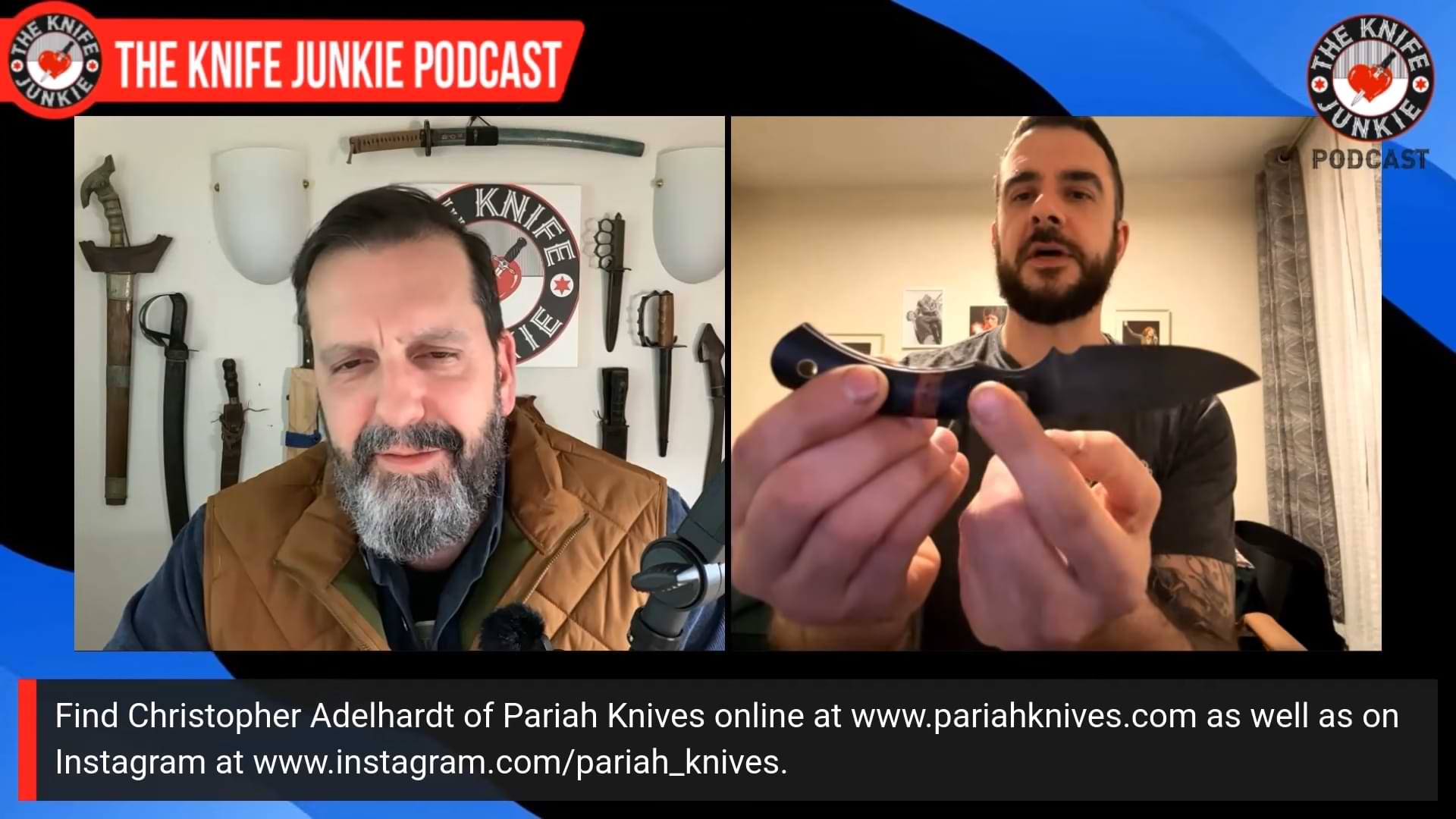
Christopher Adelhardt, Pariah Knives: The Knife Junkie Podcast (Episode 656)
On Episode 656 of The Knife Junkie Podcast, host Bob “The Knife Junkie” DeMarco sits down with Christopher Adelhardt of Pariah Knives to discuss the intersection of fine art and blade making.
Christopher brings a unique background to knife making that sets him apart from most makers in the industry. Before he ever ground his first blade, he earned a Bachelor of Fine Arts degree with a focus on ceramics and sculpture. He taught ceramics at the Erie Art Museum for more than five years and competed nationally with his sculptural work. At the same time, he worked as a finish carpenter for nearly a decade, learning precision and craftsmanship from his father.
This combination of artistic vision and hands-on building skills created the perfect foundation for what would become Pariah Knives. Christopher started making knives around 2008 to 2010, converting his garage into a workshop using equipment he already owned—including kilns from his ceramics work and carpentry tools from his father’s shop.
The Evolution of a Blade Maker
Christopher’s journey into knife making began long before he set up his workshop. As a child growing up in Erie, Pennsylvania, he and his younger brother Zach spent countless hours sword-fighting with sticks in the woods. His father, a carpenter, built wooden swords for the boys. Young Christopher took it further by shaping and modifying the sticks himself, creating his own designs.
This early love for creating blade-like objects followed him through college. During a jewelry class, a teacher allowed him to forge a copper dagger—a project that opened his eyes to the possibilities of blade making. From there, he began modifying old knives, learning to heat-treat steel, and studying the hamon, the visible temper line on Japanese swords.
 Japanese-Inspired Designs with Modern Materials
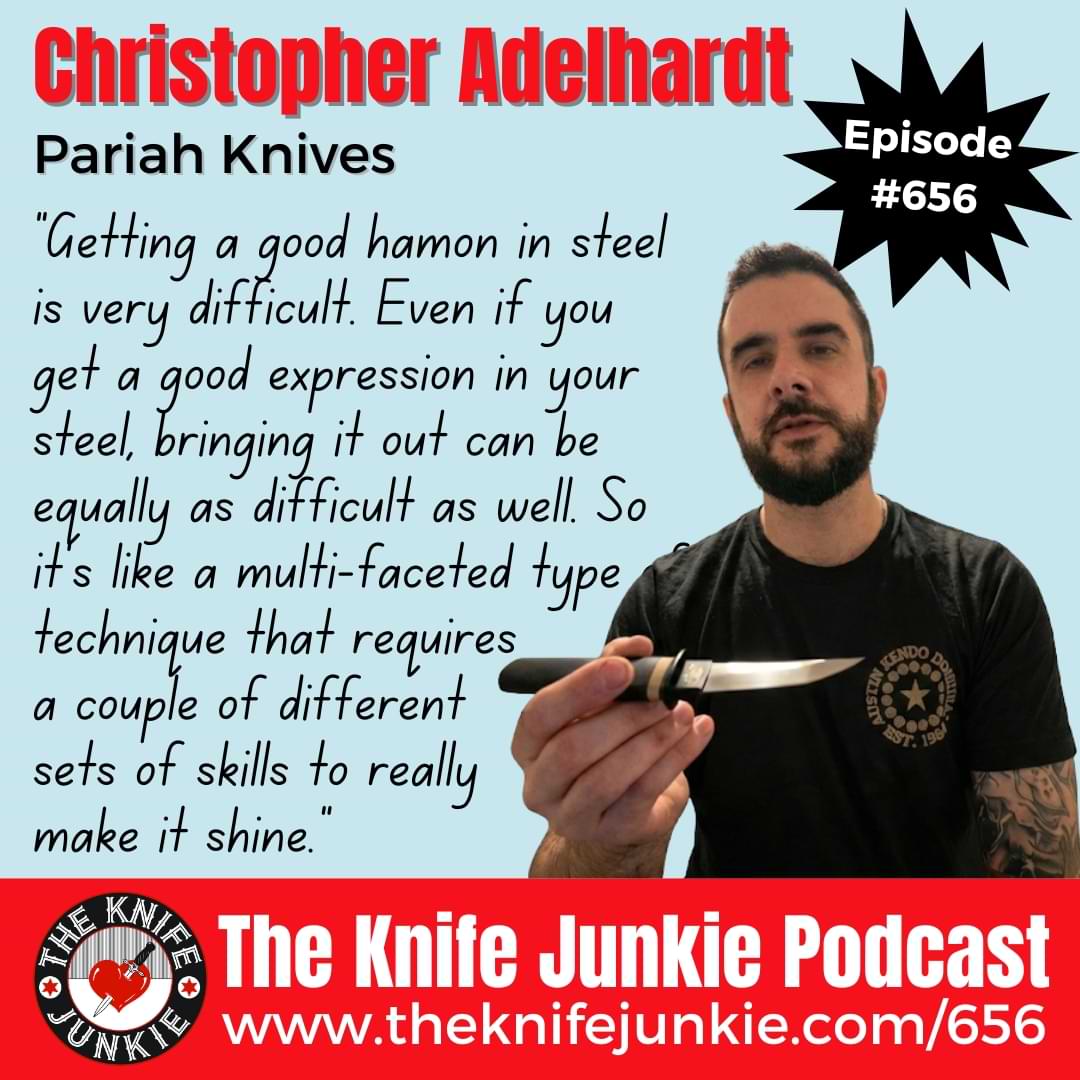
While Christopher initially made fantasy-style blades and hunting knives, his work shifted when he began creating Japanese-style pieces. The demand for tanto-style knives quickly grew, and soon most of his orders featured Japanese-inspired designs.
His background in Kendo, a Japanese martial art he practiced in Austin, Texas, gave him hands-on knowledge of traditional blade forms. This experience, combined with his sculptural training, allows him to create knives that honor ancient designs while incorporating modern materials and construction techniques.
Christopher makes each knife by hand, from the blade to the handle to the sheath. His work features distinctive geometric details—faceted designs that appear on handles, guards, and even sheaths. These signature touches, drawn from his sculptural background, create multiple points of reference for the user.
The Meaning Behind Pariah
The name Pariah Knives reflects Christopher’s own experience. Growing up, he felt like an outcast—someone who chose art school while others played football. He describes himself as a late bloomer and a socially awkward kid who never quite fit the standard mold.
“I wanted to make knives for other people who felt like they were outcasts,” Christopher explains in the episode. This philosophy runs through every aspect of his work, creating pieces that stand apart from mainstream production knives.
Connect with Christopher Adelhardt
Christopher stays connected with customers and followers through social media and direct communication. He checks his business email throughout the day and responds personally to inquiries about custom commissions and available pieces.
Find Pariah Knives online at pariahknives.com and follow Christopher on Instagram at @pariah_knives where he regularly shares new projects, finished pieces, and behind-the-scenes looks at his craft.
Whether you collect Japanese-style blades, appreciate handmade craftsmanship, or simply want to see what happens when a trained sculptor applies those skills to knife making, this episode offers a fascinating look at one maker’s journey from ceramics studio to blade shop. Listen to the full conversation to hear Christopher discuss his techniques, his inspirations, and what it means to create modern interpretations of ancient blade designs.

Be sure to support The Knife Junkie and get in on the perks of being a Patron, including early access to the podcast and exclusive bonus content. You can also support the Knife Junkie channel with your next knife purchase. Find our affiliate links at theknifejunkie.com/knives.
From clay sculptor to blade master—Christopher Adelhardt of @pariah_knives shares how ceramics, carpentry, and Kendo training shaped his approach to making Japanese-inspired knives. Episode 656 of The Knife Junkie Podcast. Share on XThe Knife Junkie Podcast is the place for knife newbies and knife junkies to learn about knives and knife collecting. Twice per week Bob DeMarco talks knives. Email Bob at theknifejunkie@gmail.com; visit https://theknifejunkie.com.
©2026, Bob DeMarco
The Knife Junkie Podcast
https://theknifejunkie.com
Transcribe Your Podcasts and Videos: https://theknifejunkie.com/magic (affiliate link)
Christopher Adelhardt, Pariah Knives: The Knife Junkie Podcast (Episode 656)
Announcer: Welcome to the Knife Junkie Podcast, your weekly dose of knife news and information about knives and knife collecting. Here’s your host, Bob "The Knife Junkie" DeMarco.
Bob: Welcome to the Knife Junkie Podcast. I'm your host, Bob DeMarco. On this edition of the show, I'm speaking with Christopher Adelhardt of Pariah Knives. I've been following Christopher and Pariah Knives for years now on Instagram, drawn in by his immaculate, intricate, and deadly-looking Japanese-inspired knives.
Beyond the Japanese blade patterns he produces, Christopher designs patterns of his own, taking inspiration from the blades of yet other cultures, all created with the most current materials. This modern treatment of ancient knife designs is fascinating and appealing to me, and we’ll talk all about it and Pariah Knives. But first, be sure to like, comment, subscribe, hit the notification bell, and download the show to your favorite podcast app so you can listen if you don't finish it right here, right now.
Also, if you want to help support the show, you can do so by going to Patreon. Go to thenifejunkie.com/patreon and check out our different tiers of support, or you can scan the QR code on your screen. And remember, if you sign up for one year in advance, you get 12% off. Take advantage! All right, coming up, we're going to talk with Christopher Adelhardt of Pariah Knives, but first, be sure to go to thenifejunkie.com/patreon.
Announcer: Want to sell your custom knives online? With LaunchCart, you can easily create your own e-commerce store—no coding required. LaunchCart is designed for knife makers like you, with built-in tools to showcase your craftsmanship, manage orders, and grow your business. It's fast, flexible, and even includes low-cost payment processing to help you keep more of your profit. Start your online knife store today at thenifejunkie.com/launch and turn your passion into a business.
Bob: Christopher, welcome to the Knife Junkie Podcast, sir. Nice to have you.
Christopher: Thanks, Bob.
Bob: So, in learning a little bit about you—I mean, I've known about your knives for a long time—but when you agreed to come on the show, I had to look some stuff up about you. And you were a working fine artist before you got into knives. You’ve got to tell me about that. And I'll tell you, I went to school for fine art and never spent a day earning a living doing it, and so I was impressed when I heard that. Tell me about that.
Christopher: Well, it's probably a close story to mine. I started college as a painting major. I wanted to be an oil painter since I was a teenager, and I went to school and tried my luck. I found very quickly that it really wasn't satisfying to me, and the personnel in the department didn't really mesh well with them.
But during that time, I started a ceramics course because, you know, in a university degree, you have to take a broad spectrum of courses if you are earning any degree. So in my 3D classes, I really fell in love with clay and ceramics in general. I really wasn't big on making pots or throwing on the wheel; I ended up taking a more 3D sculptural route and created a lot of human and animal forms—some surreal, a lot of mixed media pieces where some of the appendages wouldn't be able to be moved or opened or turned.
I used a lot of epoxy resin in my sculptural work, too, and some hair [laughter]. But I did really well in my undergrad. I competed nationally and had a few pieces in NCECA, which is a national ceramics competition every year. I did well with that, and I graduated with a Bachelor's in Fine Arts.
I went on to teach ceramics at the Erie Art Museum for over five years. I helped bring the department back up because it was kind of falling apart at that point, and Julia Weber and I kind of tag-teamed it and brought it back up. She did most of the work, but I was getting my hands dirty too.
And I was also, during that time, I was a carpenter. I worked for my dad's company for, well, almost 10 years as a finish carpenter, remodeling a lot of homes—mostly residential jobs, but we did commercial jobs too. So I was traveling a little bit and building for companies like BSI, which is a big commercial company there in Erie, Pennsylvania, where I grew up.
Bob: Erie, Pennsylvania! I grew up in Cleveland, and we used to go to Erie to go camping, you know, with school and stuff like that.
Christopher: Oh yeah, I was in Cleveland all the time.
Bob: Yeah, I liked it out there. One of the creepiest things ever happened out there, and I'll tell you another time. But so, you mentioned finish carpentry, ceramics, fine arts, painting, and that kind of thing, but you end up making knives. Making knives is what you do. Tell me about how that came about, and I'm really interested in the similarities between sculpture and knife making.
Christopher: Absolutely. It actually started a little bit before I went to school. When I was a kid, I grew up with my younger brother Zach. He's two years younger than me—I'm 40 this year, just to put it into perspective. But when we grew up, we were always sword-fighting each other with sticks in the woods and getting into all kinds of trouble.
As we got a little older, my dad, who was a carpenter, started to build us wooden swords. And so we had him make us elaborate wooden swords, which we totally destroyed [laughter]. It just kills me now as an adult thinking back—I wish I had those still, you know?
But I started to do a little bit of martial arts at that point. Not in any official capacity; I wasn't part of a dojo yet or anything like that learning Kendo, which I practiced for years in Austin, Texas. But just sword fighting and playing with sticks in the woods really got me to start to fall in love with the idea of shaping. So I would take the sticks and I would start to shape them and make them look like swords for my brother and me, and that really kickstarted it.
As I got a little bit older, I started to do more woodworking in my dad's shop and used all the tools that he had there, which is kind of funny because if you really look at it, some of the staple carpentry tools are not that unlike what we use in blade making today. The 2x72 belt grinder—you know, it was just a belt sander back then for us.
So I started making bokken, which is a wooden katana used in kata for Japanese martial arts. Started making them on my dad's table saw and with his belt sander and all his tools. From there, I went to school and I took a couple of jewelry classes, and I had a really awesome teacher, Kathy Kunard. In the first part of that semester, she was actually out because she was pregnant, but she came back and she let me build this copper forged dagger. And after I did that, everything was open to me.
I started to take old knives that I had and use those tools to recreate them and modify them—change the shape of them. And that's really what sparked my interest into everything that goes into making blades. So at that point, I started to learn about heat-treating steel and my first love, which is the hamon in Japanese swords—that's really what got me into actually trying to make real blades.
So during this time where I was teaching at the Erie Art Museum after college and working as a full-time carpenter, I really wasn't making very much money then—this was in 2008, 2010, something like that. I started to change my garage into a workshop, and I started to collect tools that I wanted to use. I had a buddy living with me at that time who said, "You should try to make knives."
I didn't have much to argue with him about it. I had all the tools then; I had kilns. In college, I was building kilns, so I had Evenheat kilns before I knew that they made them specifically for heat treating. And I really had everything I needed before I jumped into the craft. So it didn't take me long to pick it up, and that's when social media was really starting to blossom in that early 2010 time period. I know Instagram was like just taking off, and I was involved with that and I started to post my content online.
And back then, it was like the Wild West. You could reach anywhere, anyone, anywhere in the world, and there were no restrictions on anything. There were no guidelines, so everybody was really connected. It was a great time because I was able to meet and sell knives to people all over the world.
Bob: You—just from looking at your work and then seeing that you practice Kendo or train in Kendo—there's an obvious affinity for the Japanese culture, Japanese design, and blade design. Was that there before you discovered blades for yourself? And was that there when you were doing sculptural ceramics and all of that? How did the love for Japanese design and culture emerge?
Christopher: I mean, I would say that it was always there, but it really wasn't in the forefront of my repertoire until later. I started by making more fantasy-style blades. I started with these big Persian swoopy grinds and I was making hunter knives because everyone in Pennsylvania hunts [laughter]. It made much more sense to make these small, curved knives that hunters could use to field dress deer and birds and things like that.
It wasn't until later that I started to make more Japanese-style knives. And it's not to say that I didn't have a love for the Japanese culture at that point because I’d already made some wooden swords and practiced some kenjutsu on my own to try to learn. But what really kind of brought that aesthetic to the forefront for me was the popularity of it. As soon as I started to make more tanto-style work, so many more people would request it, and pretty soon most of my orders were Japanese-style knives.
Bob: It seems kind of, well, I mean, just kind of funny that by chance it would be this incredibly complicated path of knife making because, I mean, you do the traditional ito wrap and the whole nine yards. That seems complicated. Was that a serious learning curve? By the way, that's one of the things that I find so beautiful about your work and I want to see some of it here in a second—the handles are incredible.
Christopher: Well, thank you very much.
Bob: You're welcome. But learning this—what was that like?
Christopher: It was—at the time when I learned it, there was a lot of media out there on YouTube, tutorials for people who were training in sword martial arts who were actually wrapping the handles of their blades. But right around that time is when I met Matt Gregory. Matt Gregory has been a huge mentor for me in the craft. He's right there; he just popped up.
And so Matt has helped me through a lot of it. He's really good as a teacher too because he doesn't tell you exactly how to do it. He makes you like take that next step and he helps you along the way for sure. But he's the one that taught me how to tie a Turk's head knot and how to tie tsukamaki like that—like you see in the pictures there.
But really, it's all about trial and error, right? You know, this craft—we're all different, we all learn different ways. There's a lot of resources out there, but how you do it is kind of derived from what you're exposed to and how you learn as a person. So I'm a very hands-on learner. I just got in there and got my hands dirty and made a lot of mistakes, you know?
Before I made this into an actual business, the success rate of my knives was pretty low in the beginning [laughter]. You know, because there's a huge learning curve on just grinding knives. I can't tell you how many blades I've scrapped just trying something new or trying to push something and going too far.
Bob: It's funny. Sometimes I describe stock-removal knife making as sculptural because it's reductive, you know, like approaching a block of marble. But I wasn't thinking of it in terms of the kind of sculpture you were doing, which was actually probably additive in a lot of ways. But do you find a kinship in the process between sculpting a blade and making a sculpture?
Christopher: Absolutely. I really think once you learn a skill, you should be able to apply it to another skill. So using reasoning, any kind of discipline that requires your hand—utilizing that, you can find similarities in it.
I mean, painting for one—you wouldn't think there'd be any correlation between knife making and painting. But for instance, if you make a small painting, it's in the scope of the wrist. If you make a large painting, it's maybe in the scope of the arm or the whole body to make the brushstrokes. Knife making or blade-smithing is very similar. You know, you make a small knife, it's within the wrist. You make a large knife, it's within the arms or with the body. And so I also find correlation in martial arts with the craft as well because it teaches you how to cultivate a connection between your mind and your body and how you use those things.
Bob: Tell us about your martial arts practice a little. I don't think we've really talked a lot about Filipino martial arts when it comes to blades on this channel. We've talked a little bit about Japanese arts with James Williams, but haven't spoken about Kendo really much at all.
Christopher: Well, in Kendo, we use a different sword than a katana. We use a shinai. It's a bamboo sword with four segments. I can show you one right now if you'd like.
Bob: Sure.
Christopher: Okay. Yeah, I think I've seen this—I went to a place that had a Kendo school upstairs and it was always cool to hear them practice. Look at this!
Christopher: So this is—you can see it's got segmented pieces of bamboo bound together with leather—the handle or the tsuka. You can see this is the tsuru string on the back. And this is quite long—it's longer than a katana would be. It is much more flexible.
So the way that you use it—though we train in Kendo to use it like a real sword—in all actuality, the translation is a little bit different. But the correlation that I find the most in martial arts and this kind of craft is being able to connect with what you want to achieve in your mind and then using your body to achieve it.
I know that sounds vague, but you know, when you're grinding on a belt grinder, you're actually using your body to position the blade. It's really all about coordination, right? Because all these variables and all these axes are all sort of coming together with how you're interacting with it. Building a discipline in understanding how your body is reacting to what's in front of you, I think, is paramount to doing what we're doing. Even if it's in the hand alone or with your whole body, there's still some correlation there in developing those skills.
Bob: Okay, tell us about how you design your knives. And show—if you have something to show—take us through the conception of a knife and take us through its birthing process. Sorry to be gross.
Christopher: [Laughter] I've got a few different kinds of blades here that I posted today, and these are the same knives in that post. So here's a small EDC knife. I don't know if you can see that there. So we have some pale moon ebony for the saya here. You can see there's a little collar underneath the tsuba or the guard, which is also that pale moon ebony. And then I use the same piece of wood to make the pin that holds the blade into the handle there.
Now this wrap on the saya is stabilized with resin—just on the saya, of course, it's not stabilized so you can tie it. And then this is Richlite material here. Yeah, which is a material that I have grown to love.
And then you can see the blade here is 1095 tool steel, and there is a hamon in there. You can't really see it so well in this light. And then this piece here, this collar that surrounds the blade, is the habaki. And this is really what gives you the retention in the saya and holds that blade in place there.
And so how I come about my design is—my favorite type of content to look at for inspiration is architecture and furniture. Especially furniture, because the joinery in furniture I find can be so inspiring to this craft. You learn so many different cool techniques that you wouldn't see just by looking at a knife—by looking at furniture design.
But this kind of construction—you can see the blade here—and this isn't a traditionally made blade. My blades actually have a ricasso that I hide inside the habaki. Let's see if I can show you. See, there's a little spot there. So my habaki doesn't taper with the angle of the bevel of the blade—it's actually a square that hides the ricasso of the blade.
That's a more modern type of construction than the traditional style that the Japanese did. But everything else is indexed onto the blade, so there's shoulders under the ricasso. The habaki fits on there, the tsuba slides on, and that collar slides on and the handle slides on, and then the pin holds everything together.
Now most of my blades are not tear-down, so then of course everything is held together with some sort of resin or epoxy. But really, the mechanical fit is what holds everything together.
Bob: Right. So that hidden ricasso—is that a strictly aesthetic choice or does that have some utility that makes you go for it?
Christopher: I kind of developed that on my own based on the tooling that I had. It's much easier for me to mill a square slot into a piece of material than it is to mill something that's tapered to zero. And also I like it too because when somebody buys a knife from me, if they use a fixed sharpening system, this is so much easier. You don't have to run into that edge of the habaki when you're sharpening it.
Bob: That's cool. So tell us how you learned the actual process of, say, bringing out a hamon or creating a hamon and the wrap and all these things that make it—well, a very culturally Japanese—how did you learn these?
Christopher: Mostly self-taught. Of course, I had inspiration and I looked up lots of content online when I first started. But most of it is trial and error. I saw the sword, I saw what I wanted to achieve, and then I looked how I could achieve it with what I had at the time. And slowly I built up more tooling and more expertise and gradually increased as the blades kept coming and I kept trying the process out more and more.
Getting a good hamon in steel is very difficult. Even if you get a good expression in your steel, bringing it out can be equally as difficult as well. So it's like a multi-faceted type of technique that requires a couple of different sets of skills to really make it shine.
And again, with that process, it really took a lot of trial and error to get them right. In the beginning, I was very frustrated because you see these beautiful swords online and you're like, "Oh, I want to do that." But then, you know, you're in your garage and all you have is furnace cement and MAPP gas and your own, you know—it's just history from there.
And then figuring out how to index things onto the blade is pretty self-explanatory because if you look at the anatomy of a sword, the traditional way that the Japanese did it, they really lay it out all for you right there.
Bob: What are you talking about exactly? I'm sorry, you lost me there.
Christopher: Um, if you were to look up like the blueprint of a katana, for instance, it shows you that the blade is indexed onto all the pieces. And you know, there's lots of movies that, you know, show them removing the blade or sliding the pieces onto the blade. So for me, just knowing that ahead of time made that an easy skill to pick up—the indexing part of it.
The wrapping of it—there are a lot of good books out there. I don't have them with me right now to show you, but I had some old texts that helped me learn how to fold the ito so that it makes a nice diamond. But again, I didn't have a teacher for that per se, so trial and error was my best teacher.
Bob: So, for an artist and for a maker, you know, you want to arrive at a style, but it can seem inauthentic to kind of push a style, you know what I mean? Like, to go about it very deliberately. "I'm going to create my style; this is going to be the Bob DeMarco style." But obviously you have arrived at that. You’ve made enough knives; you’ve been making knives long enough that you’ve—what was it like, and when did you know that you had kind of arrived as a knife maker and that you had your own style?
Christopher: That's a good question because like you said in the beginning, you're really just kind of mimicking what you are exposed to. And I think that's normal, you know, as an artist or as a craftsman—your inspiration is what everybody else is making. So until you can start to create things and play around in that realm, you don't really have a lot to draw on except for exposure. Experience hasn't been cultivated yet.
But I would say that that's very normal, you know, to look and try to copy is a great way to build a skill. In the beginning, I was making a lot of segmented handles, and there were a few people doing that then, but we were really going crazy with it. If you go back into the early 2010s, there are some really cool segmented skills. Now, everybody can do it and it's really easy, and you see it all over the place.
But I think what made my work popular in the beginning were all those segmented skills I was building. But really what drives—what drove me to the point where I felt like I had my own style—I really want to give credit to taking custom orders and working with my clients because over the last decade plus, I took a lot of direction based on clientele that I probably wouldn't have taken or adjusted myself. You know, and those really opened up a lot of doors to learning new techniques and kind of discovering different methods that, you know, left to my own devices, probably would have taken me a lot longer to discover that.
Bob: That's—I mean, that's what you discover in collaborative work—filmmaking, that kind of thing. You discover, "Oh, my vision was good, but it's nowhere near what it would be if I hadn't had all the input of these other people who care," you know, in one way or another. And to do that with a customer as a maker is pretty gracious. I'm sure you walk a fine line there too.
Christopher: Yeah, I mean, I've had some pretty crazy orders over the years. And you know, in the beginning, you're so gung-ho because everything's fresh and you're just so in love with the process that you just take everything. I mean, it was true like that for me. And so there were times when I bit off more than I could chew for sure.
And luckily, knock on wood, I never made too big of a mistake that really cost me too much. And I mean, I was lucky in that. I know a lot of people who take on huge projects and it ends up backfiring on them and then, you know, if it's already a business for you, that loss can be devastating. Luckily for me, it took me a few years before I actually decided to make it into a business. So I’d handled a lot of the kinks worked out by the time I made that choice.
Again, I had a lot of good mentors. Matt Gregory's always been a good mentor. I work close with Jim Vandervelde from Hellion Machine Collective. He's a buddy of mine, grew up in the same town. And I helped him in the beginning start knife making, and him and I had a shop together for a few years when he first started. And working with him—he's a machinist, a toolmaker—so I learned a lot from working with Jim as well.
Bob: So what is your process for coming up with a design or making? Well, no—for actually—you've come up with the design, now you want to make it. Because you mentioned machining, but I, you know, and I'm pretty sure I know maybe vaguely how you make knives, but there are so many different ways now, and machining is a big part of it too. So I was just curious—how do you go about making them?
Christopher: So I am still very much an artist. My shop has very simple tools. Mostly I use a jeweler's saw and files. So my blades obviously I use a Northridge 2x72 belt grinder—I love my grinder. I have some wheel attachments and small wheel attachments, and I can flip horizontal. But that's it.
And then I have a drill press that I manually use as a mill, which I don't recommend to people [laughter]. And then everything else I'm still that sculptural artist. I'm still fitting pieces and cutting them and hand-sanding everything—fitting it very small bits at a time.
Bob: Let's see something else you might have in front of you.
Christopher: Okay, I've got this other—actually, I have the first knife I ever made here. It came back into the shop, and I reground the blade and refinished the blade, and then I added some new scales to it. And this is the first knife I ever made.
Bob: That looks damn good for a first knife, man.
Christopher: 1095 steel. Obviously, the original scales are gone, but it did have segmented scales. This is a couple of different pieces of quarter-sawn bog oak, some kind of crazy stabilized maple burl here. I’ve got G10 and carbon fiber liners in there, and the pin. And I just blackened the steel for a user-friendly finish. The guy who owns this knife is a mushroom hunter, so he uses it in the field for whatever—I don't know how he uses a knife in mushroom hunting, but he does.
Bob: That is a beautiful little knife. And you can see as he turns it in your hand—the sculptural elements of it. The file work on the spine of the handle and all the faceting on the handle—you can tell that a sculptor went to work on this. It's beautiful.
Christopher: Thank you very much. I loved that knife when I first made it. It stayed in my pocket—I was a carpenter and I just had it in my pocket for weeks. I was shaping it and trying to figure out what I liked, you know, when it was done. Because that can also be a big issue in the beginning: "How do I know I'm finished?"
Bob: Well, that's—you're talking like an artist now. "I’ve got to live with this painting for the next year before I know if it's done or not." Yeah, with a knife it seems like it should be more cut and dried, right? It seems like it should be because it's a tool, but when you're making it on the kind of level you're making it on—so we've talked a lot about the Japanese-style blades and I want to see more of them, but you also have this design that I think is beautiful—that's very Persian-looking. Tell us about some of your other influences.
Christopher: Oh yeah. I mean, as a kid, my mom read me The Hobbit when I was very young, so I love Lord of the Rings and all the fantasy. I read R.A. Salvatore's complete series of the Legend of Drizzt. So I'm kind of a big nerd [laughter]. And so a lot of those characters, like the elves particularly, have a very Art Nouveau style, and their blades are beautiful, swooping, like cursive writing.
And I think that there's something human about the sweeping shapes of those blades—especially the Persian-style blade—and cavalry sabers. I love cavalry sabers for the same reason because they really are made to be used by humans in the environment. And so there's this direct connection I feel with human anatomy and how it's used to use this tool.
Also, I took a lot of inspiration in the beginning from feathers. I always collected tons of feathers. And a feather, to me, is like the perfect blade. It's just designed to cut through the wind. Even if you look at a flight feather of a pigeon, it has this beautiful shape—it's so reminiscent of knives.
Bob: That's interesting what you're talking about with the cavalry sabers and the elven blades and stuff. They’re very gestural. You look at them and it looks like a human arm kind of designed them, you know, in its natural arc. And then you put it in the hand and you know exactly how it's supposed to be used also.
Christopher: Exactly, it's intuitive.
Bob: Do you have one of those sort of Persian-like knives around you?
Christopher: Unfortunately no, I don't have any of those right now in my shop. It's actually pretty rare that I make them. They used to be my most popular style of blade, but more people have kind of steered towards the Japanese style. I have two that are coming up on my client list that are going to be kind of epic like that, and you guys will get a chance to see them then.
Bob: So how does that work? Your client list, your books as we know them—are you constantly making the next custom knife for someone who's ordered it or do you sprinkle in your own work for yourself?
Christopher: I do both because I think it's healthy to not be tied down all the time. I always have a client list because I really like, like I touched on earlier, I really like the relationship of working with my clients. I feel like half of this industry is popular because people get a chance to input what they have in their imagination into the final product. And I do my best to work with them and give them as close to as I humanly can to what they expect.
But I do make things on the side all the time too. You know, when I take on a custom order, I always take a deposit and order my materials for the build, and I typically order a little bit more because I want to make my own variation of the design, you know? And so I get that freedom of kind of giving myself the space to be expressive and then also the job security of taking on custom orders from different clients as well.
Bob: Yeah, just looking at some of these blades—man, they’re so nice-looking and clean. This one right here that’s up—that’s your EDC model, right?
Christopher: Yeah, that’s correct. Yeah, the Ego Slayer.
Bob: The Ego Slayer. Such a cool blade. I was going to say, are the Japanese blades themselves all based on particular historical models or are you kind of taking inspiration? Man, I love this fighter here; that’s cool too.
Christopher: It depends. You're going to see both in my portfolio because I do have some clients that really want traditional-style work. A couple of my clients actually do the cutting, and so they require specific details. And so you'll see more accurate recreations of traditional work, and then I always like to put my twist on things because again, I'm still that artist and it's not really art unless you can sign your name on it, so to speak.
So I really like to do the interpretative part. That’s why you see there's some hollow grinds on my Japanese-style knives, which is pretty unheard of in the traditional sense. But it looks so damn cool on a tanto or on a grind like that. I just love the way it looks with the flat front meeting the deep hollow grind. It's beautiful.
I agree. I do have one of those right here. Let me see—let's take a look.
This one is a little bit special—this piece right here. Now this saya is fully wrapped, but it's two pieces of ito that are wrapped. So I allowed the pull-through from the saya. You can see this is CPM Magnacut steel. You can see it's got the flat grind kistaki here and then you see the yakote there is curved because this primary grind is hollow.
And of course, I got this nice swedge-like grind on the top too. Goes to a false edge.
Bob: Yeah, I've seen that a lot on Japanese blades—that long sort of zero grind swedge along the top. Is that for thrusting? That's beautiful, by the way.
Christopher: Thank you. Yeah, it helps in thrusting. Also, it helps when you sheath the blade, right? Because the contact is only one point at that, you know, as you're using the spine of the knife to sheath. So you're not relying on a purchase on both points—just one. That is so smart.
Bob: Okay, so you are in Austin, Texas, as you mentioned, but you kind of came up and earned your bones in Pennsylvania. Two actually—two great knife states: Pennsylvania and Texas. What's it been like? What is the atmosphere in Austin and is it knife receptive? Is there a good knife community there?
Christopher: Oh yeah. I mean, in PA I was kind of—and no ego here—but I was kind of a big fish in a small pond. I lived in a very small town, Erie, and I loved it, but it can be a little depressing there [laughter]. You know, it's like eight months of gray snow a year.
And like you said, PA's pretty receptive to knives. There's a lot of great knife shows and a lot of makers up in that area too. And I will say, Craigslist has a great choice of tooling up there because of the Rust Belt area.
In Texas, not so much, but it's a little bit more free down here. People carry knives everywhere. There's a lot of great Texas shows—everybody knows Blade Show Texas. And there's a lot more makers down here than there were up there.
Bob: Is there a sort of thriving community of knife makers and collectors?
Christopher: Specifically in Texas—I can't really say. I do the Texas Blade Show almost every year. I'm really connected online for the most part, so I don't mind traveling to meet people or go different places. But as far as like a local community, I think that there's more of an opportunity here to sell if you really want to do a local—have a local part to your craft because there's tons of different markets that you can go to and sell your work. People are kind of outdoorsy here too like they are in Pennsylvania. There's a lot of ranch-style people here that like knives and use knives every day. So I would say it's probably equally yoked. The pros and cons of each place, I think they balance out pretty equally.
Bob: So at some point, you knew that you were going to give up your other work and that being a knife maker full-time was the thing for you. Tell us what it was like evolving as a businessman within that context.
Christopher: Well, again, I was very lucky because of my timing. To do it today is much more difficult than to do it 20 years ago is much more difficult. Social media is an enormous easy resource to use. I mean, we have free advertisement worldwide. That's a pretty rare thing.
Without that, I don't know if I could have ever made it into a business. Doing local shows and taking that kind of risk is very hard to quantify. You know, people will batch out work and make a lot of money per show, but it's not a guarantee, you know? And that's hard to make a life around.
It is an art and it does take a lot of risks. And when I first did it, it wasn't so bad for me because I was in my 20s and again I wasn't really making much money and the internet really offered a lot of freedom financially for me. I started selling knives almost immediately because of social media and in a matter of months, I was making more knives working in my garage on the weekend than I was at my two full-time jobs. Wow. That's hard to, you know, it's hard to say no to, especially when it's something you love to do so much.
Bob: Yeah, I agree. How do you see your business evolving? What do you want it to become?
Christopher: It's hard to answer that question. I really enjoy what I do. I get a lot of satisfaction out of being able to make everything myself. I think in the end, in my heart, I'm an artist and kind of using my hands is something that I have to do as the creature that I am. If I wasn't doing knives, I'd still be making sculptures or doing something with—or working wood or building cabinets or doing something with my hands. There's that connectivity between having something in your mind and being able to create it in the real world that really defines me as a person.
And as a business, that's not necessarily the smartest path to take because, you know, business you have to be really adaptive. And today, there's a lot more knife makers than there ever have been. So competition is high, you know? You go on social media and Forged in Fire is a big proponent of this because as soon as that show came out, everybody started becoming a knife maker. I remember this huge boom of knife makers online, and it wasn't just about learning the craft; it was about becoming a business—a knife making business.
Which I think is not necessarily the correct way to do it. I think for something like this discipline to become a business, it has to happen because of a reason—whether it's your product that you're making or the level of skill that you're cultivating opens that door for you. And that's just my personal opinion because of how I approach the craft myself.
But for my own business, I'd love to one day have maybe like a mid-tech design or a full production design, only because I want to be able to reach all the different types of people that have limited affordability. Not everybody can purchase a giant sword—I have a sword I made this week that I'll show you guys too. Some of these builds that you do, they’re just thousands and thousands of dollars, and people get discouraged because here in the US, not everybody makes a very good living. It’s tough for a lot of people, and to really enjoy and appreciate this art, it does cost money. So one day, I'd love to have a full production line that still embodied what I hold value in the craft but was much more affordable for people.
Bob: So before you show us the sword, a similar question but with a different emphasis: what is the knife or the sword or the implement you would love to make in the future but just haven't had the chance to? Maybe you don't feel you have the chops or maybe you need more equipment for it—what is that white whale?
Christopher: Well, I've never made a long sword or an actual full-length katana because my kiln, which I use as a forge, is only 27 inches deep. So I'm kind of just one kiln away from being able to do those things.
Bob: So swords—some katana-type swords. Eventually. Okay, so show us the sword you were going to show.
Christopher: Sure. Made this week—well, finished this week. It took me a couple of weeks to do, but here—I'll back up a little bit so you can see it.
Oh my gosh. This is a wakizashi and the san mai Damascus blade. The steel was forged in Futuron Forge—it’s an Elmax core. See if I can get a little bit closer so you can see that pattern in the steel.
And then one feature of this blade that I really have to spend some time and talk about is the habaki. The habaki is actually meteorite. Wow, which man, was that a pain to work with. I don't really know much about meteorite—I know a lot more now [laughter].
I believe there's something in this meteorite like cobalt or something because man, I just destroyed a whole box of drill bits to try to cut that hole in the center of it. But you can see the tsuba is a raindrop Damascus—stainless Damascus. You can see the jacket on the san mai is also raindrop pattern.
And then of course I got this nice swedge-like grind on the top too. Goes to a false edge. Yeah, I've seen that a lot on Japanese blades—that long sort of zero grind swedge along the top. Is that for thrusting?
Thank you. Yeah, it helps in thrusting. Also, it helps when you sheath the blade, right? Because the contact is only one point at that, you know, as you're using the spine of the knife to sheath. So you're not relying on a purchase on both points—just one.
That is so smart. So you can see the collar underneath that tsuba is the same san mai. You can see that—oh yeah, the ring around it. You can see the ring in there. And the kashira is also that raindrop Damascus.
And then it's a red oak handle underneath polished stingray skin and then stabilized synthetic silk ito over top. Stabilized—that means it's got epoxy? Yeah, I use a West System’s two-part Air Force grade epoxy, slow-drying. And you can't see it on the surface—depending on the color, it will tint it slightly. But I mean—
Bob: Yeah, it's so—it's so cool. I love the grip of a wrap like that. That blade is amazing. Hold that up again. So this—basically you've got this nice piece of steel and went from there. Do you ever commission steel?
Christopher: Yeah, so this was a commission piece of steel by Futuron Forge. This is actually the longest build they've ever made. The billet itself is 25 inches long, so past the kasso area, there's actually a 5-inch tang that goes into the handle. And this is a 20-inch cutting edge.
Bob: So is that made to break down like you see in the museums?
Christopher: Yeah, you can break this one down. You can pop the pin right out. Not going to do it right now though [laughter].
Bob: No, no, no. What risk do you run making a knife like that? Do the tolerances start to wear once you've popped it out a few times?
Christopher: Yeah, of course. I mean, it's always going to have wear and tear taking and assembling and disassembling something. So there are spacers called seppa, and they can—you can make them in different thicknesses, but I always include them in what I do with tear-down builds because after time, if it does wear out and you get back to what you just said—the tolerances have to be more perfect, right? Because you can't have anything that gets a little bit weird or anything like that because it'll show up once you reassemble it.
But as time goes on and as those things loosen a little bit, you just add another thin layer underneath the guard, and that will tighten everything up. Okay, all right. So you add that just so people can just slide them on as the knife ages or whatever.
Christopher: Right. And you see this in some of the old bowie designs too—they used a rubber gasket between like where the blade—or the guard and the handle so that you could actually push in and pull the pin through. So you have like a—it's not just tight but like gathered tight. It's under pressure, yeah.
Bob: So I saw a knife on your Instagram feed—it looks a lot like a bowie; it's like a Spanish bowie or something. Tell us about that knife.
Christopher: Are you talking about the one in the high carbon steel with the hamon in it?
Bob: Yeah, and it's got a nice clip and it's also got a sculpted wooden handle, but it also has wrap over it.
Christopher: Oh yeah, I did that. That was commissioned as a camp knife for a customer who really wanted a bowie but wanted it my own sort of style—my own take on it. So obviously there's—the guard is built-in; there's no indexed parts on that—it’s full tang construction. And then I did handle scales—I think I used some reclaimed oak, quarter-sawn oak for that one—and then I sculpted the handle to be more of like a pistol-grit kind of handle, which is one of my first and favorite handle designs that I worked with in the beginning of my learning the craft. I just—there's something about contouring the handles that really interested me in the beginning. I had a lot of fun making it, figuring out how to mount my 1x30 belt grinder—that I used as a grinder—using a couple of screws and screwing it in horizontally on my bench to use the wheel part of it to do that. But I love—I really like shaping wood—that goes back to me being a carpenter. So making those handles is like my favorite part of that kind of construction.
Bob: Well, you're making art for the hand. You were—you came up making art for the eye; now you're making tools, but such a big interface is how it feels in the hand. So it's art for another sense.
Christopher: Yeah, absolutely. You don't have to walk into the room—you just pick it up.
Bob: Yeah, exactly. So sheaths—do you make sheaths for everything you make?
Christopher: Yes, I do. And for the sword here, I have the saya that I just finished today actually. Alder wood. It's got a kurigata on it, and this stops it in the belt, and then you can tie the wrap around there to fix the saya to you. Two pieces—you can see the side. Yeah, it's sort of hexagonal in cross-section.
Yeah, I shape it the same way I shape my handle, so you don't really see this kind of facets in any of the traditional swords. But it's just something that kind of happened organically in my design. And you'll see it on all my parts too—like you can see my tsubas are shaped that way, even the habaki, the facets on the front and the back are shaped that way. And my blades are shaped that way—the flat half of the ricasso above the shoulder has got the same kind of facet on it. The handle itself—I don't know if you can see that in there—the wrap contours that same shape.
And that really goes back to that concept we were talking about having that one point of contact. And I just like that—having that harder edge there.
Bob: Yeah, for indexing, and also it's not going to turn in your hand, you know? You know it's not going to turn in your hand. That is beautiful. What a beautiful package that is.
Christopher: Pretty proud of that one.
Bob: Nice. Well, is this one purchased or—?
Christopher: Yeah, this one was commissioned by a customer.
Bob: Man, alive. All right, well, tell people the best way to get in touch with you and the best way to work with you.
Christopher: Best way to work with me is just to contact me directly. You know, I'm on most social media platforms. My website has a contact page—pariahknives.com—and that contact page goes right to my business email. I check it all day long and I talk to clients every day. So if you really want to reach me, send me a direct message on Instagram, Facebook, or YouTube and my website.
Bob: All right, one last question: your name, Pariah Knives—where’d you come up with that?
Christopher: Okay, so growing up, I was also kind of always kind of like a black sheep, even in my family. I kind of did things my own way; I never really fit the mold. Everybody played football and I went to school for painting.
So I was a little bit of an outcast growing up. I was a late bloomer and a socially awkward kid, so Pariah and—it kind of fit with the Persian style that I started with in my aesthetic. It just kind of fit with what I wanted to do. I wanted to make knives for other people who felt like they were outcasts.
Bob: Cool. Well, you're doing a beautiful job. I mean, you're making beautiful knives for everybody, but yeah, definitely make any outcast feel cool.
Christopher: Thank you.
Bob: Yeah, absolutely. Christopher Adelhardt of Pariah Knives, thank you so much for joining me on the Knife Junkie Podcast. I'm really—very happy to finally talk with you after admiring your knives for years now.
Christopher: I really appreciate that. Thank you very much for supporting and following me along on my journey.
Bob: It’s my pleasure, sir. Thanks a lot.
Christopher: Thank you.
Announcer: Why pay full price for gas and food? With the Upside app, you don't have to. Just open Upside, find nearby offers, and earn cashback when you buy gas or eat out. Pay like normal and get real money back in the app. No coupons, no hassle—just easy savings on things you already buy. Download Upside today and start putting money back in your pocket. Learn more at theknifejunkie.com/saveongas.
There he goes, ladies and gentlemen, Christopher Adelhardt of Pariah Knives. Definitely check him out on Instagram—it is serious eye candy. And for those of you knife junkies out there who love the ethnographic weapons, you will—well, you'll love his page. So check it out.
All right, for Jim working his magic behind the switcher, I'm Bob DeMarco saying until next time, don't take dull for an answer.
Announcer: Thanks for listening to the Knife Junkie Podcast. If you enjoyed the show, please rate and review at https://www.reviewthepodcast.com. For show notes for today's episode, additional resources, and to listen to past episodes, visit our website https://wwwtheknifejunkie.com. You can also watch our latest videos on YouTube at theknifejunkie.com/youtube.
Share This With a Friend >>>
For early access to The Knife Junkie podcasts and YouTube videos, receive Knife Junkie stickers and be entered into the monthly knife drawing giveaway, join The Knife Junkie’s Patreon group of awesome supporters.
Let us know what you thought about this episode. Please leave a rating and/or a review in whatever podcast player app you’re listening to. Your feedback is much appreciated. Email theknifejunkie@gmail.com with any comments, feedback, or suggestions on the show, and let us know who you’d like to hear interviewed on an upcoming edition of The Knife Junkie Podcast.
To listen to past episodes of the podcast, visit theknifejunkie.com/listen.

Shopping for a Knife?
Support The Knife Junkie Podcast and YouTube Channel by Buying Through My Affiliate Links
 3 Dog Knife (25% off hardcore Alaskan-made knives with coupon code “knifejunkie”)
Angle Pro Knife Sharpener
Artisan Cutlery
Bamba Forge
Civivi Knives
eBay
Jack Wolf Knives
James Brand
Knives Ship Free
Off-Grid Knives
Sencut
Smoky Mountain Knife Works
Tiger Edge
T.Kell Knives (Get 10% OFF with coupon code: “knifejunkie”)
Vosteed Knives
WE Knives
Other Products and Services
1Password
16-in-1 Multipliers
Dark Age Defense
Podcast Hosting
Groove (Replace 17 Apps and Services in Your Business)
Groove.ai (All-in-one AI solution)
Knife Books
Rakuten (Cash Back for Shopping Purchases)
Shockwave Tactical Torch
StreamYard
Upside App (Cash Back for Gas Purchases)
SOS Emergency Sleeping Bag
Survival Saw
Wilderness Survival Skills Course
Work Sharp
Work Sharp Rolling Knife Sharpener
“The Essential Skills of Wilderness Survival” Book
Follow The Knife Junkie
Visit The Knife Junkie website
Email The Knife Junkie
Follow The Knife Junkie on YouTube
Follow The Knife Junkie on Instagram
Follow The Knife Junkie on Twitter
Join The Knife Junkie Facebook Group

Affiliate Disclosure
In the name of full transparency, please be aware that this website contains affiliate links, and any purchases made through such links will result in a small commission for The Knife Junkie channel (at no extra cost to you). If you use these links to make a purchase, TKJ will be rewarded with credit or a small commission on the sale. If you don’t want to use these links, no problem. But know that I truly do appreciate your support.