Austin and Mathew Culbertson: The Knife Junkie Podcast (Episode 667)
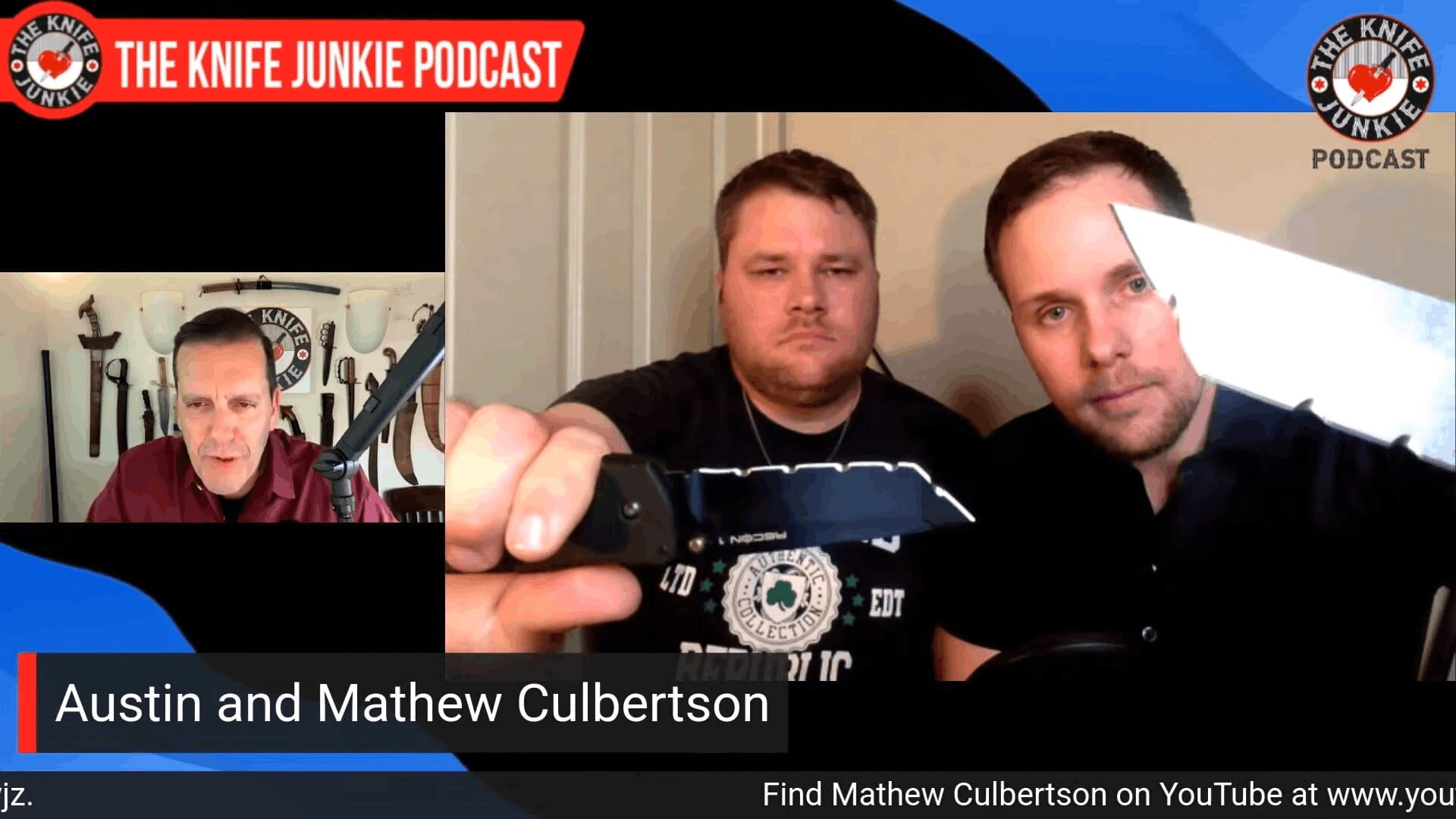
Episode 667 of The Knife Junkie Podcast brings two of the most well-known brothers in the knife community to the table. Austin Culbertson, who posts on YouTube as Hissatsu5, and his brother Mathew Culbertson have been testing knives on camera for close to 20 years. Bob has been watching both of their channels for nearly that long, and this episode is the conversation that should have happened years ago.
The topics range from how the channels started to what denim actually does to a sharp blade. Along the way, there is a deep look at serrations, a discussion of why people carry knives for self-defense, and a serious breakdown of the Bowie knife and its history.
The Start of Something Sharp
The brothers kicked off their YouTube presence with water bottle cut tests filmed on a low-quality camera. Their Ka-Bar 13 bottle cut test went on to collect over 3.4 million views, and the channel grew from there. Austin built the Hissatsu5 channel around historical research, cut tests, and specialty gear finds. Mathew took a different path, modeling his channel after Lynn Thompson of Cold Steel and the Pork Man methodology of knife instructor Michael Janich. Both brothers adapted those influences into their own hands-on testing format.
What the Culbertsons Found Out About Denim
The biggest revelation in this episode is one most knife owners have never considered: denim has a level 1 cut-resistance rating. That means a razor-sharp plain edge can hit denim and bounce off without cutting through. Mathew demonstrated this in recent cut-test videos and discussed it in detail during the episode.
“The serrated edge is going to guarantee the bite,” Mathew said. “Same knife, same geometry; the only thing that was different was the serrated edge.”
This finding drives most of the discussion of serration in the episode. The brothers cover Veff serrations, Cold Steel serrations, and Spyderco serrations, and Mathew explains the custom large flat-top serrations he has developed over time. His pattern solves the biggest problem with serrated edges—sharpening difficulty—by keeping the large flat sections accessible to a standard Work Sharp field sharpener.
Knives and Real-World Preparedness
Austin has carried a knife as a defensive tool since high school. Mathew is a prison chaplain who cannot carry a firearm on the job and trains with knives every Sunday. Both brothers carry with clear purpose, and both make the case that a knife fills roles a firearm cannot.
Austin pointed out that a knife is legal in locations where firearms are prohibited in Texas. Mathew described using a tactical pen and flashlight inside the prison facility and training with knife-based principles. He also noted that a knife can save a life in ways a gun never could, from cutting a seatbelt to breaking a window.
The History Behind the Blade
Austin and Mathew trace their love of blades to two clear threads: Japanese tanto culture (which gave Austin his online name, Hissatsu5) and the Spanish Navaja Carraca tradition. They also cover the Bowie knife in depth, discussing the range of historical forms it has taken and the trainer Bowie knives they carry from maker Bobby Raines.
Austin took a tour of the Bowie knife exhibit at the Little Rock, Arkansas, museum and sees the Bowie as defined by its use rather than its shape. Mathew keeps it simple: a clip point is required.
Links
Follow Austin Culbertson on YouTube at Hissatsu5 and on Instagram.
Follow Mathew Culbertson on YouTube and on Instagram.

Be sure to support The Knife Junkie and get in on the perks of being a Patron, including early access to the podcast and exclusive bonus content. You also can support the Knife Junkie channel with your next knife purchase. Find our affiliate links at theknifejunkie.com/knives.
Two brothers. Two decades of cut testing. One great conversation. Austin and Mathew Culbertson sit down with Bob DeMarco on Episode 667 of The Knife Junkie Podcast to talk serrations, Bowie knife history, and more. Share on XThe Knife Junkie Podcast is the place for knife newbies and knife junkies to learn about knives and knife collecting. Twice per week Bob DeMarco talks knives. Email Bob at theknifejunkie@gmail.com; visit https://theknifejunkie.com.
©2026, Bob DeMarco
The Knife Junkie Podcast
https://theknifejunkie.com
Announcer: Welcome to the Knife Junkie podcast, your weekly dose of knife news and information about knives and knife collecting. Here's your host, Bob The Knife Junkie DeMarco.
Bob DeMarco: Welcome to the Knife Junkie podcast. I'm your host, Bob DeMarco. On this edition of the show, I'm speaking with two stalwarts of the YouTube knife verse, Matthew and Austin Culbertson. Matthew and Austin, who goes by Hissatsu5, are brothers who started their complementary YouTube channels focused on their love of knives and other EDC gear around the same time. And for about that length of time, my brother and I have been watching their videos and occasionally chatting about them, especially the meat cut tests. And I cannot believe that it's been the better part of two decades. So I oddly feel like I already know the brothers Culbertson, but of course I do not, yet. But I look forward to finally meeting them and talking all things knives, Cold Steel, and the art of knife fighting. But first, be sure to like, comment, subscribe, hit the notification bell, and download the show wherever you get your podcasts. Also, if you want to help support the show, you can go to theknifejunkie.com/patreon and see what we have to offer you there. Or you can scan that QR code on your screen, by the way. Sign up for one year, you get 12% off. Again, that's theknifejunkie.com/patreon.
Announcer: Adventure delivered. Your monthly subscription for hand-picked outdoor, survival, EDC, and other cool gear from our expert team of outdoor professionals. Theknifejunkie.com/battlebox.
Bob DeMarco: Austin, Matthew, welcome to the Knife Junkie podcast, gentlemen.
Austin and Mathew Culbertson: Thank you.
Bob DeMarco: It's my pleasure. And as I mentioned upfront, it seems like this conversation should have happened years ago, but it's really great to have you here. I've always loved your content, your videos. You both have different styles on your individual productions, but you get together, you make these other great videos. How did this all start?
Austin Culbertson: Well, it's interesting. We started doing water bottle cut tests. The most famous one was the Ka-Bar 13 bottle cut test that has about 3.4 million views. And we had a potato camera. It was a terrible camera, but that video just blew up. And then I started copying what Knife and Cutler Lover would post, and then I'd do a cut test with it. And then people started asking for reviews, and Matthew did the first review on my channel because I had a very bad speech impediment and I was very bashful about it. Then I started doing my own videos. So that's pretty much the start of the Hissatsu5 channel.
Mathew Culbertson: And as soon as Austin's videos really started taking off, and of course we had always filmed together, I'm like, "You know what? I want my own channel." And of course Austin is featured on my channel all the time. And something that I've really prized about my channel is that I don't do all that great of reviews. I really want to demonstrate things. And I get that from my love of Cold Steel and what Lynn Thompson has done for the industry, but I really wanted to test things and then talk about it. Because you and I both know that you can watch a really good review, and the person has probably never cut anything with it, you know? And so I didn't want to become that because there's already so many channels like that.
Bob DeMarco: Yeah, actually, I must say, that is a lot of my close-up videos. I can't call this a review. I own it like I would own a Van Gogh painting. I own it because I think it's beautiful and I love the way it functions. But I don't have much use for it. I am more of a collector. But yeah, I appreciate the both of you for the tests and the philosophy.
Mathew Culbertson: Well, thank you. Yeah, I mean, you know, we carry these things around, we trust our lives with them. And you know, it's one thing to see an awesome Lynn Thompson video and here's the factory edge and all that, but I want to know what the blade in my actual pocket is going to do. And it's really surprised me a whole lot with our different testing over the years. Something that's literally shaving hair off my arm wouldn't bite through denim. It's a sword and a Bowie knife. And so after that sort of test, it's like, okay, I have to assess things. What am I going to do in order to overcome this? You know.
Austin Culbertson: And that kind of hearkens back to Cliff Stamp, what he said about denim being cut-resistant.
Bob DeMarco: Yeah, actually, it seems like recently this came up where you were talking about cutting something. You were cutting your pork with the denim, but you had an issue with a couple of knives and you mentioned the sword too, that you would think would chop the tree down, go right through the meat, but denim there's, I guess, something in that surface tension or what have you that if you split through it, oh man, you're done and it's going to give way in a big way. But if not, it can skate right across.
Mathew Culbertson: Yeah, meat is very, very, very easy to cut. I mean, you know, you go to a restaurant, you have a blade that hasn't been sharpened in decades and that meat is really going to cut. But when you add the addition of surface area and clothing and edge geometry, you can have a knife that will literally shave your face, it will shave your arm, but just because of how that denim is on that meat, it will hit and it will slap and it will not bite. And so something that you have to really watch out for is, you know, actually I looked this up on artificial intelligence, denim has a level one rated cut resistance. Did you know that?
Austin Culbertson: I only knew that because I watched your video.
Mathew Culbertson: But there are some things that are going to guarantee the cut. Alright? And the first thing is that you can't escape, let's just say this is a nice Vaquero right here. This is the factory serration. Okay? So the first thing that denim cannot prevent is the stab. Alright? So if your attack, and that's a fully serrated Vaquero, and right here I have a trainer. Okay? Alright, so I'm going to put the fully serrated Vaquero back. This is a trainer. It can't escape the stab. Alright, any sort of denim, multiple layers of biker jackets, that's going to go through. But the really beautiful thing is the serrated edge. It's going to have just those little bitty points and again, if you have a plain edge, even though it's razor sharp, sometimes just the luck of the draw, it'll cut big time or it'll just slap and bounce off. But not so with the serrated edge. That's the beauty of the serrated edge. There's different types of serrated edges, but me and my brother have found that a straight, we were actually doing a test the other day. And it was actually, check this out, this is a Turner CNC Gen.
Bob DeMarco: Oh my gosh, I want that knife so badly.
Mathew Culbertson: And those are custom serrations, large flat top serrations that I had installed for you. But Austin, he had his, and it's plain edge. Okay. And so it cut, and it cut the denim. Okay. Tell us what happened when it went through the denim, what happened to the meat?
Austin Culbertson: Yeah, there was just a little bitty nick. Okay? You wouldn't want it on your body, but you would have been safe. Okay? If someone would have came up to you, they would have slashed you, and the way CNC Turner, they're making these edge geometries with the multiple grinds, they're extremely sharp, but you could have gotten away and you would have had a couple stitches and you would have been fine. Okay? But guess what happened when we did the serrated edge?
Mathew Culbertson: Big cut. Big nasty cut. So same knife, same geometry, the only thing that was different was the serrated edge. And it just went through the denim, went through the meat, and that's really, when it comes to something, that's what we found is that the serrated edge is going to guarantee the bite. Yep.
Bob DeMarco: All right, I want to talk about those serrations in particular in a minute, but first Austin, how did you get into knives as a defensive tool?
Austin Culbertson: Well, first off, I'm a Texan and I was obsessed with weapons at a young age. But what really got me into knives as a self-defense tool was when I was in high school, that's around the time that the Virginia Tech thing happened. And I carried this knife to school until my teacher said it was too big. He did the thing where you put it on your palm, he's like, "That's too big, you need a smaller knife." Because I was in Ag, and in Ag I could have a knife. So I got a Hissatsu folder. But I literally carried a knife in high school for anti-mass shootings.
Bob DeMarco: We just saw that at Old Dominion University, it was successful in that case. Thank God. I'm sorry to interrupt you there, Austin.
Austin Culbertson: No, it's fine. But like I said, we went to a rural school which FFA was a big deal, and it's not as if the knife wasn't crazy, most teachers ignored it. And we never had any knife violence at our school. But both me and my brother were always very prepared. We always had flashlights, knives. Matthew had shoe knives, and none of the teachers ever caught his shoe knives. And we literally carried them because of the mass shootings and problems with that kind of deal. And when me and Matthew would go on UIL trips, we also carried on UIL trips as well.
Bob DeMarco: What's UIL?
Austin Culbertson: It's like your school competitions. I forget what UIL stands for, but it's like one-act play, debate, things you would do after school activity for competition.
Bob DeMarco: Oh, that's cool. That's what my daughter does too. So knives always a part of preparedness, always a part of your lives. Were you raised that way or was that just something that just popped out of nowhere? Like it did for me personally.
Mathew Culbertson: In some sense, we were. I mean, we were raised to be hunters, we were raised around knives, not necessarily tactical knives. I have to give Austin credit for a lot of the research that he does. He really finds the cool companies, he finds the cool flashlights, he finds the cool guns, he finds the cool knives. He introduced me to Cold Steel. And Austin, he really is like the brain when it comes to the research. He finds the cool stuff and I'm like, "Oh my gosh, I want to buy that." And so a lot of Austin's reviews and everything, well, I already get it 10 times over before it's ever posted, and then I get to make my purchases. You know.
Austin Culbertson: To be fair, Matthew does his part too. But we have very similar interests. So if he buys one flashlight that's bright on the mind, well I have to buy a flashlight brighter than his. I just recently lost my SureFire, which is really sad, and the flashlight he has, I just now bought so I'd have a tool with me. So yeah, we feed off of each other, and I think some of our best work on YouTube is when we're working together as opposed to doing our own thing. We just have two separate channels because I specialize in more of the historical stuff, and Matthew is a lot more practical.
Bob DeMarco: So how did the cut testing and how you came to the sort of medium the way you have it, and what have you learned from that?
Mathew Culbertson: Yeah, so really it comes from two sources. So the first one is going to be Lynn Thompson Cold Steel with his proof videos. And that's probably the, and it's kind of fun too because I was later told by an employee that some of my cut tests went on to influence some of their videos, particularly with the garden hose. That wasn't exactly what you asked. There's a point where he's cutting garden hose with a katana, and I was informed that Lynn or somebody had watched my video with a clip point Voyager. But so Lynn Thompson's proof videos, and then Michael Janich's Pork Man. Now the Pork Man, yeah. You know, I wish I had enough money to buy full pigs and cows and all that sort of stuff, but I don't, and I just really glommed onto Michael Janich's Pork Man. I have his book, it's called Martial Blade Concepts, that does some really good job with targeting, and also what's going to happen when certain parts of your body get cut. But the video, you can still look it up, Michael Janich Pork Man, and he has a Delica, and he also has the little... I think it's called an Ox Blade or Box Blade. And he demonstrates, and in some of the later videos, you'll see some denim. But it's just pork, it's a dowel rod, and then it's wrapped like seven times in Saran Wrap. And that original video of Michael Janich posting that, it is grainy, but I learned. Okay. And that's what me and Austin, we really glommed onto with the influence from Cold Steel, with the influence of Michael Janich, and then we're finding out what our actual pocket knives can do.
Bob DeMarco: Yeah, and that's important especially if you carry with defense in mind. What do you say to people who, and I'm sure you must get this in your comments, who say, "Well, I would just bring a gun," and that kind of thing?
Mathew Culbertson: Yeah, I got that too. Like, yeah, we got guns. Yeah, exactly.
Bob DeMarco: Like I hear that a lot, not so much anymore, but I used to hear that a lot just in comments. "Dude, what do you have that for?" What do you say to that?
Austin Culbertson: I guess, if I understand the question, what do you say to people who say, "Well, I would carry a gun, not why a knife?" Well, first off, a knife never needs to be reloaded. But also in Texas, I'm assuming this is true for other places, those places where you can't legally carry a gun is a 51% location. And in Texas, a 51% location place, you can't carry a gun or a knife that's over five and a half inches. And so if I'm going to walk into a Mexican restaurant, some Mexican food restaurants are kind of bad about this, they'll have a 51% sign, but they're not a nightclub or a bar per se, they just sell alcohol. I can carry a knife in there, and if something goes down, I have something. And so I would prefer to carry a gun everywhere, and also I mean, I hate to admit this, I'm a little bit better with a knife than I am with a gun. You know, I don't have to reload. We get to train more. And luckily, I have him, he has me. A lot of people don't have that. We get to train all the time and it's such a blessing.
Mathew Culbertson: Yeah, and for me to go to a range, it's quite a drive. So, you know, I got a gun that works well with me. I can shoot it pretty good, I competed with it, I didn't do amazing but I didn't do bad. But with a knife, it's like a Sunday afternoon ritual that we practice knife fighting. And, you know, and the thing about with a gun versus a knife, a knife has the ability not just to take a life, but to save a life. That's right. You can bust out a window, cut a seatbelt. I recently saw a car run into a fence at low speed, run into a fence, and my rescue knife was in my vehicle, couldn't get ahold of it. I didn't bust out anything or cut anything, but the point is we got the guy to roll down the window, but if he didn't, I'd have to pull out my knife and smash on it and hopefully get him out. I don't know what's wrong with him, we were afraid that he had a stroke. But, you know, there's a lot more you can do with a knife than what you can do with a gun. A gun is a one-trick pony, a knife is a lot more varied in its use.
Mathew Culbertson: And another thing, those are really good answers Austin. But I am a prison chaplain. And so I have, in fact at one point, I was the best shot on the unit. Alright? But that's just a fact. But I can't have my gun while I'm in the prison. Okay? But what can I have? Alright, Austin, go ahead and pull that out. That's a James Williams aluminum tactical pen. Alright? I can have that. I can have a flashlight. Okay? And the really cool thing is when we go to Blade Show, guess what I can have on a plane? I can have this. I can have that. Alright? And the principles that me and Austin are finding out, and we're further discovering every week, I can carry that over with that. Okay? And another thing too, my wife, she has a lot of chronic pain and disabilities and sound sensitivities and everything. I carry guns, but if she was out and about with me and a gun were to go off near her, I know it sounds unreasonable, but it would send all sorts of pain through her body even though nothing touches her. Okay? And so that is something that the knife also brings to the table. Also, you don't have to worry about your backstop either, you know, which is worth thinking about.
Bob DeMarco: You're saying it's quiet and swift and... What about the historic connection? I mean, what I'm getting at is with, I talked to a lot of different knife people, whether they're makers or collectors and reviewers and stuff, but no matter who it is, there's this inexplicable love of knives. And I guess I could break it down scientifically, but it doesn't explain why this thing that I've been into for so long is still, at age 54 for myself, still an abiding force in my life. So what I'm trying to get at is, do you think there's any historic connection or anything in our deeper than our conscious mind that has us tethered to knives and fascinated with them?
Mathew Culbertson: I know exactly what you're saying. I'm going to let Austin go first. Yeah, absolutely.
Austin Culbertson: Well, this is my opinion, and this is from a tool evolution standpoint. I believe that the knife is the first manufactured tool that man made. We could pick up a stick, we could pick up a rock and bash things with it, but you're not really making anything. But when you chip a blade from obsidian or flint or chert rock basically, you're making something with intention and it gives you something that you can use that animals are just born with. Animals are born with really good teeth, very good claws, and making cut and rip stuff. And humans are really bad at that except when they have a tool. And when you manufacture something with intention and you're able to get into that meat or marrow, that's something that really hits you really hard. And so when it comes to hunting and getting into the blood and getting into the animal, that's just the first tool you had where you can really get into that stuff. So that's my point.
Mathew Culbertson: Yeah, and so I love where you're going because I'm going to kind of hit that same question from a different angle. Because I think that there is something archetypical, there is something mystical, there's something symbolic. There's something with the grand narrative. I mean, everybody knows the knight and the dragon, right? There's the sword and the stone. There's Hebrews chapter four where it says the Word is sharper than a double-edged sword. There's something about that symbolism that speaks to everybody. It's a symbol of justice. It's a symbol of truth. Alright? You have to be... an equipped man, an able-bodied man needs to be able to defend himself, he needs to be able to defend his woman, he needs to be able to defend his community. Alright? But he also needs to be able to separate what is true from lie in here. Okay? So it's not just the physical, but it's also wrapped up and then it's symbolized in the sword. Alright? And everybody gets that. Okay? And so...
Bob DeMarco: I think you kind of know what we're speaking to. Right? I think you were saying it's not only the fact that yes, it is the first tool and that's where our personhood is connected to and our souls are connected to the fact that it cleaves two things, and you're talking about the truth from falsehoods, and yeah, yeah, it is a... yes, I think I know what you're talking about. I think I see it that way too.
Austin Culbertson: I was just thinking about my mother. And this is probably where me and Matthew get kind of our backbone. But she would tell us stories about our grandfather walking into a bar and there'll be someone slapping up a woman and him inserting himself to save that woman. And so like, there's something I reflect on a lot. That's kind of what we were expected, not necessarily to get in bar fights, but to step up for those who can't necessarily step up for themselves. So that's something that's often playing in my mind.
Mathew Culbertson: Yeah, there was, I don't even know what school it was, I don't even know the principal's name, but there was a principal that tackled a guy that was about to be a mass shooter and they actually made him prom king, which is awesome. But, you know, I am a prison chaplain. I work in a prison. I work around a bunch of teachers, I work around a bunch of officers that aren't in shape. And I'm just looking around and I'm like, I'm basically it. You know what? And I see that guy, elderly guy, overweight, he sees the gun, he sees the man, what does he do? He runs and he tackles him and those feet keep on pumping. That's what I want to be like. Alright? And unfortunately, I don't think he had anything, but he had it right here. Alright? And he was able to take out that shooter. And so yeah, you're absolutely right Austin, that prepared mindset of like, I'm going to help somebody even if I got to lay this down. Yeah. And so yeah, it's not necessarily knife-related, but it's something that plays in my mind quite a bit.
Bob DeMarco: Yeah, well, I mean that doesn't have to be knife-related. Knives are the gateway, you know what I'm saying? Like when I was in school, I had to learn art history and it was so hard for me to learn the dates and then I learned about the actual history and I was like, oh this is cool. Same thing has happened with knives and the history of knives. I mentioned this before, the historical connection, but what era of knife history resonate most with both of you?
Austin Culbertson: Well, this is a progression. You may not be aware of the term, but there's a term for people who are obsessed with Japan, and that was me. I loved anime, I loved samurai swords, tantos, wakizashis. And so I was all about the Japanese blade culture. And then I realized that Europeans and later Americans had their own blade culture, and I wanted to appreciate that. So when I have to sum up the two big influences, I would have to say the Japanese tanto, aka Hissatsu, Hissatsu 5, and the Spanish Navaja Carraca, which this is what it's modeled after. I love long swords and rapiers and stuff, but I like the fact that both with the Japanese tanto and the Spanish Navaja, which has its own manual called the Manual del Baratero I think, I mispronounce that, don't quote me on that name, but it's a knife fighting system based on folding knives in Spain. So I like the historical martial arts that apply to me as someone who can't legally walk around with a sword, it's just not practical. In Texas you can carry a sword, but in practice, I can carry this and use a historical method in my use of the blade. So I love Japanese and I love European, and I'm starting to fall in love with Bowie knives again.
Mathew Culbertson: Yeah, and that really is an Austin question because he really is the historian and he trickles that down to me. And Lynn Thompson, he's another historian. We had dinner with Lynn and Thomas, and Thomas Alos from Tactical Tavern, and I love the question that Thomas had for Lynn. He says, "If you could go back and you could train with any fighter, this is just off the cuff, any, you know, who would it be?" And Lynn, he sat back and he said, "It would be the Knights of St. John." Yeah, and he went and explained in detail, better than you can get off AI, better than you can get off Wikipedia. He explained the Siege of Malta and how I believe it was around 1565 or so, you can look that up, it was around 600 knights and they took on about 50 to 60,000 Ottoman warriors. And they held them off, and this is just what he has off his head. And so I'm not so much the historian, I really like the practical, but I love when you get someone like Austin, when you get someone like Lynn, and they start going into that. But just for me and the culture that I breathe, it would have to be the Bowie knife. Alright, James Bowie. And these are trainers from Bobby Raines. Alright. And by the way, Rolando and Bobby say hi, they wanted me to say hi to you.
Bob DeMarco: Oh, thank you. Thank you.
Mathew Culbertson: Bobby, this is his rainmaker, alright? And a nice S-curve guard. This is the one that he made for me. And then Austin, show him the one that he made for you. Alright, and that's a tribute...
Austin Culbertson: Hell's Belles.
Mathew Culbertson: Yeah, that's the Hell's Belles tribute.
Bob DeMarco: Going a little bit about that, Austin?
Austin Culbertson: Okay, yes. I've owned the Ontario Bagwells. I've owned two of them. I never got to actually use the guard work because the factory rubies they had had barely no guards on them. They worked, but you couldn't really do guard work with them. Love this, I've learned so much from this knife, so I'm very much indebted to Bobby Raines. I will say this, I did a lot of research into Bowie knives, and my definition of a Bowie knife is a little bit different. It's your sure defense. It's the defense that always works. And you'll find in history, from what I've been able to tell, I gave a tour at the Little Rock Arkansas Museum on the Bowie knife exhibit, I've watched some catalogs of some historical Bowies that were auctioned off, I did a lot of research on this. And this, to me, is like the quintessential fighting Bowie, but historical Bowies really didn't look like this, very few of them did. And so there were some that had upward curved guards and stuff, but you also had a lot of drop points, you had a lot of four or five inch Bowie knives, you had ones that were basically hangers, you know, the Confederate saber Bowies or D-guard Bowies which were basically swords. So a Bowie knife, from what I've been able to tell, is defined by its use, not necessarily by its form. The first Bowie knife that people called a Bowie knife was Jim Bowie's knife that he used at the Sandbar, and they described it as a butcher knife. And like, I differ from Bill Bagwell on the definition of a Bowie knife, but it's so amazing because the Bowie knife is an enigma. It takes many shapes, sizes, it's just, there's no set form to it, so there's a lot of artistic liberty when you set out to make a Bowie knife. And so this is my preferred fighting Bowie knife style or themed knife. But it's just amazing if you look at Samuel Bell or any of the San Francisco Bowies, you know, they're just beautiful artwork. And you'll find that the different regions had kind of their Bowie knife. The San Francisco Bowies were usually a little bit shorter and they had a drop point, they were made with abalone, walrus ivory, and stuff like that, a lot of gold because California was known for the gold. The Texas Bowie had a little bit more clip to them, and were a little bit closer to this, although they did have some drop points. And then like during the Civil War, the Southern Bowie was kind of stereotypical of that swashbuckling cutlass style.
Bob DeMarco: Yes. Yeah, yeah.
Mathew Culbertson: I, my brother got me a, it's an old Confederate Bowie that has such an extreme shape. I wish I had pulled it out. It's beautiful. But it's so like, it's like a cartoon almost. Now to me personally, because I think about this a lot, a Bowie knife, I tend to stick loosely to the factory settings, if you will. Quarter inch thick-ish, 10 inches-ish. But to me, it has to have a clip point. And I know that that's, you know, the world doesn't care what I think, but to me it's got to have a clip point to be a Bowie. What do you think?
Austin Culbertson: I would say that contemporary Bowies have to have a clip. Historical Bowies don't necessarily have a clip. I do want to point something out, that Bowie knives are not strictly an American phenomenon, they were calling them Anglo hunting knives or Anglo-Indian hunting knives. And if you look at them, they're just like the English made Bowie knives for America, but they were made for Englishmen who hunted in India for tigers and stuff. It's so funny, they just kind of stamped Bowie knife when they were shipping to America, and then when they went to India, they were Anglo-Indian hunting knives, which I don't think that was the name of them, but that's fascinating.
Bob DeMarco: Because my two favorite fighting knives, Bowie and Kukri, and what do they kill tigers with? Oh my gosh. Bowies and Kukris.
Austin Culbertson: So, but the Anglo Bowie knives generally didn't have the exaggerated clip, but they were the basic form of the knives that they were shipping to America. But they just favored a more, let's just say, less aggressive style. But I would say that for a fighting Bowie, a clip is very necessary for the back cuts and for penetration. Like, practically speaking, the clip does a whole lot, but historically, the Bowie knife is a very broad subject. So most people would agree with you that the Bowie needs a clip. I prefer the clip, but historically, that's not always there.
Mathew Culbertson: Yeah, when I see something that is called a Bowie that doesn't look like one, I'm like, "Are you sure you can't call that something else?" Yeah, I can definitely see that.
Bob DeMarco: So I want to get back to serrations. I know we're jumping around, but I want to get in depth a little bit about serrations. Now, I love them. I know they, it's like when knives first started popping up in stores. Now, this is a caveat here. I grew up in Ohio, spent a lot of time in the Northeast. As a, as the knife world was starting to bloom in the 90s and this kind of thing, serrations early on, serrations and spring assist were huge. Everything had serrations and spring assist. And then there was a huge resistance to that. Serrations kind of went away and then they selectively came back, which is actually how I prefer it. Because when I get serrations, it's a deliberate choice. And I get them frequently. I love Microtech serrations, Spyderco, and Cold Steel. So why let's talk about that. Why do you think they fell out of vogue, and why are they coming back?
Mathew Culbertson: Yeah, I think the reason why they fall out of vogue is that people just can't sharpen them. Alright? I think that's the number one reason. And one reason why that is, is that they're not really, like some of them, the way they're made, especially like the old CRKT Triple Point, they're very hard to sharpen. Okay? I don't think those are properly made serrations. Veff serrations are a different thing. Okay? But they're very, if you aren't experienced in sharpening, it's very difficult. But there's also a flip side to that. If you have a female in your life, and she's never going to sharpen her knife, and she's going to use it and use it and use it and use it, and she's just never going to sharpen it, having that serrated edge, it's always going to get an extra cut, it's going to bite into denim, it's going to continue to bite into meat. And so I think that's probably the ultimate reason why they fell out of favor with a lot of people, people just don't understand them and they can't sharpen them for the most part.
Bob DeMarco: Okay. Alright. So now that they're back, maybe that's just me. Now I like them again, you know. And I seek them out on certain models. I love them on recurves. I showed you the Desperado, one of the... I love the Vaquero design. By the way, they need to make a larger fixed blade version of this. I don't know why they don't, but they really, really do. I know somebody. Oh, please, mention it, mention it. But yeah, just the usefulness of them and how if you have a 50/50 setup, you can have the best of both worlds and you can be cutting from now till the cows come home. But you have been doing your own serrations, and you've been doing this for a while. You've been doing your own sharpening and reprofiling and stuff. How did you get interested in that and skilled in this?
Mathew Culbertson: Yeah, so again, Spyderco, they make a great serration. I think the biggest thing they make is about the Police model. Alright? Cold Steel, they make really good products, but as you know, let's see if this is a Cold Steel right here. These, although they're very effective, they can break off and snap. Okay? And for someone that doesn't know how to sharpen them, they can be a bit hard. Veff serrations, some of the best serrations there are, that's going to be a Veff style right there. And those are early too, so those aren't the best and let's flip it over. There we go. And so Veff serrations are some of the best, but the problem is from the production, you only get that 50/50. Maybe you get four of them.
Bob DeMarco: Because of the diameter of the wheel?
Mathew Culbertson: Well, no, it's just... I actually had a conversation with Veff probably nine years ago now. And it was, you know, let's say the M16 model. They'll do a batch of 25. And they'll put on the first serration on knife one, knife two, knife three, knife four, all the way to 25. And then they'll do the second serration. And so you're only going to put on four of them. And it's just a guy doing it by hand over there in Taiwan, and they do a fine job, by the way. But when you fight with knives, 50/50 is fine for utility, but you want that whole thing covered. And when you have a knife that's just 50/50 serrated, so this is a Recon Tanto, and I have it fully serrated with my large flat tops, which I do believe is absolutely the best of both worlds, and I'll explain that here in a second. If the serration is just right here, in the fighting context, you actually need that 50/50 up here. You need it near that tip. You're about to say something?
Austin Culbertson: I was thinking of the Trenas. The Victorinox actually does a good job with their 50/50 serration because it's like a steak knife and it's actually at the forward. And by the way, those are really sharp, by the way. But your point, Matthew, about having the serrations at the front is a really good point. And I've often thought that it would be cool to put Veff serrations at the very front of the Vaquero.
Mathew Culbertson: Yes. Yes. Veff, if you send it to him, he will just do it at the front if that's what you want him to do. But, you know, I'm like, man, I want to learn how to do this. I want to do it myself. And so eventually evolved, and I started to do my own style of pattern.
Bob DeMarco: Tell us how these are different and how they perform differently.
Mathew Culbertson: Yeah, and so Veff, again, they're some of the best. But these are really good because I'm going to try to zoom it in. You get a large flat, and then you get the actual gullet. And so that large flat will absolutely shave. And by the way, you go on this side, guess what? The large flat is just a standard plain edge. So that means you can get the actual field sharpener by Work Sharp, and guess what you can do? You can sharpen it. You can get this thing razor sharp, and you don't have to send it to a professional, you don't have to send it to Veff, you can sharpen it yourself. And you're still going to get that absolute bite, and if you need it to shave, it's still just going to shave, shave, shave. And so another thing too is since you don't have... let's see, let's get the Cold Steel out. Cold Steel serrations. So you see the big serrations, and then you get approximately five of the tiny points. Those can break. Especially if you do chopping tasks. You can chop with these, and they're not going to break. I mean, at some point they're going to break, but it's fun too because when you chop with this, all that kinetic energy, when it gets in the gullet, it really chops well. It's really surprising, because a lot of times if you have a plain edge and you chop, you're going to hit that log and sometimes it'll just kind of slide out real quick. This, it's strong, but yet when you go to chop, it's going to bite, and it's just going to give you just that little bit more push even into wood. And so that's why I think I'm not saying this is the most superior serration ever, but it's actually very practical, and if you like plain edge, you still have a lot of plain edge, but yet you have all that grab.
Bob DeMarco: Let's talk about the one serration on the front of the Tanto. I like that. You recently demonstrated the efficacy of that against some chicken breasts through some jeans, and yeah, both of those. They just, I love the way they look.
Mathew Culbertson: Yeah, and so this is coming from two influences. The first obviously is Lynn Thompson with the Americanized Tanto. And then I also have to give credit to Tom Veff. If you go to his website, and he's actually, it's early, early serrations, and you can tell his serrations look a lot better, but this photo has been on the website for probably 13 years or so, at least 10 years. And he has an old school Voyager, so it's not the triad era, it's the old school Voyager. And he has a huge serration right here on the flat. And I saw that, and I'm like, you know what, I got to try that. And so the cool thing is, is with that snap cut with the Ycote, it's going to split open that Y shape on meat, but guess what? You don't just have this point, you have one, two, three, four, five, six. And if you go even wider, you're going to get more, but if you just get that flat right there, you're going to get all that into the meat, and if there's a little bit of drag, it's just going to exaggerate it even more. So I jokingly call this the snap master. Because if it was great at snap cuts already, but now you get that whole area right here, it's just going to explode. And it's so sharp. I was at Blade Show Texas, and actually with this Voyager, I did a lot of the blood test, this is the blade sport cut. This hollow grind, and then this stronger flat, in concert with these serrations, I mean the Vaquero is great. And I'm not saying this is better than the Vaquero, but this is a wicked knife to have on you.
Bob DeMarco: Yes. Yes. I have the whole collection, almost full of the Voyagers period, but all of the large knives, and I love them. It is my favorite sub-collection. But I think now I do have to get something... I would like to have these serrations just to try them out and just to have them as a part of things. So I might have to get a Voyager and send it over. I am really looking forward to it. I know you guys have probably seen what's going to be on that table. I've seen a little bit. Locked up in your heads, I can't wait. Oh my gosh. Alright, well, we're going to continue this conversation for another 10 minutes for patrons. But for everyone else, I want to say thank you guys so much for coming on the show. It's been a real pleasure meeting you, and I look forward to more conversations in the future.
Mathew Culbertson: Absolutely. Yes, sir.
Bob DeMarco: Alright, take care.
Announcer: Why pay full price for gas and food? With the Upside app, you don't have to. No coupons, no hassle. Just easy savings on things you already buy. Download Upside today and start putting money back in your pocket. Learn more at theknifejunkie.com/saveongas.
Bob DeMarco: There they go, ladies and gentlemen, Matthew Culbertson and Austin Hissatsu5 Culbertson. Two guys I've been watching for so long, it was great to finally meet them. Check them both out on YouTube and Instagram, and I think Jim has put their information on screen. You'll be glad you did. Alright, for Jim working his magic behind the switcher, I'm Bob DeMarco saying until next time, don't take dull for an answer.
Announcer: Thanks for listening to the Knife Junkie podcast. If you enjoyed the show, please rate and review at reviewthepodcast.com. For show notes for today's episode, additional resources, and to listen to past episodes, visit our website theknifejunkie.com. You can also watch our latest videos on YouTube at theknifejunkie.com/youtube. Check out some great knife photos on theknifejunkie.com/instagram, and join our Facebook group at theknifejunkie.com/facebook. And if you have a question or comment, email them to bob@theknifejunkie.com or call our 24/7 listener line at 724-466-4487, and you may hear your comment or question answered on an upcoming episode of the Knife Junkie podcast.
Share This With a Friend >>>
For early access to The Knife Junkie podcasts and YouTube videos, receive Knife Junkie stickers and be entered into the monthly knife drawing giveaway, join The Knife Junkie’s Patreon group of awesome supporters.
Let us know what you thought about this episode. Please leave a rating and/or a review in whatever podcast player app you’re listening to. Your feedback is much appreciated. Email theknifejunkie@gmail.com with any comments, feedback, or suggestions on the show, and let us know who you’d like to hear interviewed on an upcoming edition of The Knife Junkie Podcast.
To listen to past episodes of the podcast, visit theknifejunkie.com/listen.

Shopping for a Knife?
Support The Knife Junkie Podcast and YouTube Channel by Buying Through My Affiliate Links
 3 Dog Knife (25% off hardcore Alaskan-made knives with coupon code “knifejunkie”)
Angle Pro Knife Sharpener
Artisan Cutlery
Bamba Forge
Civivi Knives
eBay
Jack Wolf Knives
James Brand
Knives Ship Free
Off-Grid Knives
Sencut
Smoky Mountain Knife Works
Tiger Edge
T.Kell Knives (Get 10% OFF with coupon code: “knifejunkie”)
Vosteed Knives
WE Knives
Other Products and Services
1Password
16-in-1 Multipliers
Dark Age Defense
Podcast Hosting
Groove (Replace 17 Apps and Services in Your Business)
Groove.ai (All-in-one AI solution)
Knife Books
Rakuten (Cash Back for Shopping Purchases)
Shockwave Tactical Torch
StreamYard
Upside App (Cash Back for Gas Purchases)
SOS Emergency Sleeping Bag
Survival Saw
Wilderness Survival Skills Course
Work Sharp
Work Sharp Rolling Knife Sharpener
“The Essential Skills of Wilderness Survival” Book
Follow The Knife Junkie
Visit The Knife Junkie website
Email The Knife Junkie
Follow The Knife Junkie on YouTube
Follow The Knife Junkie on Instagram
Follow The Knife Junkie on Twitter
Join The Knife Junkie Facebook Group

Affiliate Disclosure
In the name of full transparency, please be aware that this website contains affiliate links, and any purchases made through such links will result in a small commission for The Knife Junkie channel (at no extra cost to you). If you use these links to make a purchase, TKJ will be rewarded with credit or a small commission on the sale. If you don’t want to use these links, no problem. But know that I truly do appreciate your support.