
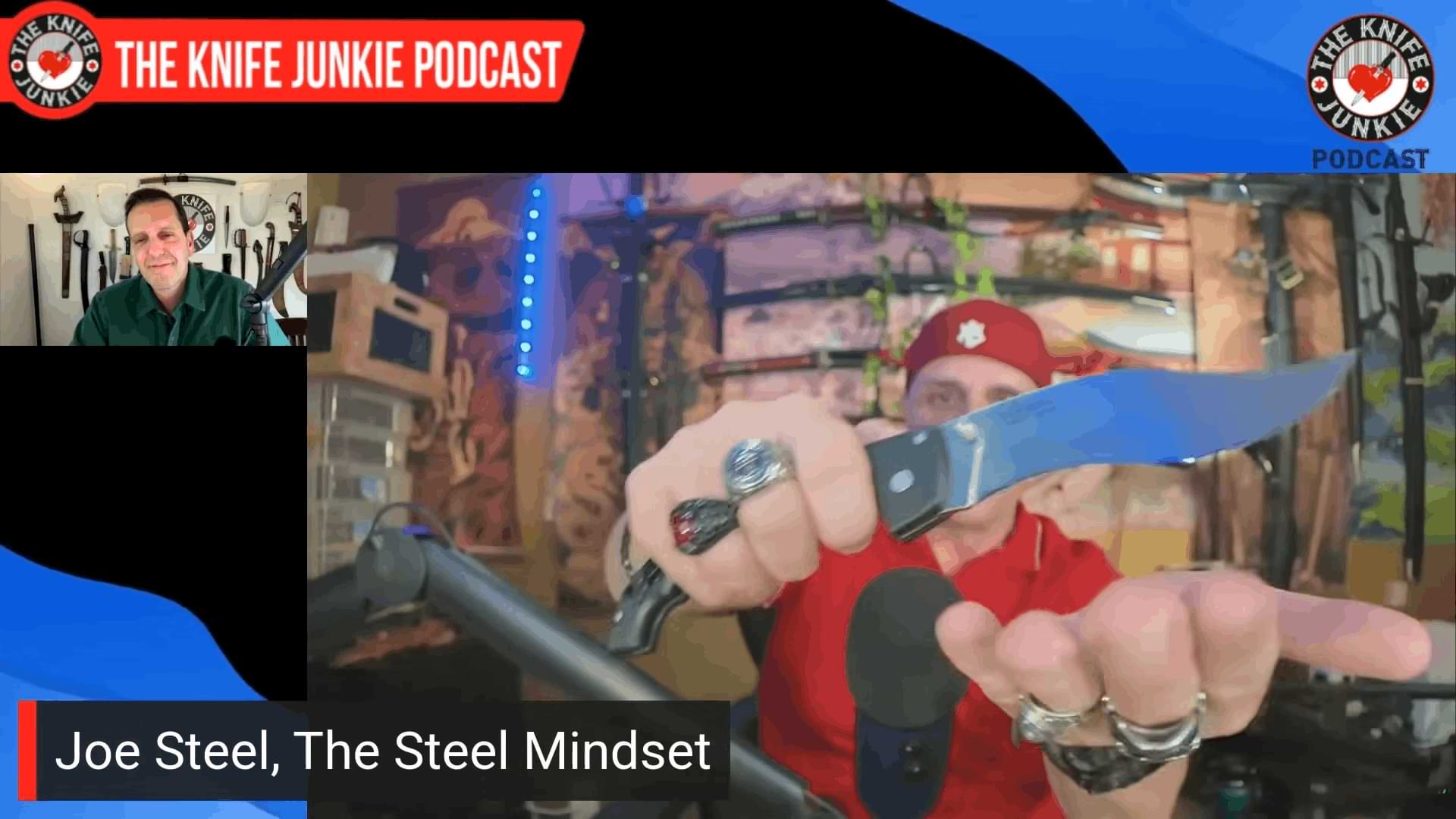
Joe Steel, The Steel Mindset: The Knife Junkie Podcast (Episode 669)
Bob DeMarco has a talent for finding guests who love what they do. In episode 669 of The Knife Junkie Podcast, he sits down with Joe Steel, the creator behind The Steel Mindset YouTube channel and co-host of the Blade Talk podcast with Joe and Scab. These two have a lot in common, and the conversation shows it.
Where It All Began: Conan the Barbarian, 1982
Joe Steel was about nine years old when Conan the Barbarian opened in theaters on May 14, 1982. The forge scene at the start of that film changed the course of his life.
“From that point on, the first scene that came in when they were forging that sword, I was hooked,” Joe said. “I was completely hooked on bladecraft and the whole adventure of it all.”
He grew up picking up flea market swords and bringing blades back from travels abroad. Long before YouTube existed, he was already building a serious collection and a deep knowledge base. The passion never slowed down. It just kept growing.
From Live Events to YouTube Creator
Before starting The Steel Mindset, Joe built a career in live event production. Corporate functions, large private events, rooms with anywhere from 200 to 3,000 people. The 2020 shutdown ended all of that work overnight.
“I have been doing production on a day-to-day basis since I was 10 years old,” he said. “For me, it was like, I do not know what to do with myself right now.”
He found sword review channels on YouTube for the first time, including Matthew Jensen’s catalog, a highly respected sword reviewer. Within two weeks, Joe had watched roughly 80 percent of every video on that channel. He started buying swords again and quickly realized his production background gave him everything he needed to make his own content. The only thing that took some getting used to was going from behind the camera to in front of it.
Once he made that adjustment, The Steel Mindset was up and running.
The Katana: Deadly Art
Joe talks about the katana the way someone talks about something that got into their blood when they were young and never left. As a teenager, he spent time at libraries and bookstores reading about Japanese culture and blade forging. He learned about tamahagane, the iron-rich sand from a Japanese mountain used to make traditional blades, and the quenching process that gives the katana its natural curve.
“I found art in a katana,” he said. “I call it deadly art.”
He explained how a katana is built to be disassembled for cleaning and maintenance, held together by a single bamboo peg called the mekugi. The tang of the blade, called the nakago, tells you how much care went into a sword. A clean, well-finished tang under the handle means a maker who took pride in every part of the work, including the parts no one would ever see.
“If you take it apart and you see a beautiful, refined piece, you know there was a lot of pride in making that sword,” Joe said.
Recommended Brands for Production Katanas
Joe named Citadel and Motohara Evolution Blades as two of the best production katana companies available right now. He also recommended Hanwei, which is producing strong work under new leadership, and mentioned Huawei as a maker of excellent swords that are hard to source. For handmade American pieces, he pointed to smiths Walter Sorrells and Howard Clark.
Blade Talk, Scab, and Life in New York
In addition to The Steel Mindset, Joe co-hosts the Blade Talk with Joe and Scab podcast with Scott Baldwin, known as Scab of Choirboyz Cutlery Outdoors. The two became friends online during the shutdown and built the show together. Bob and Joe also talked about the frustrations of collecting knives in New York State, where strict laws mean Amazon will not even deliver to Joe’s home address.
Follow Joe Steel
You can find Joe and all of his content on The Steel Mindset YouTube channel and on Instagram at The Steel Mindset. Subscribe to the channel, follow along on Instagram, and check out Blade Talk with Joe and Scab when you want more great blade conversation.

Be sure to support The Knife Junkie and get in on the perks of being a Patron, including early access to the podcast and exclusive bonus content. You also can support the Knife Junkie channel with your next knife purchase. Find our affiliate links at theknifejunkie.com/knives.
'I found art in a katana. I call it deadly art.' Joe Steel of The Steel Mindset sits down with Bob DeMarco on Ep. 669 of The Knife Junkie Podcast. Katanas, Conan the Barbarian, blade craft, and more. Share on XThe Knife Junkie Podcast is the place for knife newbies and knife junkies to learn about knives and knife collecting. Twice per week Bob DeMarco talks knives. Email Bob at theknifejunkie@gmail.com; visit https://theknifejunkie.com.
©2025, Bob DeMarco
The Knife Junkie Podcast
https://theknifejunkie.com
Transcribe Your Podcasts and Videos: https://theknifejunkie.com/magic (affiliate link)
Announcer: Welcome to the Knife Junkie podcast, your weekly dose of knife news and information about knives and knife collecting. Here's your host, Bob The Knife Junkie DeMarco.
Bob DeMarco: Welcome to the Knife Junkie podcast. I'm your host, Bob DeMarco. On this edition of the show, I'm speaking with Joe Steel of the Steel Mindset channel. Joe's channel is built around his unabashed love of swords, knives, and the science and craft that go into making and testing them. From what I know, Joe has an abiding passion for katanas and other swords, but he also loves Cold Steel and Off-Grid knives, and other knife junkie favorites. Mr. Steel co-hosts the Steel Mindset podcast with Joe and Scab where he and Scott Baldwin of Choirboyz Cutlery Outdoors have revealing conversations with knife world luminaries. Plus, Joe's voice and demeanor remind me a bit of the cousins I see at DeMarco family weddings and funerals, the ones that are fun to hang out with. We'll meet Joe and find out about his channel and podcast, but first, be sure to like, comment, subscribe, hit the notification bell, and download the show to your favorite podcast app. If you want to help support the show, you can do so by joining us on Patreon. The quickest way to do that is to go to theknifejunkie.com/patreon or you can scan the QR code on your screen. And if you join for an entire year at once, you save 12%. theknifejunkie.com/patreon. Again, that's theknifejunkie.com/patreon.
Announcer: Adventure delivered. Your monthly subscription for hand-picked outdoor, survival, EDC, and other cool gear from our expert team of outdoor professionals. theknifejunkie.com/battlebox.
Bob DeMarco: Joe, welcome to the show. It's nice to have you here, sir.
Joe Steel: Really good to be here, Bob. I've got to tell you, I was talking you up behind your back a little bit. I love your podcast. I think you bring so much to knife media in terms of bringing people together. It's professional, it's organized, you do a great job, and I'm just really glad to be here.
Bob DeMarco: Thank you, man. I could bounce that same compliment right back at you, but thank you for those kind words, I appreciate it. You only need to be on your channel or your Instagram page for an instant to see your absolute devotion and love for this hobby. I recognize it, and I'm sure most people who are in this hobby recognize it as well. Before we get into the meat of your channel and what you're into, tell us where this all began.
Joe Steel: Where should I start? Should I start with my love for blades or YouTube?
Bob DeMarco: We'll get to YouTube. We'll go to the beginning.
Joe Steel: Okay, we'll go to the beginning. Like I was telling you off-air, I physically figured out the actual day that I got into blades. That blade was pretty much my passion. That was actually May 14th, 1982. Can you think about what significance that day was?
Bob DeMarco: '82. May 14th, 1982. Let's go a little further. We're almost at that anniversary.
Joe Steel: It was a movie, a really great movie that shaped our childhoods.
Bob DeMarco: First Blood?
Joe Steel: No, it was actually Conan the Barbarian. That was the debut of Conan the Barbarian. From that point on, the first scene that came in when they were forging that sword, when his father was forging that sword, as crude as it may have been back then, I was hooked. I was completely hooked on blade craft and the whole adventure of it all. Like all of us with the ninja movies, G.I. Joe was a big motivator, Storm Shadow, Snake Eyes. Think about our childhood with the cartoons we watched, Thundercats. Everything was built around a sword. Our childhood cartoons and what we were into were built around swords and knives. It's not really much different than anyone else for the most part. It's just that I threw an affliction to it at an early age, and it never stopped. It grew and grew to the point where I was a lover of it for my whole life. It was only until later on in life when YouTube came along that I'm like, wow, I could actually collect and use this stuff. This is pretty damn cool.
Bob DeMarco: As someone who goes by The Knife Junkie, I like that you call it an affliction. That's an apt term. Conan the Barbarian is one of the greatest movies of all time. I mean that not just because it means a lot to me, it's a really well-made movie. My wife and I just showed it to our daughters, who are teenagers, and they loved it. A timeless classic. Both of those swords, the Atlantean sword and Conan's father's sword, had a lot to do with my development of loving swords. Man, I'm feeling it so far. So Conan the Barbarian, where did it go from there?
Joe Steel: Back then it wasn't like it was today. There was no recreation of the Atlantean sword or the Conan father's sword like you can pick up these days. So there were these flea market type of things that I used to pick up. The 440 stainless steel ones that weren't sharp, or they were dull, or they were falling apart. Some of these flea market swords I picked up were like, it's a sword, it's metal, it's not plastic anymore. I have a metal sword in front of me, and that's how I started collecting back then. I didn't know any better. I have one of my first swords that was like a barbarian sword, it's about eight pounds. The damn thing is huge, and it's ugly as hell, but it was my first sword and I still have it. I think my brother had gotten it for me when I was 11 or something like that, and I still have it in my closet somewhere.
Just collecting various little items like that just to feel like I had swords with me. As I started traveling, getting older, going to Cancun, going to Mexico, I'd pick up swords from Mexico. Back then the travel restrictions weren't as strict as they are now, so you could basically bring swords in your suitcase and bring them home. I just started collecting wherever I could.
Leading up until today, for the most part, if I may, it really started in 2020. What was 2020? We had the shutdown, the pandemic. My line of work doing private sector events and functions, corporate and things like that, where I am at all times in a room full of anywhere from 200 to over 3,000 people, was the first thing to be shut down. Literally overnight, it's like, I have two events to do the next few days, I'm not going to them anymore, and I don't know when I'm going to another one. Everything was completely shut down as far as my line of work.
I was going stir crazy. I've been doing production on a day-to-day basis since I was 10 years old. I'm 53. For me, it was like, I don't know what to do with myself right now. I don't know how I started getting into YouTube. I guess everybody has so much time on their hands. I started watching YouTube, and I was never really a YouTube watcher before. I came across sword videos from Matthew Jensen. Matthew Jensen is pretty much the king of sword reviews. He does an amazing job, very knowledgeable, fantastic. I basically started watching his videos, and he was on probably about 13 years before I was. Within two weeks, I must have watched about 80% of his entire video catalog. I'm like, I can't believe that this is a thing. You can actually buy a katana, you can buy all these knives, you have all these things, you can actually do it.
I said, you know what, I'm into production, I love this stuff, and I started acquiring swords here and there. I started finding ways to get them into my hands, and then I said, I could do this. I think I could do a review. I could do a showcase of the sword. I have the talent, I have the equipment, I know how to do production. It's just a matter of being comfortable in front of the camera. I've always been behind the lens. I was never in front of the lens. That was a big step for me to change roles a little bit and be behind, and be like, alright, I gotta handle that camera. It's a one-man operation, it's tough.
So I started from there, and it was more like just something to keep myself and my mind occupied while the shutdown was going on by doing these swords. Then I regained that passion again as far as blades, and sword after sword after sword. Long story short, I bumped into Scab online, Choirboyz Cutlery Outdoors. I don't even know what his name is now, CCC... he's an icon. He's like Prince now. He's just a symbol. Pretty soon he's going to change from his acronym, he's going to be a symbol, like Prince. I love you, Scab.
I bumped into him, and he was early on in this as well, and I started getting into knives. Him, Donnie B All Day, we started getting tight, and Scab is always a helping soul. He saw I was getting into it, and he gave me some shoutouts here and there. Donnie gave me some shoutouts. It was really not that long from when I started speaking to him. He called me and was like, Joe, listen. You're north, I'm south, we have a northern/southern vibe going on. Let's do Blade Talk with Scab and Joe. Let's do a show together. That's where Blade Talk with Scab and Joe was born. It's kind of a great vibe because we are totally different people in terms of how we speak. New York, Southern, the whole thing. We started hooking up and doing the show together, having all these great people on. It's been fun and entertaining ever since then. That's pretty much where we are, I guess.
Bob DeMarco: It's awesome. You guys make a great counterpoint to one another. I have a real affection for Scab. The three of us are about the same age, I mean you're older than I am, but we're all kind of about that same generation, and I think we can relate, especially with the origins. I too was really influenced by entertainment in the 70s and 80s. Everyone had a knife on them. For me, it was knives. I always loved swords too, but when I realized I could actually have a knife, swords were harder to come by. This love of swords grew, and it really seems, just from looking at you right now in this picture, but also from seeing a preponderance of katanas in your videos. Tell us how that love in particular grew, and what drew you to the katana?
Joe Steel: It's hard to say. I've always had a respect for Asian culture. I've always had a respect for the Japanese and their discipline. I guess from the ninja movies and stuff like that we used to watch, and all the samurai movies and things. I think I just... you know when you watch, you see something and it just clicked with me. From an early age I started studying and getting books. I went to the library in my teens and was learning about Japanese culture, and I went to Barnes & Noble, I got books, world culture books, and I started researching sword forging and tamahagane, and how they forged swords. I was so interested in it. It was something about it that just felt like it was in my blood. Like, this is what I want to know. I want to know more about this. I want to somehow live this, but I don't know how to. I just know it was something of great interest inside me.
Just the whole geometric of the katana, which you see behind me, the whole artistic aspect of it. Listen, I've always had an artistic eye in terms of being very creative, very creative in my production. I find art in everything that I see, that's pretty much my job. I have to find art in things, be creative in what I shoot, how I shoot it, my composition, and all that stuff. I found art in a katana. I found the aesthetics of it. I call it deadly art. That's exactly what it is. It's so strict in terms of the discipline in making them, and how everything has got to fit together and be able to take it apart. Things have to line up exactly the same way. The discipline just astounded me. Out of all swords, the katana was just something that I wanted to be around at all times, and that's where it came from. European swords are great, I love all swords, the whole swordcraft in general. But there's just something special about the katana that hits me.
Bob DeMarco: Something that always fascinated me about the katana once I learned it was how that curve is created.
Joe Steel: Yeah, the water basically with the heat basically going into the water and then oil or water, mostly the water, and it just creates that natural curve. And just think about back then, how we produce steel now, and think about back then where they had primitive stuff. No power hammers. They tied steel on rocks, on sticks, and they were hammering things up. Think about how they figured this stuff out on their own. You think like maybe aliens came down and showed them what to do because there is a theory about that as well.
Bob DeMarco: I speak that language. Believe me, I do. We can go down that path. But before we do, also when you think about the steel that they were actually the raw materials they were starting with, it couldn't have been that refined, but through the process it became more and more refined.
Joe Steel: Smelting, yeah. They found iron deposits in sand on a specific mountain in Japan and they found a way, I don't know how they figured out that let's heat this stuff up at crazy amounts of temperature and let's see what comes out of it. And then, oh, we've got some metal ore here. Alright, let's see if we can use this. I just, it's amazing to me how they figured this stuff out.
Bob DeMarco: And then after that, which sounds primitive, it's like, now let's create the most refined sword that history has ever known. In a process that's insane. I guess arguably, you'll have sword makers saying, excuse me.
Joe Steel: Yeah, I know what you mean. I love European swords. As a matter of fact, I saw Scab had a cutting video just today with this giant broadsword he's been showing that's so beautiful. I sent it to him, yeah. Yeah, the Katzaiberia sword. I'm like, I love the Filipino swords. I like the short sword. They appeal to me aesthetically, but also I know how to use them because I've done that martial art or I've trained in that for a while. To me, it's the exotic shapes. The katana is really the king of the exotic shapes, and it's so refined and, like I said, simple.
Bob DeMarco: So a couple of things. First, you mentioned one of the things you want to know it can be taken apart. Is that like when you go to the Met and you see the swords that are unmounted and then you see the hilt and everything separated, you just knock a peg out and the whole thing comes apart? Is that what you mean?
Joe Steel: The beauty of a katana that's different from any other weapon on the planet is the fact that it is made to be disassembled. Now the reason why it's made to be disassembled is because they want to be able to maintain the blade. They want to be able to maintain the tang. They don't want to make sure there's no rust or no blood or no water that goes into the tang that's going to rust it up. So basically the responsibility of the samurai was to be able to take the sword apart and maintain his blade after a battle or after use.
Bob DeMarco: Like a Marine with his rifle.
Joe Steel: Exactly, exactly. So it's amazing to me that something with so many pieces can be taken apart and put back together and still be act like a unibody and be such a powerful, formidable weapon. And how they figured that out. Let's get some fish skin, let's get some ray skin and tie it around the handle, the tsuka, and let's wrap some cord around it, it'll hold it in place. And we're going to hold a whole thing in place with two bamboo, or not even in Japanese culture there's only one peg, one wooden peg, mekugi it's called. And that one little bamboo peg holds the whole sword together. I still don't understand how it works, but it does. It just works, you know, and it's just taken apart. I look for a sword that can be, not it's not a prerequisite, it's not something, oh if it can't be taken apart, I don't think not every sword that I can, not many people do, it's not even people look for it, but it's nice to know if you have, if you're paying a certain money for a certain type of refined sword, you want to be able to take it apart and see that the tang isn't in good shape, it's not a big rusty mess because what happens if you take the sword apart and you have a bare blade, right, and the tang or the nakago it's called is grinded well and it has the signature of the smith and it looks beautiful. You know that there's a lot of pride that was put into making that sword. There's some swords out to pick apart where it's a big rusty mess, which is pretty much the norm. So when you take it apart and you see a beautiful, refined piece, like you see in the Met, like you see in those swords that are that are polished well, you know there was a lot of pride in making that sword, making that blade, and you could imagine if they take care of that piece of the sword that you don't see, you could imagine how much more care they took in the pieces you can see. So I appreciate those little things, you know?
Bob DeMarco: Okay, so who does it best right now in your opinion with the current day katanas?
Joe Steel: Well, who does it best? There are still masters in Japan that are making swords. There's only a certain amount that are allowed to be made in a year. There's so many restrictions as far as, you know what's funny? In Japan, you're not allowed to own a Japanese katana if it wasn't made on Japanese soil. They're not allowed to own anything that was made in China. And it's got to be registered like a firearm. It's got to have a serial number, it's got to be registered like a firearm, and it's got to be made on Japanese soil in order for them to physically own it. I'm sure there's black market stuff. Because otherwise it has no cultural value. It is, it is just a weapon. But that's why I love the fact that they're still looking at this culture that they're still living like the discipline of the samurai is still alive and well in the ethics and the discipline that Japanese people live today. They still have that same type of discipline. Everything they do is with discipline. There's, they have a certain way of living that's just so amazing to me that it really emulates the past. So it doesn't surprise me that that's what they look for. But I digress on that. They're still making those. So those are obviously the most incredible swords that you can find, that's if you have 20 to 30,000 to spend on them and if you're able to get one, and that's not easy to do. But that's not to say you can't get aftermarket ones and use ones, that's a whole other market. The swords in America, there are two smiths in America that make some of the best swords anywhere, and that's Walter Sorrells, I had him on my show a long time ago, and Howard Clark. They're American smiths and they make amazing, amazing blades. But besides that, the production companies that are available to most people, the two companies I think are making some of the best swords out there are Citadel and Evolution Blades Motohara, Motohara Evolution Blades. Are two companies that are making the most high-end pieces out there. But there's a lot of them, there's Huawei, there's a lot of good companies. And I gotta tell you, even Hanwei are making some incredible items these days.
Bob DeMarco: Is Hanwei Chinese?
Joe Steel: Hanwei is Chinese. Frenchie Jin is the one who's heading it. Hanwei had a fire and it burned down and they reinvented Hanwei and Frenchie Jin who was doing Dragon King and is very close in association with Patrick Bley and Cas Iberia, he's making, he is now heading the Hanwei factory. He got a lot of the people from the old Hanwei, cause he was an original, Paul Chen was the original maker of Hanwei. It was him and Frenchie Jin and Paul Chen over 20 years ago, they originated Hanwei and they, all the designs that we see today were from them over 20 years ago and they're still alive today, and he now is now revitalizing the brand of Hanwei under his helm, you know.
Bob DeMarco: But okay, and you mentioned another company before that.
Joe Steel: There's Huawei. Huawei makes an amazing, amazing sword, and I have one of them, they're very hard to get, and they're not really producing swords that much, I don't know why, I think it is just maybe I can't even explain it, but it's a shame because they make some of the most incredibly refined beautiful swords on the market, and they're not too expensive, they're probably in the thousand dollar range, a little less. But that's an oddity. But for the most part, if you really want to get the best sword in terms of fit and finish, performance-wise, those two companies with Citadel, which is also under Cas Iberia brand, and the other brand is called Motohara Evolution Blades. Two brands that are pretty much production-wise that you can get swords from.
Bob DeMarco: So you're in New York, right? Somewhere... and I know that New York is not a very friendly state for...
Joe Steel: No, it's not. I can't even get Amazon to ship knives to my address.
Bob DeMarco: Oh stupid. I mean just ridiculous. So how does that work?
Joe Steel: I get a message that comes up and it says you need to choose another address, there are shipping restrictions in sending this item to your address. There has been times when I actually had, I had gotten a knife from Amazon, got it shipped to Florida, to Scab, and I had Scab mail it to me. I'm like stupid. I mean just ridiculous. Just ridiculous. So yeah, there is a there is a problem with with knife, I guess you just gotta be smart and you gotta know where and you can and can't and you can't be flamboyant with them, and you just gotta know when, where and how. I mean that's pretty much what it is. It is enforced, you don't want to be caught with it, you don't want to be in a fight with it and have it in your pocket. God forbid you should, you know, unleash it during a fight, it's just, you just gotta be a lot smarter with them, knowing that they're in your pockets or at your hip or in your car and just know how to handle them. But it's as long as you keep it down low, it's it should be fine. For the most part.
Bob DeMarco: I lived in New York City for, you know, as a I didn't grow up there, but I lived there for about 12 or 13 years in my 20s and 30s. And I was there at the tail end of when there was a place right on Times Square that had a huge knife counter, Roseland Martial Arts. I talk about that a lot because I, now I remember, I can't believe you could just wander in there and buy any cold steel that was on the market at the time, and then things got very restricted.
Joe Steel: Upstate is easier. I mean it's, if you get the further you are away from the city the better is like upstate New York, they're all carrying knives around, you know, it's just the further you get away from the city it gets a little bit easier when you get more into the country areas and things like that for the most part.
Bob DeMarco: So let's talk a little bit about Blade Talk with Scab and Joe. Your podcast, you've had a lot of luminaries on the show. It started where Scab and I were speaking and we had a vision. What are you looking most forward to in this coming year?
Joe Steel: I am really looking forward to making the Blade Show this year. I want to get to Atlanta and I have a couple of things set up, some interviews set up, and some booths that I want to visit. Going solo this year, Scab can't make it. So I'm looking forward to Blade Show and getting whatever I can out of Blade Show in terms of people on, and stuff like that, and seeing a lot of the new product. I think it's gonna kind of shape how I treat the rest of the year. And growth, channel growth. I mean it's that's I'm looking to grow my channel constantly. I've been struggling to get over that 10,000 subscriber mark, and I'm really close to it, and I just want to get to the point where my channel is a lot more valid, getting to a certain sub count. So it's about channel growth, it's always a big thing for me. I'm really geared towards growing my channel, doing more podcasts, doing more lives, doing all the normal YouTube stuff that you gotta do to grow your channel. And that's it's about channel growth, it's about getting more companies on, about getting Blade Talk on again, and just getting some influential people in front of people's eyes and in front of people's screens.
Bob DeMarco: Outstanding. Well, Joe, thank you so much for coming on the Knife Junkie podcast, sir. It's been a real pleasure meeting you and having you on.
Joe Steel: My pleasure, and you going to the Blade Show this year?
Bob DeMarco: I am indeed. I look forward to shaking your hand, my friend, and thank you for having me on. I look forward to that too. We'll show off what we've purchased thus far. Absolutely. Thank you for having me on. My pleasure. Take care.
Announcer: Why pay full price for gas and food? With the Upside app, you don't have to. Just open Upside, find nearby offers, and earn cash back when you buy gas or eat out. Pay like normal and get real money back in the app. No coupons, no hassle. Just easy savings on things you already buy. Download Upside today and start putting money back in your pocket. Learn more at theknifejunkie.com/saveongas.
Bob DeMarco: There you go, ladies and gentlemen, Joe Steel of the Steel Mindset channel and Blade Talk with Joe and Scab podcast. Awesome podcast, do yourself a favor, check them out on YouTube, also on Instagram, and subscribe to his podcast which they're warming back up. It's awesome. You'll love it if you like good knife talk, because here you are. Alright, for Jim working his magic behind the switcher, I'm Bob DeMarco saying until next time, don't take dull for an answer.
Announcer: Thanks for listening to the Knife Junkie podcast. If you enjoyed the show, please rate and review at reviewthepodcast.com. For show notes for today's episode, additional resources, and to listen to past episodes, visit our website theknifejunkie.com. You can also watch our latest videos on YouTube at theknifejunkie.com/youtube. Check out some great knife photos on theknifejunkie.com/instagram, and join our Facebook group at theknifejunkie.com/facebook. And if you have a question or comment, email them to bob@theknifejunkie.com or call our 24/7 listener line at 724-466-4487, and you may hear your comment or question answered on an upcoming episode of The Knife Junkie podcast.
Share This With a Friend >>>
For early access to The Knife Junkie podcasts and YouTube videos, receive Knife Junkie stickers and be entered into the monthly knife drawing giveaway, join The Knife Junkie’s Patreon group of awesome supporters.
Let us know what you thought about this episode. Please leave a rating and/or a review in whatever podcast player app you’re listening to. Your feedback is much appreciated. Email theknifejunkie@gmail.com with any comments, feedback, or suggestions on the show, and let us know who you’d like to hear interviewed on an upcoming edition of The Knife Junkie Podcast.
To listen to past episodes of the podcast, visit theknifejunkie.com/listen.

Shopping for a Knife?
Support The Knife Junkie Podcast and YouTube Channel by Buying Through My Affiliate Links
 3 Dog Knife (25% off hardcore Alaskan-made knives with coupon code “knifejunkie”)
Angle Pro Knife Sharpener
Artisan Cutlery
Bamba Forge
Civivi Knives
eBay
Jack Wolf Knives
James Brand
Knives Ship Free
Off-Grid Knives
Sencut
Smoky Mountain Knife Works
Tiger Edge
T.Kell Knives (Get 10% OFF with coupon code: “knifejunkie”)
Vosteed Knives
WE Knives
Other Products and Services
1Password
16-in-1 Multipliers
Dark Age Defense
Podcast Hosting
Groove (Replace 17 Apps and Services in Your Business)
Groove.ai (All-in-one AI solution)
Knife Books
Rakuten (Cash Back for Shopping Purchases)
Shockwave Tactical Torch
StreamYard
Upside App (Cash Back for Gas Purchases)
SOS Emergency Sleeping Bag
Survival Saw
Wilderness Survival Skills Course
Work Sharp
Work Sharp Rolling Knife Sharpener
“The Essential Skills of Wilderness Survival” Book
Follow The Knife Junkie
Visit The Knife Junkie website
Email The Knife Junkie
Follow The Knife Junkie on YouTube
Follow The Knife Junkie on Instagram
Follow The Knife Junkie on Twitter
Join The Knife Junkie Facebook Group

Affiliate Disclosure
In the name of full transparency, please be aware that this website contains affiliate links, and any purchases made through such links will result in a small commission for The Knife Junkie channel (at no extra cost to you). If you use these links to make a purchase, TKJ will be rewarded with credit or a small commission on the sale. If you don’t want to use these links, no problem. But know that I truly do appreciate your support.