Lynn Thompson: The Knife Junkie Podcast (Episode 671)
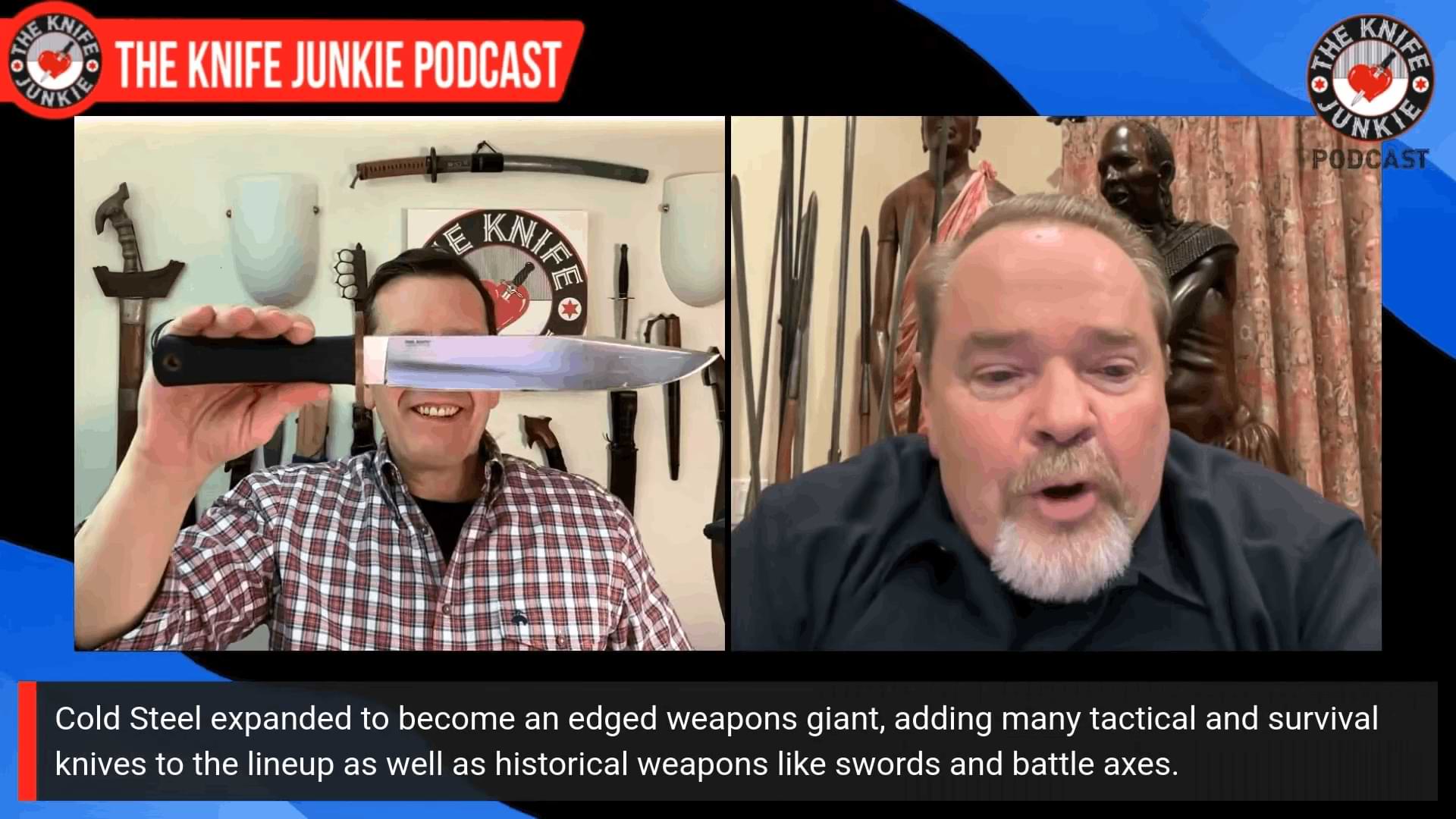
In this episode of The Knife Junkie Podcast, Bob DeMarco talks with Lynn Thompson, the founder of Cold Steel Knives and one of the most influential people in the history of tactical knives. After selling Cold Steel to GSM Outdoors and sitting out a non-compete that expired in June 2025, Lynn is back with a new company: Lynn Thompson Tactical Knives.
This is a wide-ranging conversation that covers Lynn’s childhood in Brazil, the push daggers he was building in 1980, before anyone else in the industry, the story behind the Tanto and the Trail Master Bowie, the art and science of knife fighting, and what his new company will look like.
How It All Started
Lynn has loved knives since he was four years old. When he was growing up in Brazil, his father made him wooden knives to play with. That passion never left. When he got to college, he was already training with blades and thinking about how to improve the designs that were available to him.
The push dagger came first. Lynn saw women in self-defense classes putting their keys between their fingers and decided there had to be a better solution. He designed the Urban Pal, an all-steel push dagger, in 1980. The early prototypes were rough and expensive. But he believed in the concept and kept pushing.
“I was tactical when tactical was not cool. There was no tactical knife industry when I started.”
The Origin of the Tanto
Shortly after the push dagger, Lynn was training in his backyard and broke a Gerber Mark II. Then he broke the spare. He called the company, reached Pete Gerber, and got offered a replacement. That was not good enough for someone who grew up where the nearest town was 48 hours by Jeep.
He set out to build a knife with an indestructible point. Years of drawing, prototyping with makers like Joe Cordova and Jim Merritt, and testing led to the Tanto. The final Trail Master design was sketched on a placemat at the Pierpont Inn in Ventura.
Knife Fighting and the Art of the Bowie
Lynn trains with blades four sessions a week alongside Luke LaFontaine and a group of students that includes Washington-based martial artist Richard Lee and his students Sean Alm and Matt White. His gymnasium holds $80,000 worth of aluminum training weapons.
That training history shapes his designs. He is a passionate advocate for the Bowie knife as a fighting tool, calling it hard to beat as a pure fighter because it functions as a cleaver, a knife, and a dagger all at once. He also talks openly about what he would do differently with the Trail Master guard if he were building it today. His new Bowies will have longer, more functional fighting guards.
He also breaks down the sub-hilt fighter, the double-edge-versus-single-edge debate, and why he believes carrying only one knife leaves serious gaps in your preparedness.
“Using a single-edged knife is like carrying your Glock with a half-empty magazine.”
Lynn Thompson Tactical Knives
With the non-compete behind him, Lynn is launching with 35 knives, including a Japanese Quaken, two new Bowie designs, a cutlass, and plans for sword canes. His factory features 12 five-axis CNC grinding machines, robotics, and automatic sharpening and polishing equipment.
The quality standard is the same one he held at Cold Steel: knives you can bet your life on.
“I am going to pursue my interest in almost wholly martial things. There are enough categories of martial knives for my company to work on for the next 200 years.”
You can find Lynn Thompson at Blade Show 2026 in Atlanta, booth 2413, in the secondary room.
Links:

Be sure to support The Knife Junkie and get in on the perks of being a Patron, including early access to the podcast and exclusive bonus content. You also can support the Knife Junkie channel with your next knife purchase. Find our affiliate links at theknifejunkie.com/knives.
Lynn Thompson is back. The man who built Cold Steel just launched Lynn Thompson Tactical Knives with 35 blades and one goal: knives you can bet your life on. Episode 671 of @TheKnifeJunkie Podcast. Share on XThe Knife Junkie Podcast is the place for knife newbies and knife junkies to learn about knives and knife collecting. Twice per week Bob DeMarco talks knives. Email Bob at theknifejunkie@gmail.com; visit https://theknifejunkie.com.
©2025, Bob DeMarco
The Knife Junkie Podcast
https://theknifejunkie.com
Transcribe Your Podcasts and Videos: https://theknifejunkie.com/magic (affiliate link)
Narrator: Welcome to the Knife Junkie Podcast, your weekly dose of knife news and information about knives and knife collecting. Here's your host, Bob "The Knife Junkie" DeMarco.
Bob: Welcome to the Knife Junkie Podcast. I'm your host, Bob DeMarco. On this edition of the show, I'm speaking with Lynn Thompson. If you've been living under a rock or are new to knives, perhaps Lynn started Cold Steel Knives, my absolute hands-down, no-doubt-about-it favorite knife company of all time, and ran it since its inception.
Now, about five years ago, and after about 40 years, Lynn sold Cold Steel to outdoor equipment conglomerate GSM Outdoors, who've been keeping things up quite nicely, if I do say so myself. But now, Lynn's non-compete with GSM has expired, and he's back with something new. And if it's from Lynn Thompson—yes, that Lynn Thompson—you know it's going to be sweet.
All right, we'll catch up with Lynn and find out what's new and all about his new venture. But first, be sure to like, comment, subscribe, hit the notification bell, and download the show to your favorite podcast app. Also, if you want to help support the show, you can do so by joining us on Patreon. Go to theknifejunkie.com/patreon or join us right here on YouTube. You can also scan the QR code on your screen. Join for one year at a time and save 12%. That's theknifejunkie.com/patreon.
[Ad Break: BattlBox]
Bob: Lynn, welcome back to the Knife Junkie Podcast, sir. It's great to see you.
Lynn: Thank you so much. I'm honored to be here.
Bob: Oh, the honor is all mine, sir. The honor is all mine. So, I have so many things that I want to talk to you about, especially your new venture, and we will get to that, no doubt. But maybe for people who are new to the show, or maybe who are new to collecting knives—and as the knife world expands, which it's been doing at a great pace lately—maybe they don't know your story. So let's do a quick and dirty about Lynn Thompson and how you got into knives.
Lynn: Well, I've loved knives since my earliest childhood. I might have mentioned before that when we were in Brazil—I grew up in Brazil—my dad made me carved wooden knives. And I have photos going back to me at four years old playing with wooden knives in Brazil. So, it's in my blood, and we don't know exactly where it came from.
My dad was a very skilled and enthusiastic hunter and a tremendously good shot with a rifle or a shotgun or a pistol, and a very talented athlete. Fortunately, I got some of his attributes, not all of them, and I just always loved knives. It was natural for me to go into the knife business.
Bob: All right, so now this is going to be kind of a—to use a common current term—this is going to be a meta question. But what is it about knives, do you think, philosophically, that draws people like us? For me, it's a matter of self-reliance and self-defense. But what do you think it is to you?
Lynn: Well, I would have to 100% agree with you. To me, a knife is a weapon first and a tool second. Now, to a lot of people, it's a tool first and a weapon second. So, that's why I called my new company Lynn Thompson Tactical Knives, because this time around, I'm going to pursue my interest in almost wholly martial things.
Bob: It's funny that you say that because a lot of people who look at Cold Steel—the catalog through the many years—there was definitely a very heavy tactical presence there, self-defense presence in your designs, but also a historical tip of the hat to all things historical. I know you've got a vast collection. But tell me a little bit about your looking back into history to come up with some of the designs and some of the ideas that carried Cold Steel through the years.
Lynn: Well, I can remember why I created the first push daggers, and it's interesting you bring that up. Today, I see a lot of people on YouTube acting like they just discovered push daggers. And they're making different variations, that some are better than others. But you gotta remember, I made my first push dagger in 1980. I was tactical when tactical wasn't cool. There was no tactical knife industry or tactical knives when I started. I could arguably say that I'm a huge innovator in tactical everything for knives.
Bob: I mean, that's easy to argue. But something that's kind of interesting: people think of you as the father of the modern American Tanto, that shape we know and love so much and is so utilitarian, even in the outdoors, by the way. But you did push daggers first?
Lynn: Yes, I came up with push daggers probably six months to a year before I even came out with Tantos. I came out with the Urban Pal, which was an all-steel one, and the Urban Skinner, which had a rubber handle. And Patagonia—believe it or not, the famous outdoor company—made that first rubber handle for me.
And they tried to help me, but they really weren't set up to manufacture knives, so I went down the road looking for other manufacturers. But I made the push dagger because I was in college, you know, they would teach in self-defense classes for women to put their keys between their fingers. Have you ever hit anything like that?
Bob: Oh, it hurts like hell.
Lynn: Oh, it hurts like crazy. It's miserable. So I said, "No, I'm going to make a push dagger." That's how I started it. Alex Collins, who is a contemporary of Jody Samson, made some of the first samples, and they were incredibly crude. I remember he charged me $150 for them, and I looked at that asymmetrical blade and the crap grind and all that stuff and thought, "You've got to be kidding me." But I paid him anyway.
So, that was the push dagger. But as I'm working on the push dagger, in my mind, one of my interests in knives so much was when I started—just before I started Ventura C-9s—I broke a Gerber Mark II. The seven-inch blade dagger. Mark II.
So, I was training in my yard, thinking I was a knife fighter. I stabbed it into a wooden target I'd made. I stabbed it moderately hard, but I was trying to withdraw it very gingerly. You know, I was working it out ever so slowly, and the blade snapped off. I mean, I lost like an inch and a quarter, an inch and a half of the whole tip—gone, snapped off.
Well, you know, I was a long ways from wealthy then, and that hurt. But I had a spare, because I've always believed in having a spare. So I went in the house, got my spare, and I broke it too.
That pissed me off. So I called Gerber. And I called and I called and I called, and lo and behold, I got a hold of Pete Gerber. Imagine that. And I can never forget, he said, "Oh Lynn, happens all the time. Just send it back and we'll replace it." And I thought, "What if you grew up in Brazil like I did, where you're 48 hours by Jeep from the nearest town? A replacement's really not an option."
So, that was my quest then to start making a knife that's really, really resistant to breaking. And from that came the Tanto.
Bob: So in the early days—and I wasn't there in the very earliest of days, but my best friend in high school tipped me to Cold Steel in probably like 1986. He's like, "All the CIA guys carry these, and they can pound them through car doors!" and I was like, "Oh my god, I gotta have one."
And I jumped on that and, as we talked offline a couple of days ago, I got one of those. But before we get to the Tanto, and I want to talk about that, the push dagger had a rich history. I know we think of a lot of the Indian—what was that, the katar?
Bob: The Indian katar. But it also had a rich history with American gamblers and such. Can you just fill us in on that before we move on to the Tanto?
Lynn: Well, the katar was a Mahratta weapon, primarily a Hindu weapon. And it was developed because they needed to be able to puncture through chainmail and plate. And you can't do that with a bent wrist in a forward grip. You're not doing it. You might be able to get through with a really good point, you might be able to get through with chainmail, but you're not punching through plate.
So, they invented something that allows you to hit with a locked wrist and it had extensions to protect your forearms. And people don't know why those extensions are there. Those are to protect your arm as you withdraw and your counter-cut.
Bob: Okay, I always thought those were there to stop your wrist from bending in a weird way.
Lynn: Kind of. That's part of it, but it's also armor. Because sometimes they had a bar on the top and bottom of your forearm, and sometimes they had a whole sleeve that encompassed your entire forearm in metal. And that was there to prevent the counter-cut or a counter-stab as you made your blow. You landed your blow and you're trying to get out, and that's how you get out unscathed instead of being counter-cut.
Bob: Right, right, because you get a blade in your arm and as you retract it, you're toast.
Lynn: That's the hardest thing in knife fighting: to land a clean thrust and escape unscathed. I can—we practice this a lot on Saturday—I can hit you at almost any given moment with a stab. But, here's the big caveat: getting out unscathed and not being counter-cut or maimed or seriously injured, even though you may—I might deliver a lethal blow.
I don't want to come out and lose precious tendons and all those things. I want my fingers to work, you know? This trigger finger, I want it to continue working and stuff. So, yeah, it's really hard to get out making or landing a thrust and not being counter-cut, provided you're going against somebody really skilled.
Bob: Right. It almost seems like if I can just—yeah, you may get the thrust and of course I may be finished, but if I can just press my blade against your forearm before you pull it out, I might get something out of it.
Lynn: Well, you're going to be so strong. They have this saying: when you're stabbed in the heart, for the next five seconds, you're as strong as you'll ever be in your entire life. So when I land that thrust, you could come down with mighty force—more force than you think about. So everything you do when you're actually fighting is multiplied by adrenaline. So you're always going to hit harder than you think.
Bob: Makes sense. Especially in those desperate moments. All right, so Lynn, I want to jump back to the push dagger.
Lynn: I wanted to find out what its provenance was. It comes from the katar—and some people, I used to believe that too, in fact, in a trial where I was an expert witness, I told the whole history of it—but it may have developed from the gimlet, which was a woodworking tool. It has like a corkscrew blade, or sometimes just a sharpened blade, and you would turn it to make holes.
Bob: Oh, like a hand drill kind of thing.
Lynn: And it would go between your fingers. And there would be a handle at right angles to the blade, and you would turn it like this and drive it through things. Called a gimlet. And so some people think it derived from that. So we don't know exactly.
We know that it showed up in the very early 1800s, primarily in the South. And it took some hold on riverboats. But by 1849, it was in San Francisco, and the Price knife guy was making beautiful push daggers and stuff. So, yeah, I don't know exactly where it comes from.
Bob: That's what I was getting at, actually. I'm glad you brought that back up—is the riverboat gambler sort of mythos. I really like it. I don't know if it's true or not, but I love the idea that these southern gentlemen had them tucked in their cummerbunds and they were ready for like—
Lynn: Well, there's a reason why they used the push dagger. Do you know what it is?
Bob: No.
Lynn: It's shorter overall length than a knife. So if you've got a boot knife, it's about—with a normal boot knife, it's nine inches overall length. Five-inch blade, four-inch handle, arguably that's the standard. The push dagger, you could have a five-inch blade, it'll be seven inches with the same length blade. So two inches shorter, or about 20% shorter overall. So that's easier to conceal.
Quite often they would clip it to the armpit of their vest, and yes, to their cummerbund, but they would conceal it. And it had to be short enough to have that—I mean, a Bowie knife, you're not sticking that inside your coat very easily. You can put a four or five-inch push dagger and conceal that really well and grab it also in a hurry. So you grab it, and as soon as you grab it, it goes. It's in action. So you lean right across the table and let somebody have it.
All right, actually, this brings up a question, and I can't think of anyone better to ask than you. I've thought a lot about what makes a Bowie. Quarter-inch to 5/16ths of an inch thick, 10 inches roughly, or a little shorter, a little longer. I like a sharpened swedge personally, though I know you don't actually need it to do a lot of damage with a back cut. But what about scaling it down for the quote-unquote "vest Bowie" or the gentleman's Bowie that is hidden? Can you take that knife and distill all of the qualities of a Bowie just making a small clip point?
Lynn: No. No, you can't. Bill Bagwell—I call him the father of the American Bowie—we got off to a rocky start in the '80s when I first met Bill, but later we became friends. And Bill's definition is a 9.5-inch blade or bigger. And he would like to, I think, at least be quarter-inch or more thick, and I agree with that.
A Bowie should be a quarter-inch or more in thickness—I prefer 5/16ths or even 3/8ths. I prefer a 10.5 or 11-inch blade. I do prefer a sharpened clip. But when you try to distill it down, you lose all of the fighting attributes—not all, but you lose a great deal of the fighting attributes of the Bowie.
Like Luke and I were fighting with Bowies on Saturday, and we were talking about that. It's really, really hard to find a better fighting knife than a Bowie knife. As much as I love Tantos, as a pure fighter, I think the Bowie's better. It has—it's because of the fact that it's both a cleaver, a knife, and a dagger, and can make back cuts as well.
It has the power to deliver limb-severing blows and head-crushing blows. And even when it's dull, it's formidable. Even when the edge is chipped up to shit and bent over from fighting and all that, you still have 17 to 18 ounces of steel in your hand and with a sharp point. And so you're never really out of the fight when you have a Bowie. You're always formidable, no matter what condition the edge is in.
Now, when you scale that down, like a Recon Scout, seven and a half inch blade—but is it as good as a Trail Master? No. Does extra two inches help? Yes.
Bob: Okay, this is what I was going to get at, and I want a Recon Scout. I've never had one. It's one of those—there are many Cold Steels I've wanted for like, say, 30 years. Like, for instance, the five-inch Vaquero. I just got it after 30 years of wanting this knife. Finally got it.
I'm a huge fan of the Trail Master. This is my old one, it's been reprofiled many times. I've had it for 25 or so years. Been on a lot of adventures. I've gotten a new one, I love it. But there is nothing quite like this knife in particular. I love all of the Cold Steel Bowies I have, and I have I think them all, but this one is—there's nothing that beats a Trail Master. How did this come about?
Lynn: Okay, so I read Bill Bagwell's "Battle Blades" column in Soldier of Fortune magazine. I started reading that magazine in 1980, and I went to every convention except one. I didn't go to the first convention in Missouri, but from '81 to the last convention in 2000, I went to every one of them.
And Bill talked about the Bowie, talked about the Bowie. I said, "I want to make a Bowie." I see there's a gap in the market, no one's—other than Western and Case—and theirs look quite similar. There wasn't really anybody making a Bowie knife commercially. So, the one thing I have against some Bowies is their points are quite fragile.
And so, going back to my experience breaking that Gerber Mark II, point fragility has always been in the back of my mind. The point has to be strong enough to at least endure combat. And you're going to miss. That stab you think is so well-placed, that guy's moved, and you're going to hit the wall or the concrete post or a wood post or whatever. And you can't chip the tip off.
It has to have—and also I don't want something bent over on the sternum or the ball joint of the shoulder or the ball joint of the hip. And I want to be able to—if you did come down on the head with the point, the point's going to be intact. So then, how did I do that? There was a lot of drawing.
So, I drew that Bowie, the final Trail Master, at the—what's it called, Bri? The inn. Pierpont Inn. So the Pierpont Inn on the cliffs there in Ventura, I drew that final version on a placemat. I love it. And Joe Cordova made two or three prototypes for me.
And it went from there. It went through a few iterations until I got it to where I wanted it. And I just want to say that there's like Jim Merritt that used to work with Bob Loveless. Jim Merritt, I met him in 1980, and he ground a lot of knives for me when I first started—all those small push daggers, one-piece Urban Pals. He was a big influencer and encourager of me in my early career.
And Joe Cordova also. He helped me with the Trail Master and he helped me design the handle for the Kukri. And so, I have had also Pat Crawford made some prototypes for me. And there's so many custom knife makers that have been enormously generous with me. And I want to give them a shoutout and show my appreciation for them.
Bob: We talked a lot about the American Tanto last time and your innovation in that realm. You were just talking about Bob Loveless. One of my favorite knives that you've ever put out, and another one that I recently got from the old days with the leather sheath, is the Black Bear Classic. This is one of my favorite knives and knife designs of all time. This double-edged, fully double-edged clip point blade with the sub-hilt. It's an awesome fighting knife. It's not a Bowie, but it's a fighting knife. Tell me about your love of that knife and why this is useful. I know this sticks in a lot of crosshairs, that sub-hilt, but tell me about the sub-hilt fighter.
Lynn: Okay, there's a lot of advantages to the sub-hilt fighter. Before I made the OSS, I called Bob Loveless and asked permission, and he said, "Yes, go ahead and make it." And when he got a sample, he said, "Thank you, you've done an enormously good job with his vision." And it's a treasured memory that I finally even got to talk to him, and that I had his permission to make that knife.
So, I love sub-hilts because centrifugal force wants to drag your knife out of your hand. And we have a saying when we fight: "You drop your knife, you lose your life." And you may be able to recover, but it's unlikely. A skilled knife fighter, if you drop your knife and you don't have another one—you can't break range and get another one or draw another one—you're pretty much fudged.
If I beat your knife out of your hand, now you're standing there like this with your 10 fingers, right? And if you think you're going to shoot on me, take me to the ground, control my knife and arm, get two hands on it, and somehow take it away from me... I've got some swampland in Florida I'd like to sell you.
It won't work. It might work against people who aren't skilled, but a really skilled knife fighter... When I take my knife and I cut the hair like this—see the hair coming off my arm?—when I do that, all your thoughts of wanting to grapple with me go out the window. All you want to do is find something in another zip code and get there as fast as you can. This is a human dissector.
Now, you might be able to do it against people who aren't skilled, but a really skilled knife fighter... I heard someone ask Jared Wihongi, who does a lot of knife fighting stuff, "How do you hold your knife?" and he said, "Tightly." And I thought that was hilarious because, yeah, there are a lot of different ways to hold your knife, but if you drop it, you're screwed.
Getting back to the sub-hilt: when you're fighting with a knife, this finger, this finger, and this finger—your last three fingers—do most of the holding. Because your index finger and your thumb have to be more relaxed to give you the wrist articulation that you need. Lots of times I'll have to move my wrist radically to either avoid or engage in the incoming arm.
And that sub-hilt helps you from losing that knife. If you beat my knife with, say you've got a Bowie and you smack the top or side of my knife, and I've got a sub-hilt, it's much more likely I'm going to hang on to it. And the other thing is, you can stab as hard as you want in forward or reverse grip with absolutely no fear of ever going forward onto that sharp double edge. And then when you extract it, you're not going to lose it.
Yes, you also have more power—it's a good point you said that—when you extract it, you're not going to lose control of it because you've got something stuck between your finger. You're not going to pull off that slippery handle. If your hands are bloody or wet or sweaty, that sub-hilt is going to help you adhere to that knife handle under even the most adverse circumstances.
Even under impact... I've never had anything—I've stabbed a lot of stuff. Unlike most of the people on YouTube that talk, they have never spent the hundreds of thousands of dollars I have around the world stabbing things. And so, I have never had a blade stuck in anything. Not in a rib cage, not in the stomach. There's no suction.
Now, I have had the choil on a knife get stuck a little bit in the skin as I'm pulling it out. And I had some old guy tell me you can't have a choil on a knife because it'll get stuck in the skin of a wild boar. You just tug a little harder. I just give it a jerk. If you drop your weight suddenly and you jerk your arm and shoulder back, it'll pop free.
But where was I going with this? So, that sub-hilt helps you clear all the time, fast. So you can make your fast insertion and you jerk it out. It also helps you when you make an insertion parallel to the ribs—it also will help you crank the handle and turn the blade.
Bob: Yes, it makes a lot of sense, because I've thought of that too—the lateral strength you get from it too, not just the straight in and out, but the twisting.
Lynn: You're not going to get any... Even though you have a flat handle, relatively flat, if your hands are wet, you could still slip on that, but with that sub-hilt... The other thing is, when you come underneath somebody like this—let's say this is my blade—and I come underneath you like this and I have that sub-hilt, I have more power to pull through with that sub-hilt. Pull through and back. And you just have to try it without one and then with one and you go, "Oh yeah, Lynn's right."
Bob: All right, I want to get to Lynn Thompson Tactical Knives, but before we do—since we're talking about the sub-hilts and I'm also a huge fan of daggers, though I like an asymmetrical double-edged fighter better—not because I've been in a bunch of knife fights, it's just an aesthetic thing for me. But how do you feel about double-edge versus single-edge? I know some people have very strong feelings.
Lynn: At first, when I did with the Tanto, I was really down on double edges because of how fragile the points were. But as I grew as a knife fighter, I have to agree with Paul Vunak: using a single-edged knife is like carrying your Glock with a half-empty magazine.
As you—like, I fight with Tai Pans every week. And as I fight with them more and more and more, even against the Bowie knife, that extra edge helps level the playing field. Because I can flick either side or up and down, diagonally, and I'm always cutting you. When I miss and I go underneath you, I just pull up with the top edge. If I go over the top, I drop the bottom edge.
I can also just take my hand like this and just flick it sideways into your fingers. I don't have to have any power. And now I drove that razor-sharp edge into your fingers that are holding the handle. So now I've got your fingers trapped against the handle with that double edge, and all I do is have to flick and pull a tiny bit, get that little tug.
Bob: Do you notice a difference between the blade shape, the silhouette of a dagger, which is perfectly symmetrical, and something like a Bowie or a sub-hilt that has that different shape on the back? Do you get more purchase on whatever you're cutting with that other irregular shape?
Lynn: I'm going to say you get more with a broad-bladed dagger—not the real narrow ones like a Sykes-Fairbairn, they don't cut worth shit. I dare say that I would be afraid of the point, but if you cut at me with a Fairbairn-Sykes and I had to go through the door to press the button to save the world, I would absorb that on my arm and not even bother counter-cutting you and just take you out and go through the door.
The cut is... Yeah, I'll take it on the outside of my arm, so if I jam that in there, whatever it was, I'll try to hit your hand or your arm. I'm not sticking it in the blade unless by luck you cut me. But I'm going to hit you—you may pull back and try to cut me—but for that small moment in time, your arm's going to be transfixed or occupied.
And then you're going to eat my blade because I don't fear that. It can't deliver a disabling or grievous or life-threatening or life-altering cut. It doesn't have that bevel and edge profile to cut that deep. Does that make sense?
Bob: Yes.
Lynn: But something like a Tai Pan, where you've got maybe very close to three-quarter-inch wide bevels on each side that are severely hollow-ground... Oh, they're going to bite, baby, if they're sharp.
Bob: Okay, so actually this brings me to something I wanted to mention. You're talking about all these different knives versus all these other different knives, and Austin and Matthew Culbertson—great guys, brothers—they were just on the show. I've been watching them for years, and I feel close to them, but they have a lot of really great videos. Not only were they testing different Cold Steel blades against meat on a tree and against meat wrapped around bamboo and stuff, but they've been doing a lot of these sparring sessions.
Lynn: They're seekers after lost knowledge. All of the knowledge that I—and I am too—I feel like we lost all of this vast knowledge about edge weapons and pointed weapons, and it wasn't really written down and it was passed down. And then when firearms—when we got the centerfire cartridge in 1873, we got the Colt Single Action with the centerfire cartridge, and that very quickly started making the need to carry a large backup knife obsolete.
So now, I'm trying to—they like me are trying to find out what really works, what doesn't, and get all this lost knowledge that everyone had. I mean, they'd laugh at me in 16th, 15th century India because they knew.
Bob: The reason I brought them up in particular—not only do I just think they're awesome—but I love how they've been doing these Tanto versus Navajas or Navaja versus Bowie. They've had some very surprising results with their Navaja versus Bowie fights. Like, there's some very interesting stuff going on there. How valuable is that kind of research? I know you do a lot of sparring on a weekly basis with Luke LaFontaine, who's a master and has designed some incredible knives based on historical examples. How valuable is that, one blade type versus another blade type?
Lynn: Well, when—I hope you can come and visit me and see my gymnasium. In my gymnasium, I have $80,000 worth of aluminum weapons. I start out with a Vaquero—a Voyager, that's the smallest folder I normally fight with. Vaquero, then I fight everything—five-and-a-half-inch Vaqueros against Bowie knives, Tantos, Kukris, swords, everything.
And then I constantly—we constantly go against different weapons that we might encounter in the street. So for me, I know I'm always going to have at least three five-and-a-half-inch Vaqueros on. And then I also know that if I'm expecting any kind of anything, I'm going to have a big fixed blade. So I'll either have a Laredo Bowie or a Tai Pan or a seven-and-a-half-inch Espada.
So I fight usually with a bigger knife in my right hand and a five-and-a-half-inch Vaquero. If I'm using a sword or a cutlass or a sword cane, I always have a five-and-a-half-inch Vaquero in my left hand. If I'm using a small sword, same thing. Because that knife is a knife that I know I'll always have, and I suggest that if you're going to carry a knife for self-defense, that you do the greatest preponderance of your training with that knife against allcomers, against fixed blades, against folding knives.
There's a huge difference between a five-and-a-half-inch Vaquero and a seven-inch Tanto. And then when you go up to a twelve-inch Tanto or a Laredo Bowie, it gets exponentially harder. But you'll learn that you can do... You'll get better and better and better and your survival rate will go up. I think it's a very important—at least for myself, and I would say anybody who's a real knife fighter is going to oppose all kinds of different weapons all the time.
You're going to see me in 2012, 2011, 2013 at IWA, and I am fighting folding knives. I'll use seven-and-a-half-inch Espadas against swords, I'll use Vaqueros against cutlasses and hatchets... I oppose all kinds of stuff. I'll go Bowie, double Bowie knives against a sword and a Bowie, all kinds of stuff.
Bob: So the Vaquero in particular, this is one of—I mean, I have a lot of Cold Steels, but one of my favorite sub-collections is the Vaquero blade. I just recently got the Desperado, which I wanted for so long and someone had, you know, the fixed blade. I hope they make a fixed-blade version of this knife someday. But what I was going to say about this knife is that that yatagan shape, that recurve, and the serrations especially... To me, if I have this knife in particular, and then I have a bunch of other less special non-signature versions, but this is one of the ones—I'm walking the dog in the park, whatever it is, I think I might need a knife—this is the knife I bring for sure.
Lynn: Well, you're extremely well-armed with that knife because you have the five-and-a-half-inch blade and at least another three-and-a-half inches of handle that will stick out past your hand. So you've got arguably an eight-and-a-half, nine-inch blade in your hand when you have that.
Bob: I want to talk about Lynn Thompson Tactical Knives. GSM Outdoors—you can—you can go ahead and start designing your own knives because in June of 2025, your non-compete agreement expired.
Lynn: Okay. I wanted to be careful to keep my word and keep my agreement. It's very important that you do what you say you're going to do in life. But after that agreement's over, I'm free and clear to do whatever I want to do.
Bob: So, tell us about this new venture.
Lynn: Well, I got bored. I worked a lot on my ranch, I did a lot of training, I do a lot of shooting—I still do—but I have all these things that are still welling up in me. I never had more free time, ever, than since I sold Cold Steel. And I've never watched so much YouTube either.
So, I have all these things I still want to make. And should I have sold Cold Steel? Looking back, probably not. But it had gotten so big that I had risen to the Peter Principle where I wasn't wholly competent to take it to the next level, and they were better placed to do that than I was. The synergism of having over 60 companies could help them grow that brand more than myself.
And as I look back to start something new, I'm going to indulge myself in my own interest more than just building a more broad-based knife company. Like, I don't think I'll make many fidgety knives, I don't think I'll make very many everyday carry knives unless they're classics. I'm primarily just going to make martial knives. It's Lynn Thompson's Tactical Knives. There's enough categories of martial knives for me and my heirs and my company to make knives for the next 200 years and not repeat ourselves. So I'm going to pursue my love of all the different variations and genres of tactical knives.
Bob: So from my perspective, this is so good to hear because you're the person who made all these other things that people with interests like mine possible—Navajas. Who else is making a modern-day full-size Navaja? No one. You're the guy. And of course, now Cold Steel is carrying on that. But you're the one who brought that. You want a Norman sword? Lynn Thompson brought the Norman sword to... You want a grosser messer?
So I'm very happy that you're carrying on in that side of the market because we've got plenty of people making really sweet little fidgety knives.
Lynn: I'm not good at it, and I say well done, go for your life, mate. It's not my interest.
Bob: So what are some of the knives—I know you're going to come out with some Bowies. You must. Tell us some of the things you're thinking of without spoiling it.
Lynn: Well, I can show you one right now. I'll show you one that I have planned to make this since 1981 when I bought an original. This is a Japanese Quaken. And it has a six-inch blade, it has an integral habaki, it has a rubber grip, short rubber grip. It'll have a plastic injection-molded sheath with a really good boot/belt clip that will also be easy to take out and put an UltiClip in if that's your pleasure.
So, it goes in your hand like that. So I can get an entire—for me—four fingers on the handle, and my thumb wraps around here, so I've got it in a good hammer grip. If I can—it's got a mune on the top. I don't know if you can see that.
Bob: Is a mune like a full swedge? What does that mean?
Lynn: A mune is the ridge line that you see in a sword. And almost all samurai swords have a ridge line on the spine like this, and that ridge line's called the mune. They will use that if they can to receive a blow or push a blow aside on their mune or their flat rather than their edge. But they also blocked and parried with the edge too because you'll do anything to not be cut by a samurai sword.
Bob: Right. You got a samurai sword coming to you, you might just sacrifice that edge.
Lynn: Especially in an era when you get cut, you're going to get infected and die.
Bob: Oh my gosh. All right, so you showed us the Quaken. I know you have others. What is the—
Lynn: I've got 35 knives I'm starting with.
Bob: I can't wait. And I know you're going to be at Blade Show so we can see some of these.
Lynn: I'll have all of them there, maybe not in quantities enough to sell for all of them, but I hope to have examples of everything.
Bob: So are you offering knives in a spectrum of fit and finishes, or how's that working?
Lynn: I'm going to give you the same quality goals that I had at Cold Steel. I'm going to make knives that you can bet your life on. And that's the highest standard there is. So we'll be using the best locking mechanisms, we'll be using what I think are the most appropriate steels. Some knives whose function is more fighting than anything else, they might get a tougher steel that's real sharp versus a super hard steel that might be a little bit more brittle. Does that make sense?
For instance, a push dagger. A push dagger I can use a steel like 416 or AUS-8A or something like that. A very tough steel, very hard to break, holds a decent edge, very easy to resharpen. And you're not going out in the woods and doing woodworking projects with a push dagger or a boot knife.
And even if you are going out and doing woodworking projects with AUS-8A, if it's heat-treated properly, you're probably fine. What do you think of all the steel snobbery and how are you going to approach steel?
Lynn: Most people don't understand the vast amount of cheating that I've seen in the knife industry over my 40 years.
Bob: Like what?
Lynn: I have been in factories in China and seen contemporary knife companies having their knives made in the same factory as myself—mine being made in Taiwan—I won't say their names because I don't want to spend my time in lawsuits.
AUS-8A got a really bad rap because a very major knife company used—called their knife made in AUS-8A, it was 420J, which is a decent steel but it won't get harder than 56 RC. And people got a bad reputation, AUS-8A did, because it wasn't AUS-8A that they were using.
Here's the thing with AUS-8A: if you vacuum heat-treat it and you sub-zero quench it and you double temper it, which is what I'm going to do with all of my stainless steel knives, they can be very, very tough and good. It's better to have an enormously well heat-treated knife out of maybe inferior steel than have great steel with modest heat treatment or mediocre—mediocre is what I want to say—mediocre heat treatment. So your heat treatment is the heart and soul of the knife. And when you sharpen it, that's when you make or break the knife.
Bob: All right, so Lynn Thompson Tactical Knives. Are there swords involved?
Lynn: Not at the beginning. I'm making the cutlass because it's one of my signature weapons. I will probably make sword canes because I love sword canes. But will I go back into that other business? I don't know. I have an enormously good situation with my factory, and I can grind up to 22 inches now.
So I can make a lot of sword-length blades—short sword-length blades. But yeah, I might do that in the future. But right now my emphasis is on tactical knives, and there's so many categories of that that I'm interested in, that can keep me fully busy. And swords are really expensive to store and ship and handle.
You know, bringing them in and... Like, we would have to fly to China or India or whatever and do the inspections before we'd bring the swords in. So I can't tell you how many times I would go to China four and five times a year with a couple of my crew, and we would sit there all day long in blistering heat with our 42-point checkpoint and go over those swords. Not this one, not this one... And then they would try to bring them back and I said, "I just rejected that one, you think I'm stupid?" So, it's hard to make swords.
Bob: Talking to you, it sounds frustrating. But ordinarily I'd say, "Hey, nice work if you can get it," checking swords all day long.
Lynn: Well, when it's 94 degrees and 100% humidity and you're in a crappy factory in China and the bathroom is like a shared experience for the entire block and you have to hold your breath to walk in there, it's not always a lot of fun.
Bob: So on a different note, what are you thinking of in terms of Bowies? You mentioned to me you have a number of designs for Bowies for your new company.
Lynn: I've got two new Bowies at the Blade Show.
Bob: Okay, so what's really new? What's the ethos behind them?
Lynn: Well, I wanted to make longer blades, because the more I fight, the 11-inch to 12-inch Bowie is about ideal. 13 inches, you start to get into sword territory and it becomes a little bit more clumsy in the hand compared to a Bowie. A Bowie should be very svelte and very agile in your hand. It shouldn't feel very ponderous. And when you get a longer blade, your balance shifts forward further and further and further, and your recovery becomes slower and slower and slower.
On the other hand, if all the weight's in the handle, you don't have any real chopping power. So I believe the balance on your Bowies should be about an inch and a half in front of your guard—two inches max. Otherwise, it feels like it's going to drop like this all the time.
The other thing with a Bowie is you use that guard constantly, and it has to be very agile. That's the other thing: my Bowies are going to have fighting guards. We talked about the Trail Master. I made a mistake when I did the Trail Master.
Bob: How?
Lynn: In Filipino weapons, there was a lot of influence on not having very much in the way of guards at all, or small guards or modest guards. It's because they carried these weapons in the jungle, and if you have a big guard like you have a D-guard or a basket hilt or big quillions like a big parrying Spanish parrying dagger, the vegetation tends to grab them and jerk them out of your scabbard or halfway out of your scabbard, or you get tied up and you gotta fuss and disengage your stuff.
Well, I had some of that thinking carry over in the Trail Master, and I made the guard too short. It should be about a quarter of an inch longer on each side. So I'll remedy that in the future, and I've remedied it because James Keating had a huge influence on me watching all of his Bowie knife fighting videos, I think it was in the mid-90s to early 2000s. And that's when Ron Balicki, my training partner for so many years, we started fighting with Bowie knives and we learned how to use that guard.
And it's painful at first. You're going to suffer a number of bruised fingers and stabbed fingers, you know, you're going to learn some new dance moves when you get hit on the index finger or the nail with a Bowie knife. But eventually, as my teacher Dan Inosanto says, "Your muscles get brains." And you'll learn—your wrist will learn to turn, and your arm and your elbow, everything will work in concert to pick up that incoming blade and catch it on your crossguard. Now, it sounds ridiculous to say that and that how can you do that? And I thought that too. But don't judge me by your lame ass, and I won't judge you by my lame ass.
Bob: Right on! And we're talking to a guy who practices. You actually practice fighting with a Bowie knife.
Lynn: Week alone I have in four sessions. I fight with my—it's not just Luke, I fight with a lot of people. One of my top students is Richard Lee in Washington. He's a very renowned martial artist and a great knife fighter. And then his students, Sean Alm and Matt White, fantastic athletes. Matt owns a jiu-jitsu school now, just got his black belt, a very, very talented knife fighter.
So I have a bunch of students that are really talented knife fighters. The Culbertsons are beginners, they're learning. And I try to help them and critique them, but they're still in the novice—they're not in the apprentice or the journeyman or the master level. And but they're growing, and I'm trying to help them grow.
I didn't have some of that. I wish I would have had somebody to mentor me in knife fighting like I'm trying to mentor them. They're also creative and inquisitive and that's all the things that draw me to them. In any kind of art, no matter what you're doing, you have to be those things.
Let me just say something real quick about the guard on the Trail Master. To me, Trail Master always seemed like the most—underline "the most"—versatile Bowie knife that Cold Steel ever made. Great in a fight and I know for a fact that it's great in the outdoors, it's a great all-around outdoors knife. But man alive, would it be an amazing knife to fight with. That said, it doesn't seem like the guard on the Trail Master is too small. It seems like the guard that Laredo got was too small.
Lynn: Okay, there's a much sharper curve on that.
Bob: This guard seems like your fingers go around it rather than a fighter.
Lynn: No, you're exactly right. It's more an all-arounder. It's more a tool than an absolute fighter. But I have more interest as I go forward in Bowie knives to go and make more absolute fighters and less tool-like.
The other thing is my Bowies are going to have fighting guards. We talked about the Trail Master. I made a mistake when I did the Trail Master. I always wanted to say that about Fällkniven, by the way. I really hate them. I wrote them a letter one time and they just said that I was just an angry man. I said, "I'm an angry man because you copied all of my shit!"
Bob: Just an angry man, Mr. Lynn Thompson. Before I let you go, I know a lot of our listeners here love Bowie knives—we're all Bowie fans here. Give us a taste—you said the Lynn Thompson Tactical Knives Bowies are going to be fighters, so I think long, slender, sharpened clips, but give us an example, give us a taste.
Lynn: One's going to have what I call an S-guard. A really long S-guard, and it's going to have a drop handle. A five-inch long—like a pistol hilt, like this. Okay, yeah, the handle will have a curve to it, because I designed it for the forward grip and for knife fighting or dueling, if you will.
Some people say there's no such thing as a knife fight, no one knife fights. I always say, "Look at all the people running around wearing tactical folders." Well, if you get in a beef with somebody and they're wearing a tactical folder and they jerk that out, and you can't run, and you jerk yours, you're now in a knife fight.
Bob: Thank you! I wish everyone could hear that. Everyone should be armed all the time, to protect themselves and their family.
Lynn: And that's why people don't carry two. You've got two hands, why would people only think that you carry one knife in this hand? And they're using their precious fingers, these precious fingers that God gave us—this is what the Filipinos call our "live hand," right?—and they're using this to intercept, catch, move, block, attack, block, etc. But do you see any steel here? Those fingers are just—those are like carrots, they're about as strong. And they're putting these in the way when they could be putting steel in the way.
Bob: Well, that's something you told me recently. I told you I was going up to Saratoga to meet up with some knife buddies to do some Bowie fighting. You said, "Fight them with two Bowies."
Lynn: Yeah, and watch that change. See how that works for them. They're on the horns of a dilemma all the time. They're not used to guarding that rear hand. So all of a sudden you will step to that rear side after you feint to their lead side—you feint there, but you move your body, you move your right leg forward the other way. And then you recover and take a diagonal line and reach in and cut that back hand. And this—I guarantee that hand's going to be asleep because if you don't teach—I tell myself, you watch all my—I have like thousands of hours of me knife sparring. And I'll say, "Get to work! You're asleep!" I get mad at myself because this hand didn't fire. Does that make sense?
Bob: Yes, it does.
Lynn: You have to learn to make both hands as ambidextrous as you possibly can. And as a knife fighter, you need that because what if this hand gets cut or disabled? If you can't use your left, you're done. And you're headed towards the boneyard if you can't get away.
Bob: All right, Lynn, I said I was going to let you go, but I got one more esoteric... I've been doing JKD there. I remember looking out the window and watching the Sikh gentlemen walk down the street with their curved scimitars and they're doing these beautiful cadenza moves in their own style of sword fighting. And something they did that I really loved was after they did like an angle one and they came way back here, they recovered by coming up with the back and hitting with the back of the blade and then turning it back.
So, what I'm getting at is that seems like a really good use of the back of the blade or the swedge or the false edge, but I've never seen that in a sort of Western style fighting. What do you think of that kind of recovery from an angle two using that back of the blade there?
Lynn: Well, what they're doing is they're recovering their momentum and coming back up again. But I have some familiarity with Sikh sword fighting. Nidar Singh, the last Sikh warrior, he came out and trained with me for a week. We had some very good Sikhs fight in the Cold Steel Challenge. And here's where the Sikh swordsmanship falls apart: they don't oppose enough different styles. They're very vulnerable to the thrust.
Because their scimitars are so curved and in... You're making all these motions, right? And they think it's an impenetrable wall. That's what they've been taught. Their movements and all this stuff is to leave no point unguarded, right? But have you ever watched girls jump rope? And they go like this and they go like this and they hop in and sometimes there's three jump ropes going and I look at them and I go, "Wow." What they did is their sense of timing that they've developed since they were little girls is awesome. They might start jumping rope when they're four or five years old; by the time they're twelve, they can handle three jump ropes.
So it's the same thing. All of this stuff—I can look at that and go—and I'll stick my point right in the middle of your bullshit. All this waving around. That can be timed. And I'm not saying it's not useful, but you also have to be aware that you're opening and closing avenues all the time. Like Dan says, you know, if you move your knife here or here, you're giving me openings. Anytime you move it—so that's why cutting straight down number 12, point right between your dicks. Whenever everybody's flashing and doing all this shit, and it looks so cool, I just cut straight right down the middle. And most of the time you'll catch them either leaving or passing and hit them.
So when they're doing all that, I drop my point on my sword or my knife and I'll drop my point and lean back a little bit, and it's to get this upward angle here and go up 12, straight up and down, right through the throat or into the nose, because they're crossing and uncrossing, crossing and uncrossing with all this cool shit, but most of the time you'll catch them either leaving or passing and hit them.
The same thing: when you see people flourishing like this and it looks so intimidating, if you have a rapier you're the boss. You have even a long saber, anything that's long, anything that's has some point orientation, some thrusting ability, you can just time it and stab right through that stuff. And they're not used to stopping the point like that. It's very hard to see. It's very hard to see, and if you don't—you've got to fight against everybody. Does that make sense?
Bob: Yeah, well, this is what you are.
Lynn: Martial arts research systems, we have all these things that these different styles that we try to be good at and research. And so, you know, we're doing Silat, we're doing Kali, we're doing Boxe Française, we're doing Western fencing... All the Chinese martial arts, you know, I have—I do chaos kung fu, which I'll explain to you how that works sometime—something Ron and I have worked on for years. I taught it at a MARS camp one time, and there was maybe 30 people in there and I got calls for two weeks about everyone complaining about the bruises from chaos kung fu.
Bob: Nice! All right, I'll ask you about that in our Patreon interview. Lynn, thank you so much, sir. It's been so much fun.
Lynn: Call me anytime.
Bob: Oh, thank you, I will. And just tell people before we check out of here, where you'll be at Blade Show, what to expect, and that kind of thing.
Lynn: We're not in the main building because I'm a newbie and I couldn't get in there. So I'm in the secondary building, of the second room. We have two 10 by 10 booths and we're going to have quite a few employees, I think about six, so we'll have enough people to answer your questions. And I just want to encourage everyone that was a Cold Steel fan before to continue—we'd really appreciate to have your allegiance and support in the future because I'm back and I'm going to be back the same way if not better.
The quality and the performance and everything you wanted—my new factory has capabilities that I've never had. So I have 12 five-axis CNC burger grinding machines, I've got robotics up the yin-yang, I've got automatic sharpeners, the best automatic polishers, so I've got some of the best—the best technical support I've ever had in the knife industry. No one in the knife industry has a better knife factory.
Bob: You add that with Lynn Thompson's design and knowledge of knife history... It's booth 2413.
Lynn: It's booth 2413. Booth 2413 in the cool room, the room where all the cool stuff happens. And I'll be there on Friday and Saturday and maybe Sunday morning because Sunday afternoon I have to fly to New Mexico for the shooters holiday where I get to shoot for a week with all my fellow pistolero people.
Bob: Nice work if you can get it. Lynn Thompson, thank you so much, my man. It was so cool to have you here.
Lynn: My pleasure. My pleasure. I really enjoyed myself.
Bob: As did I. We'll continue this conversation in a few minutes.
Lynn: Wonderful to talk to someone who loves knives. If you love knives and swords and guns and stuff, I love you. And if you don't, I want to know do you have red blood in there or not? If you don't, you're just waiting to start loving it, that's all. I hope so. You're just in figurative virtue. Thank you, Lynn. Take care, sir.
Lynn: All right, thank you.
[Ad Break: Upside app]
Narrator: There you goes, ladies and gentlemen, the great and powerful Lynn Thompson. Always so cool to see and talk with him. Be sure to join him and check him out at Blade Show 2026 in Atlanta with Lynn Thompson Tactical Knives, two 10 by 10 booths in the secondary room—the secondary room, which is where all the cool stuff happens. So go check it out. I cannot wait.
Okay, for Jim working his magic behind the switcher, I'm Bob DeMarco saying until next time, don't take dull for an answer.
[Outro]
Share This With a Friend >>>
For early access to The Knife Junkie podcasts and YouTube videos, receive Knife Junkie stickers and be entered into the monthly knife drawing giveaway, join The Knife Junkie’s Patreon group of awesome supporters.
Let us know what you thought about this episode. Please leave a rating and/or a review in whatever podcast player app you’re listening to. Your feedback is much appreciated. Email theknifejunkie@gmail.com with any comments, feedback, or suggestions on the show, and let us know who you’d like to hear interviewed on an upcoming edition of The Knife Junkie Podcast.
To listen to past episodes of the podcast, visit theknifejunkie.com/listen.

Shopping for a Knife?
Support The Knife Junkie Podcast and YouTube Channel by Buying Through My Affiliate Links
 3 Dog Knife (25% off hardcore Alaskan-made knives with coupon code “knifejunkie”)
Angle Pro Knife Sharpener
Artisan Cutlery
Bamba Forge
Civivi Knives
eBay
Jack Wolf Knives
James Brand
Knives Ship Free
Off-Grid Knives
Sencut
Smoky Mountain Knife Works
Tiger Edge
T.Kell Knives (Get 10% OFF with coupon code: “knifejunkie”)
Vosteed Knives
WE Knives
Other Products and Services
1Password
16-in-1 Multipliers
Dark Age Defense
Podcast Hosting
Groove (Replace 17 Apps and Services in Your Business)
Groove.ai (All-in-one AI solution)
Knife Books
Rakuten (Cash Back for Shopping Purchases)
Shockwave Tactical Torch
StreamYard
Upside App (Cash Back for Gas Purchases)
SOS Emergency Sleeping Bag
Survival Saw
Wilderness Survival Skills Course
Work Sharp
Work Sharp Rolling Knife Sharpener
“The Essential Skills of Wilderness Survival” Book
Follow The Knife Junkie
Visit The Knife Junkie website
Email The Knife Junkie
Follow The Knife Junkie on YouTube
Follow The Knife Junkie on Instagram
Follow The Knife Junkie on Twitter
Join The Knife Junkie Facebook Group

Affiliate Disclosure
In the name of full transparency, please be aware that this website contains affiliate links, and any purchases made through such links will result in a small commission for The Knife Junkie channel (at no extra cost to you). If you use these links to make a purchase, TKJ will be rewarded with credit or a small commission on the sale. If you don’t want to use these links, no problem. But know that I truly do appreciate your support.