
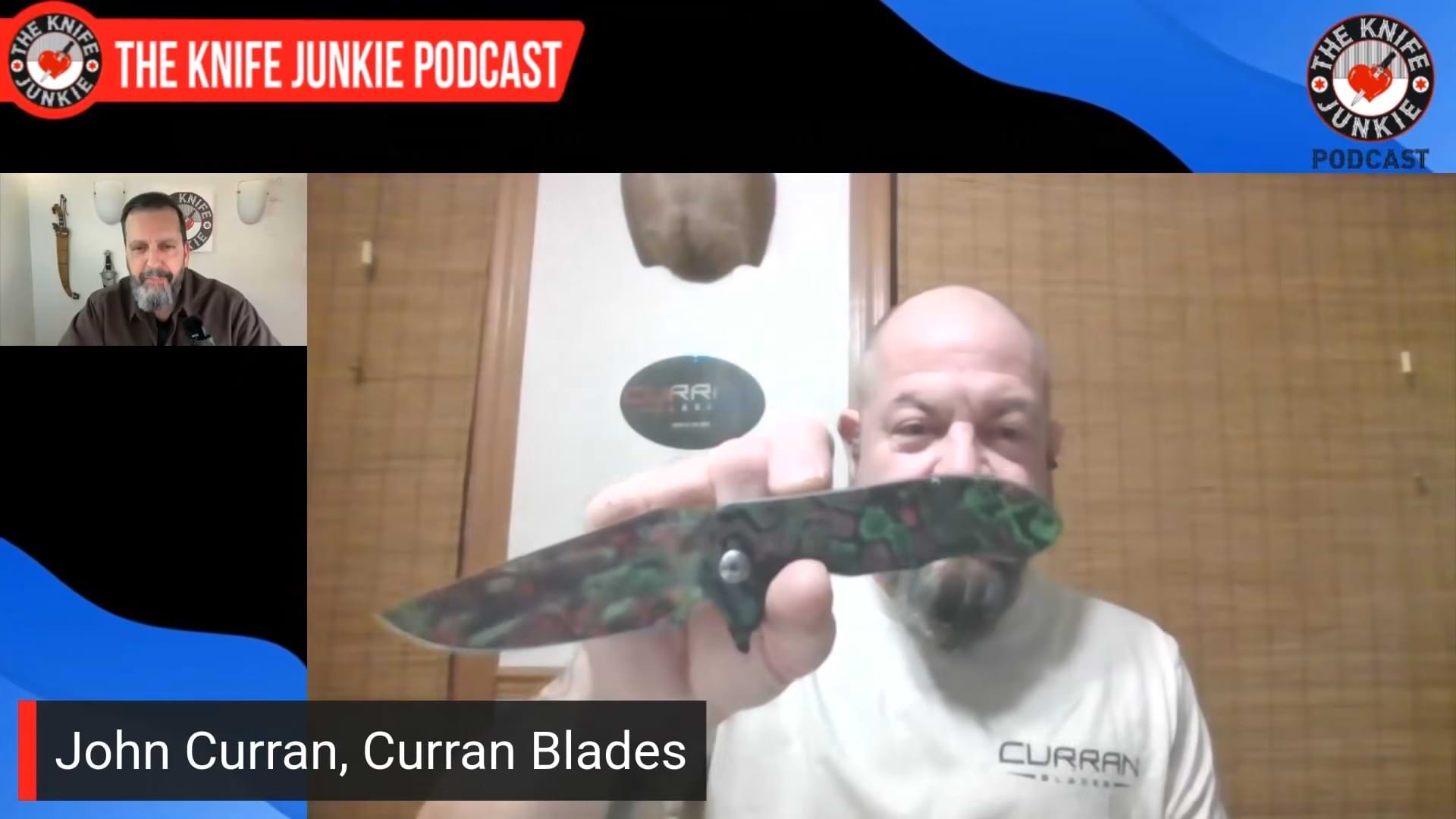
John Curran, Curran Blades: The Knife Junkie Podcast (Episode 654)
John Curran of Curran Blades makes knives that grab your attention. Bold shapes. Strong finishes. Unusual material combinations. But look past the eye-catching design and you will find something more important: these knives work.
On this episode of The Knife Junkie Podcast, Bob DeMarco sits down with the Vero Beach, Florida, knife maker to talk about his path from building his first crude fixed blade to creating custom tactical folders that collectors track down and buy.
From Hunting Problem to Full-Time Business
Curran did not start out planning to become a knife maker. He started because he needed a specific skinning knife and could not find one in stores. So he decided to build it himself.
That first knife taught him the basics. He made his own Micarta. He heat-treated the blade with a torch and motor oil. The process was rough, but it worked. More than that, it showed him something he loved doing.
Twenty years later, Curran still has that first knife hanging in his shop. It reminds him how far he has come.
 The Folder Bug
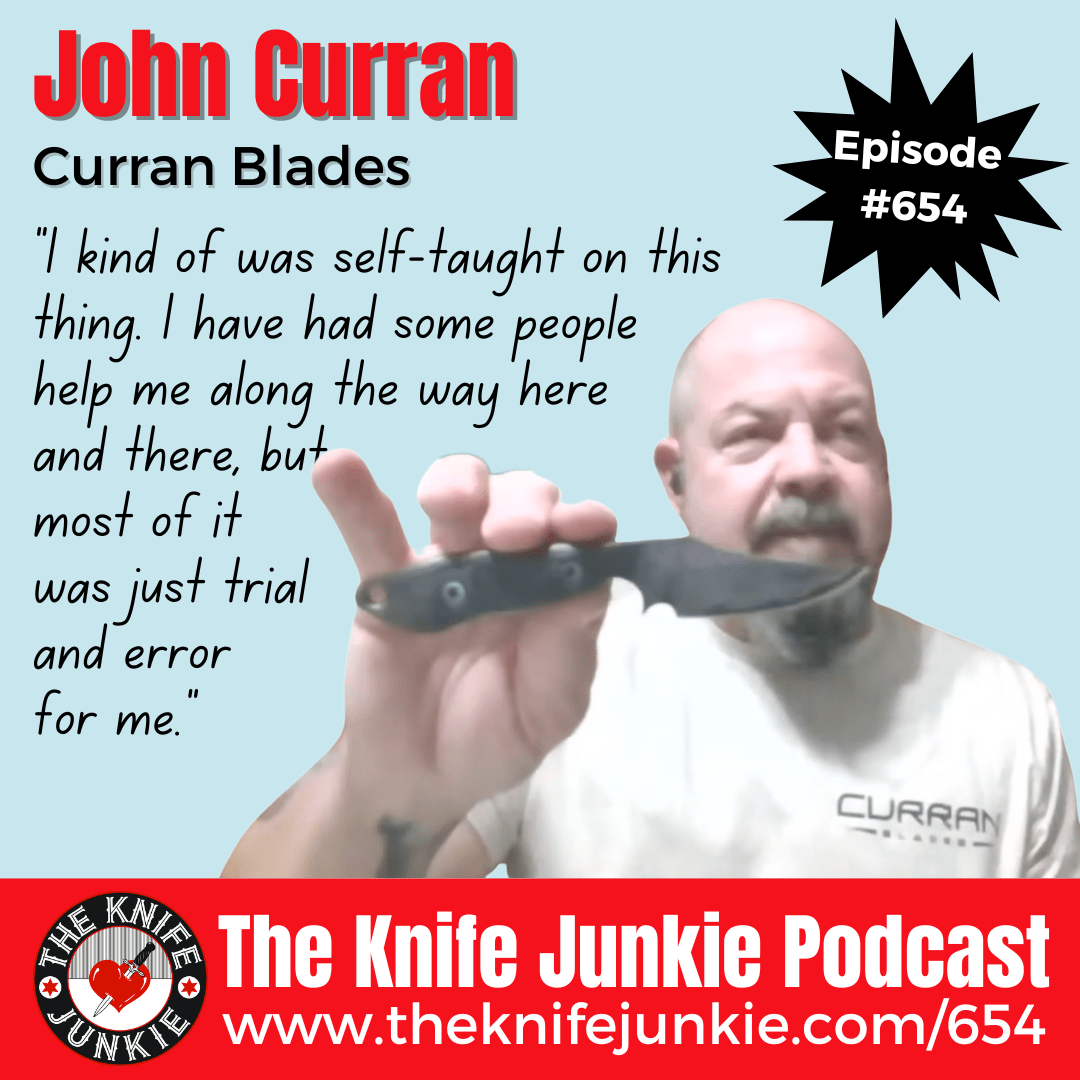
For most of his knife-making career, Curran focused on fixed blades. Then about three years ago, he caught what he calls “the bug” for building folders. The obsession took hold fast.
Building folders involves tighter tolerances. Everything has to align perfectly, or the knife will not work properly. One mistake in blade geometry or pivot placement can ruin the whole project.
Curran primarily uses CPM-154 steel for his folders. The steel holds an edge, takes heat treatment well, and machines cleanly. But he also builds with high-carbon steels such as 1095 and O1 when customers want a traditional look and performance.
What Makes a Curran Blade Different
Every knife Curran makes is one of a kind. He does not build the same design twice. Each piece gets its own combination of materials, finishes, and details.
But the bold looks are not just for show. Curran keeps his knives rooted in real-world function. These are tools meant to be used, not just admired.
The attention to detail shows in the finished product. Curran describes himself as a bit anal about getting everything right. If a knife does not meet his standards, he sets it aside and starts over. That level of care is exactly what you want from a custom folder maker.
Building the Business
Before making knives full-time, Curran worked as a superintendent at a high-end private golf course. The job consumed his life. Now he builds knives full-time, and while it still takes up all his time, it feels different. This work belongs to him.
Curran has no interest in becoming a large production company. He wants to make a comfortable living building knives and getting them into the hands of people who will use and appreciate them. Repeat customers tell him he is on the right track.
He stays connected with the knife community through Instagram and Facebook, where he shares new builds and talks directly with buyers.
The Dream Project
Ask Curran about his dream knife, and he will tell you: a big, beautiful Damascus Bowie. Mosaic Damascus steel. Premium handle material. A gorgeous guard. The whole package.
The project waits for the right time. Right now, Curran focuses on building his folder business and keeping customers happy. But that Bowie sits in the back of his mind, waiting for its moment.
Where to Find Curran Blades
Check out John Curran and his work at CurranBlades.com. Follow along on Instagram @curran_blades and Facebook to see new builds as they come together.
Every Curran knife is one of a kind. When you buy one, you get something no one else owns. And you get a knife built by someone who understands that the search for perfection, even when you never quite reach it, makes all the difference in the final product.

Be sure to support The Knife Junkie and get in on the perks of being a Patron, including early access to the podcast and exclusive bonus content. You can also support the Knife Junkie channel with your next knife purchase. Find our affiliate links at theknifejunkie.com/knives.
From golf course superintendent to custom folder maker in Vero Beach, FL—John Curran of @curran_blades talks obsession, perfection, and building bold tactical folders on The Knife Junkie Podcast. Every knife is one of a kind. Share on XThe Knife Junkie Podcast is the place for knife newbies and knife junkies to learn about knives and knife collecting. Twice per week Bob DeMarco talks knives. Email Bob at theknifejunkie@gmail.com; visit https://theknifejunkie.com.
©2025, Bob DeMarco
The Knife Junkie Podcast
https://theknifejunkie.com
Transcribe Your Podcasts and Videos: https://theknifejunkie.com/magic (affiliate link)
This is a full transcript of The Knife Junkie Podcast, Episode 654, with guest John Curran of Curran Knives.
Bob DeMarco: Welcome to the Knife Junkie Podcast, your weekly dose of knife news and information about knives and knife collecting. I'm your host, Bob DeMarco. On this edition of the show, I'm speaking with John Curran of Curran Blades. John is a knife maker out of storied Vero Beach, Florida, who makes fine, robust tactical folders and fixed blades that each are one of a kind. John is not afraid to get bold with silhouettes, finishes, and material combinations, but I have to say that all the Curran Blades that I've seen have been as practical as they are easy on the eye. We'll meet John and talk all about Curran Blades, but first, be sure to like, comment, subscribe, hit the notification bell, and download the show to your favorite podcast app. That way you can listen on the go. Also, if you want to help support the show, you can join the other gentlemen junkies right on thenifejunkie.com/patreon. You can scan the QR code on your screen, save 12% for a whole year, or just go to thenifejunkie.com/patreon and see what we have to offer you.
Announcer: Why pay full price for gas and food? With the Upside app, you don't have to. Just open Upside, find your nearby offers, and earn cash back when you buy gas or eat out. Pay like normal and get real money back in the app. No coupons, no hassle, just easy savings on things you already buy. Download Upside today and start putting money back in your pocket. Learn more at thenifejunkie.com/saveongas.
Bob DeMarco: John, welcome to the Knife Junkie Podcast, sir.
John Curran: Thank you, Bob. I appreciate you having me on.
Bob DeMarco: Oh, it's great to have you. You know, I was taken in by your knives, and then when I went to your website to check out your stuff and see who you are, I see that you used to be a superintendent of a golf course, and that made me nostalgic because my very first job, and also my brother's very first job, was at the country club through the woods from our house, and we were both men's locker room attendants, which was like the lowest job you could possibly have at the country club. But it's led to a lifelong life of stories. What was that like?
John Curran: It was fun, it was enjoyable, but let's just say I'm glad I'm not doing it anymore. It occupied a lot of my time, a lot of my space, a lot of everything. I kind of lived the job 24/7. Not that I don't with what I'm doing now, but it was more than that, and it was a very high-end private country club, so the demands were pretty steep.
Bob DeMarco: So our superintendent was Fred Vrabel. I remember that. So Fred, if you're out there listening to the Knife Junkie Podcast, thank you. So John, how did this lead to knife making?
John Curran: Well, really, I got into knife making—I love to hunt and I was looking for a particular skinning knife and I couldn't find it, so I just had said to myself, let me see if I can figure out how to make one. And a few years later, I kind of became hooked and that's just seemed to occupy my time. That was my number one hobby, I enjoyed doing it, and it just kind of took off from there.
Bob DeMarco: Well, what was the knife you were looking for? Was it a particular knife or was it certain qualities that you couldn't find in knives?
John Curran: It was more of a particular size, I think. You know, at this point it's hard for me to remember, I just remember that's how I got started. The first knife I've got hanging on my wall in my shop and it kind of, you know, I look back on it now and it shows me where I've come in this career and how much better I've got. Not to say there's anything wrong with the first one, but it's a lot better now.
Bob DeMarco: So you've been making knives for about 20 years, right? Like 2006 or so, is that when you started?
John Curran: That's pretty close, yes.
Bob DeMarco: All right, so when you look back at that old knife hanging on the wall—and of course we're going to take a look at your knives here coming up—but if you were to take a look at that knife on the wall and think about where you came in 20 years, what would you say are the major milestones between that knife and the very last knife you made?
John Curran: Well, probably attention to detail. I think the first one was kind of just a "let's just throw something together," you know, heat it with a torch and shove it in some motor oil and have a hard blade and go from there. And that was actually on that knife I made my own Micarta, so there was kind of a couple of different things going on there. It was fun, but it just really wasn't what I intended to do when I made it and it kind of sits on the wall to remind me that, hey, you've come a long ways.
Bob DeMarco: So let's fast forward to now and just talk about the kind of work you're making, and then I want to find out how you actually learned to do this. What I've been seeing of most in your feed lately are these incredible folders.
John Curran: Yeah, I kind of got the bug to build folders about three years ago and it's kind of become an obsession now. You know, I learn from every folder I make. There's still pieces and parts going into the scrap bins every day. I don't really have it completely dialed in the way I'd like to have it dialed in, but as I said, you know, I learn from what I'm doing and I kind of was self-taught on this thing. I've had some people help me along the way here and there, but most of it was just trial and error for me.
Bob DeMarco: You said obsession. What about making folders would make you obsessive, in your view?
John Curran: Well, I think the search for perfection. I think would be the best way to say it and, you know, to me that's never going to be attained, but I strive for it. People say I'm a little anal about everything, but to me it's like if I want everything to look right, it's got to be put together right, and when it's not, I kind of sometimes will put that one aside and start another one and just go from there.
Bob DeMarco: Yeah, I mean, that's exactly—you want your custom knife maker, especially if it's a folder maker, you want your custom knife maker to be anal-retentive. Yes, you do. Maybe not in all aspects of life, but in the making of your knife, you definitely want that. You know, it occurred to me that making a fixed-blade knife is kind of like sculpture and making a folder is more like engineering a machine in a way. I know they both kind of involve both, and I'm not a knife maker so I can't quite say, but it seems like the things you're striving for in a folder are a lot different.
John Curran: Yes, 100%. I'm not going to say it's easy to make a fixed blade, but it's definitely simpler. There's not as much, you know, the mechanism of the thing moving, the lock, how smooth it opens—there's just a lot more to it versus putting some parts together and putting a folder together. I don't want to take away from making fixed blades because I still love making them. It's just I've kind of gotten in here lately to really getting into folding knives and kind of gotten away just a little bit from fixed blades.
Bob DeMarco: Well, let's take a look. Show us something you've worked on recently that—you showed me the green one before. That's cool.
John Curran: Yes, this is one I had done about a month ago. I fell in love with camo carbon, which was kind of hard to get there for a little while, so when I got some of the watermelon sugar, I decided I wanted to kind of make the blade match it. And well, there you go. I'm not going to say it's a perfect match, but you know, it's not too far off.
Bob DeMarco: Wait, wait, hold that back up, put that back up. How in the world—how did you get that—how'd you get the blade to look like that? And I think the match is pretty damn close. What did you do? Is that Cerakote? What is that?
John Curran: That's Cerakote, yes. I kind of—just like I am in my knife making, I'm self-taught on Cerakote. And this was just something I kind of had sprayed it, didn't like it, wiped it off and kind of started mix-matching and sponging in some different colors, and lo and behold, this is what happened, to kind of put it simply.
Bob DeMarco: That is cool. I didn't know that Cerakote worked like that. I had no idea how it worked, but I didn't realize you could get painterly with it. I mean, that looks like a little oil painting.
John Curran: Yeah, well, to be honest with you Bob, I didn't either. So this was kind of a trial and error and, you know, my first thought was well, you're going to feel the texture on it, but you really don't. So it worked.
Bob DeMarco: So with Cerakote, when you're done applying it to the blade, you bake it on there? Is that right?
John Curran: Correct, yes.
Bob DeMarco: Okay. And then once it's on there, it's hard and that's it.
John Curran: That's it, yep. I mean, it, you know, it's like any other finish, it will wear eventually, but you know, it holds up very well. It's a very good finish.
Bob DeMarco: So the model you were just holding up, what is it? And walk us around it a little bit.
John Curran: Sure, this is a little over a three-inch blade. I really don't have a name for this model, I just kind of came up with this blade style and put this knife together and really, it's the only one I've done like this. You know, it's a regular frame lock. The clip was all done and designed by me. Elmax blade. Really don't know what much else to say about it, it just, you know, was one of those things I kind of came up with in my head and next thing you know, there it was.
Bob DeMarco: So is that how you work generally? Do you work from patterns or do you just kind of approach it like you're approaching a sculpture, like a block of marble or something?
John Curran: No, I've kind of gotten to more of doing more designing now from the computer versus freehand drawing. And the latest design I've come up here was something I actually drew up on the computer and I'm hoping to kind of not make this a production model, but you know, maybe have four or five different versions of it and some different color schemes. And I just really enjoy this blade style, I, you know, it's a nice thick tip on it and you've got a good cutting edge. And it just works for what I like. We'll see what the public says about it.
Bob DeMarco: Okay, hold that one close to the camera so we can take a look. All right, that's beautiful. So it's got a hexagonal, elongated hexagonal opening hole, and a sort of recurve American Tanto. That blade is so cool. And that handle looks super ergonomic. And the handle-to-blade ratio also looks great. That's something that—that looks really good. So, is this a model of yours that you do on a regular basis? Is this something you're going to turn into a production, is that what you were saying?
John Curran: I'd like to turn this into somewhat of a production. I don't really ever see myself doing a big production line, but I'm kind of hoping to be where we'll, you know, maybe we get five or ten of a certain, let's take for instance back to the camo carbon watermelon sugar, we do five or ten of those as a drop, and then maybe some of the 80s camo carbon. And even this carbon fiber is just, it's a unique carbon fiber and just something I wouldn't mind doing, you know, four or five more of these as well.
Bob DeMarco: Yeah, okay. So these, to me, to the non-knife maker, it seems like that kind of a knife is really difficult to make. Take us through the steps from when you first started and you had that, you know, knife that you put in motor oil and you have on the wall right now, and take us through your evolution process-wise.
John Curran: Well, whoo, I get to go back and think about this. It was like I said, I think every knife maker starts out doing fixed blades just because it's a little bit easier to figure out. You know, one of the big things for me on making a knife was that I wanted it to be the process all done by me. So I think one of the first purchases I had done was a heat treat oven. And I wanted to be able to do my own heat treat, you know, know where it came out to. At that point, I did not have a hardness tester, so I was playing around with it. I have a friend of mine locally who had one, whenever tested some blades, found out I was going in the right direction. And then from there on out, it was now I could get into some of the stainless steels and it just kind of—everything just kind of went from there.
The fixed blades were mostly for me. I did a lot of culinary stuff for people in the beginning. I still do it now. Christmas time people really seem to want, you know, it's a good sale for people, chef's knives, sets of steak knives. And I don't want to say I want to get away from that, but I don't enjoy that as much as I enjoy the tactical endeavor of it.
Bob DeMarco: That's funny. I got my sister a custom kitchen knife for Christmas that she had to give to a friend. But yeah, it's a great gift, but I could see how that is like a sort of annual thing you gotta do is like, "yeah, gotta do kitchen knives before I can make the cool tactical folders." You mentioned heat treat oven was one of the first things you got when you knew that you were going to be serious about knife making. To me, and I'm sure to other pedestrians, it seems like magic, the whole heat treat thing. You know, we know that the heat treat is the soul of the blade and all of that, but how do you learn? How did you learn?
John Curran: By putting a bunch of different blades in a scrap pile. It was trial and error. Obviously there's a lot of good information on the internet. You can kind of look up what you want anywhere now and find out from any of the big steel suppliers the proper heat treat for a lot of these knives. But, you know, my oven is not the same as everybody else's oven, so it just took me playing around. I shouldn't say I threw away a lot of blades, but I used a lot of coupons. If I go to a new steel, I'm going to cut some up, I'm going to do some different testing with it until I finally get it to where I want and then kind of go from there.
Bob DeMarco: So what are those—what are the things you want out of the steel?
John Curran: Depending on the knife, but obviously edge retention is big. You know, some of these newer stainless steels, they're just insane the edge they hold, the toughness, everything. But, you know, I have a lot of people that I've done folders for who absolutely do not want stainless steel. So, you know, and a lot of these guys are hunters, they're out in the woods and they want to be able to sharpen the knife whenever they can. You know, some of these new steels like MagnaCut, they're a bear to sharpen if you don't have the right setup for it.
Bob DeMarco: Yeah, I love high carbon steel. I have a collection of all sorts of knives and I love high carbon steel and I do wish that it appeared more on the like super robust frame-lock folders and the kind of knives I like to collect, but you never see it, you never see it there. I also don't need like the super fancy steels. I'm sorry, what were you going to say?
John Curran: Oh no, I was going to say, I mean, you just hit the nail on the head because most people like me are making stainless unless somebody specifically asks for carbon steel. You know, one of the things I found a long time ago was knife aficionados understand, you know, a carbon steel is going to patina and they're fine with it. But to the general public, if you sell a knife to them, you get that phone call, "Hey, my blade's got some black spots on it" and blah, blah, blah. And it's kind of like at one point it was like, well you know what, I'm just going to start selling everybody stainless steel and then you kind of revert back to "this guy wants carbon," so you're kind of all over the place.
Bob DeMarco: You know, to me, that is the—to me, a light user, let me as a collector, the reason I like carbon steel is for that purpose. I like the patina, I like the history that you can build on it, especially quickly if you're a guy who's got a million knives and you don't use them all all the time.
John Curran: I agree 100%. I mean, to me that, you know, it makes your knife unique. And I try to tell people that when they buy it, but you still gonna get that phone call where, "Hey, my knife turned black" or you know, the worst one is "I put it in the dishwasher and, you know, this happened" and it's like—that was one of the first things I told my wife when I started making knives, because our kitchen's full of knives now, ones that just weren't good enough for me to do anything else with, but "just please don't put them in the dishwasher."
Bob DeMarco: Oh my gosh, yeah, never. My daughters, I've had to train them how to take care of our knives because they're now dishwashing, and so yeah, they have to take care of those, take care of those knives. So, you got the heat treat oven, you learned the heat treat, and I want to get to geometry, lockup and how you figured out all that, but that's down the road. What then? I mean, as you're building out your capabilities, you're building out your skills, you're also probably building out your shop. How did that evolve?
John Curran: Well, my first grinder was one of those contraptions you put together yourself. It ran full speed and if you weren't careful, there'd be nothing left of a blade in a matter of a few seconds. So it was kind of like I put my money in the beginning that way and into a heat treat oven and once I got it to where I was like, this is going to be a little bit more than a hobby for me, I'm going to do it more than I originally thought, I upgraded grinders. And since then, you know, I've added another grinder, I've got a—actually just invested in a fiber CNC laser for cutting out my own blanks on stuff.
Bob DeMarco: Nice.
John Curran: Well, it will—go back before that. One of the other things I always wanted to learn was Damascus. So I built my own forge, tried doing it by hand, it just got super frustrated, saved up my money and bought a press, and just kind of went from there. And, you know, it all kind of goes back to where I wanted to be in control of what I sold somebody. You know, nothing wrong with Damascus you buy, but I didn't know what it was.
Bob DeMarco: So do you put your own Damascus in folders?
John Curran: I have, yes.
Bob DeMarco: That's so cool. I feel like you don't see it that much. I mean, you see Damasteel in some production folders, like Civivi's and We's and stuff like that, but I mean like real Damascus in a folder unless—I don't know, I feel like I don't see it that much.
John Curran: No, I don't either. I love the idea of that, as I do just a carbon steel in a folder, in a modern frame-lock folder. Okay, so tell me about how you went from fixed-blade knives to making these lockers now, these locking knives.
John Curran: You know, I try to look back and it's hard for me to remember what it was. I mean, I've always carried a pocket knife ever since, you know, my dad gave me one when I was four or five years old. I think we all got the first, you know, Swiss Army knife that had the tweezers and the toothpick and all that stuff. And I think what it was for me finally was I'm to the point now where I feel pretty confident in what I'm doing, let me try to figure this out and be able to carry my own pocket knife. And the first few, I mean, they just didn't work. The lockup didn't work, they wouldn't stay open, they wouldn't flip open, and it was just trial and error, trial and error, and, you know, asking friends of mine who made them, you know, some tips and tricks and, you know, like I said, even to this point today, there's a few that I'll put together and they just don't feel right to me and they're not in a point to where I would feel confident selling to anybody. So they either going to go in my pocket or they're just going to sit here until maybe I have time later on take it apart or redo, you know, either the blade lockup on the blade wasn't correct or I had messed up the, you know, the lock bar or something and couldn't maybe put them together and cobble something out of them. But if not, it's just a lesson learned.
Bob DeMarco: So who were the influences for you in terms of design and sort of process?
John Curran: Well, the one person who local to me that I was really able to bounce stuff off was TJ Marfione from Heretic Knives. I've known him for a while and he's been most helpful for me to come by the shop and, "Hey, try this, do this, angle this a little bit this way, do this and do that," and, you know, it really kind of got me when I was stumped on a few things back onto where I wasn't feeling like I didn't know what I was doing and I would keep going. And, you know, I could give a big shout-out to Tony, he's a great guy, he's really helped me out and, you know, I don't know that my folders would be anywhere close to what they are today without his help.
Bob DeMarco: So is that like—I used to hear a lot about how difficult it is to get the lockup, you know, to be just right so that it presents a lot of lock face against the tang enough for it not to fold, but you want it to have life, so people used to talk about percentages, "Oh, this is at 40%, this and that," which to me is like, man, that's very refined engineering and filing and stuff. Is that the kind of stuff you benefit from in speaking to old hats like that?
John Curran: Oh yeah, for sure. I think on my first folder I didn't realize that you're supposed to have angles on it, and I had everything kind of flat touching flat. And I said to Tony one day, "What am I doing wrong?" He's like, "Well you gotta have an angle on this," you know, and it was just a little things that I don't—I probably could have looked it up on the internet, I just dove into it headfirst and as I got going, I'm like, well, I'm missing something here and something's not working there, and that's when I kind of sought out some help.
Bob DeMarco: Okay, so how long have you been making the folders and are they now your main sort of area of focus?
John Curran: It's been about probably a little under three years, I think. And yeah, I'm just to the point now where I want to, like I said, perfection's never going to happen, I mean it, you know, but I want to get as close as I can with them. And the only way to do that is to continue to make them. And, you know, it's like you make one and you think it looks good and like, well, maybe I can tweak this little bit, maybe I can change the blade a little bit, a little bit more in the handle here or something like that. And hence the reason I don't really have one model that I just keep making, I just kind of keep going from there.
Bob DeMarco: Something that your designs, especially your folders, that pop out to me is the sharpening choils. They're like really nice and high and they look like they're—looks like you get a lot of edge life out of the blade just from those super high choils and where they are in relation to the plunge grind. What's the evolution of your blade geometry been like?
John Curran: Well, that was—it's funny that you notice that because that was one of the things for me when I first started making knives like this is it was, you know, let's go back to the old Buck knives that we used to carry when I was a kid and you'd have them in your little leather sheath on the side of your belt and, you know, after about a year or two of sharpening, and obviously back then I really didn't know what I was doing, you'd start to wear that edge up and it'd start looking really funny. So it was like I wanted that little choil in there just so you could get that thing on the stone, get it on the grinder and not have to worry about making a big dip in there and—I mean I'm looking at the knives I have sitting here now and I think I've got that on pretty much all my knives. And it's just I don't know that I'll ever get away from it at this point because it just makes sharpening easy to me.
Bob DeMarco: Yeah, I also personally think it just looks cool. I've always been a sucker for that. I love the way it looks on the folders. But also, I love your Javelin model. That's a fixed-blade knife. Now this one seems to be like a model that you do over and over, is that right?
John Curran: That's correct. This one started—I had a customer ask me for a dagger-style fighting knife and he was a retired air marshal and he knew knives, so we kind of had gone back and forth. Normally when I first come up with a knife, before I had the CNC fiber laser, I would cut something out of wood just so I'm not wasting a piece of metal and all the time and effort into that. And what I had done was made a couple of these. He and I went back and forth and kind of figured out to what he liked and what I liked to make, and this is kind of what we ended up with, and it's just one of those knives that you don't see a lot of double-edge fighting knives. And it was a big hit with him, it's become a big hit here locally and it's something that I'd like to try to get going more.
Bob DeMarco: I love that knife. And I am a huge fan of double-edge fighting knives. I love daggers too—don't put it away, please. I love daggers too, but an asymmetrical double-edged fighter is my favorite kind of knife and this one really caught my eye. Walk us around it a little bit. I see two areas for the thumb too, like two swells for the thumb, I see a long double edge, take us through it.
John Curran: Yeah, this was another buddy of mine, he's like, "You know, obviously with a double edge we want to make sure our thumb's not sliding up on the top blade." The top edge. And so we've got the jimping here for that, and then he was like, "You know, it'd be nice if we could actually get up in here a little bit if we wanted to get in tight and do a little bit of work," and that kind of became that. Obviously we've got a lanyard hole. I kept this kind of pointy so with the knife in your hand if you had to come back on a backstroke you're still going to get somebody here. Reverse grip, same thing, you got room for your thumb right here.
It's just an all-around good knife and it, you know, to me the big thing was and I know this is becoming popular now is the G10 to have it to where there's actually grip to it. I've seen instances where your hand gets sweaty or, you know, God forbid you get blood on it, your hand slides up on the knife, I wanted it to be able to be gripped. And then that's kind of where we went with that.
Bob DeMarco: So did this start off as a custom, and tell us about your approach to custom knives.
John Curran: Well, it unless somebody gives me specifics, like on this knife it was kind of like they wanted a fighting knife and you look at what's out there and make something and then it was like, well maybe let's put a double edge on it and like I said, I kind of had drawn it up, but you know, I mean there's sometimes you put something on paper or you draw on the computer, looks good but when you put it in your hand it just doesn't work. So I started taking every design I do now before I even put anything on steel, it's going to be cut out of a piece of wood or a piece of cardboard and actually put it in your hand to make sure it works. To me that was very important because if not, I mean if the knife doesn't feel good in your hand, you're not going to use it.
Bob DeMarco: So in terms of your approach to customs, I mean like this gentleman came to you and said, "I want this kind of knife" and you designed it for him and he came back to you with tweaks, or do people send you drawings, how do you navigate that? Because I know some don't like to take those kind of orders.
John Curran: Yeah, this was—I don't think this was—he didn't really send me a drawing, it was kind of in his head, "This is I'm looking for this style of knife" and I kind of just went to town with that one and, you know, I'd say, "Hey, what do you think of this?" and he'd be like, "Well let's try this" and then, you know, about three designs later, we got to where we're at here with this one. And it became a very popular style and people love it.
Bob DeMarco: That's kind of a fun process. I've done that a couple of times, just collaborating that way on a design and just to see someone else's style come through. So, I like that a lot. Now if someone were to come to you and just with a more specific design that they want, not a notion that you both work through, would you make a knife like that or would it have to make sense for your design style?
John Curran: You know, it really would have to fit into—I'd have to look at it and you kind of see does this fit what I do? Does this fit the style of knife that I like to make? And, you know, I would have no problem doing that as long as it fit those parameters. The one thing I tell people is, you know, I think every design on a blade has been made many, many times over. I will not copy somebody else's knife, but you know, if you show me something that you like, it kind of gives me an idea of the part of the knife that you like, and then I put my own spin on it. And that's kind of how I've handled all the one-off customs I've done for other people up to this point is, you know, you show me what you like and let me take it from there and, you know, I'll send you a drawing of it and if you like it we make it, if you don't we tweak it and we go from there.
Bob DeMarco: So how did you know when you were a knife maker? Like just having knowing how to negotiate that kind of design collaboration means you know what you're talking about. When was it, what was it like when you knew this is what I'm going to do now?
John Curran: That's a tough one. I think for me to be able to actually sell a knife to somebody, it probably was a year or so after somebody looked at my knives and said, "I really like those, I think you could sell these" and you know, to me no, it wasn't good enough and then finally it was just after you heard that enough, I'm like, "Okay, let's give it a shot" and, you know, I'm not going to say it's been easy, but it is what it is and I enjoy doing this every day. It's not—what's that old saying? "If you do what you love, there's never a day of work." Well, that's how I feel. This is just, you know, coming from being a golf course superintendent for 25 years to doing this is just it's great. I enjoy it, hopefully it continues to be enjoyable. I know it takes a little bit of a pounding on the body standing out there all day long doing this, but you know, it is what it is and we take the good with the bad and just go from there.
Bob DeMarco: It's also a pretty solitary act. What's it like going from being a working man out in the world for 25 years to going to a life of kind of solitude and quiet work?
John Curran: I absolutely love it. Not going to lie. You know, I'll put on audiobooks and podcasts and, you know, my wife will probably tell you I talk too much when she gets home because she doesn't want to talk, she's been around other people all day long. But, you know, I'll be honest with you, I just it's enjoyable and there's never a day that I'm bored. I mean, let's just put it that way. I listen to books just nonstop, podcast nonstop and, you know, it's kind of like when you get your mind involved in something like that, the day just goes by like that. It it's, you know, I do find sometimes I've got to put it away and listen to some music because you'll get so focused on a book or a podcast and I'm kind of forgetting what I'm supposed to be doing, but yeah.
Bob DeMarco: Yeah, I think I would imagine 99% of the people listening to this, and probably 100% of the men listening to this, yearn for that. Like, "I just want quiet time in my shop building stuff" or whatever it is. But yeah, I aspire to that too, for sure. So, do you find that when you get into that knife-making flow, that's when the designs or the design ideas start popping up, does the material talk back to you, that kind of thing?
John Curran: Sometimes, but I find if I kind of do that, I get too sidetracked in what I'm doing. So it's kind of like I've got to be—I've got to have an A, a B, a C and a D for me when I start in the morning and it's like, I've got to get this done, I've got to get that done, or I may just be wandering around, you know, getting nothing accomplished because all the stuff's going around in my head. So it's, you know, it's a mix of all that. Normally I try to have a plan when I walk out into the shop in the morning so I'm not just wandering aimlessly and looking around.
Bob DeMarco: And do you operate in the way that we've heard people have books? Like you have a long list of people who have signed up and you know what model you're making for them, or what's your production model?
John Curran: I don't have a long list right now. I have knives that I'm working on for people, but my goal this year is to kind of really take this this business that I'm working on here to the next level and and I think in doing that I've got to come out with a couple of core models that hopefully people really like and and want to have. And that's what I really want to focus on and I don't want to say a production side, but more of a semi-production side and have the customs kind of on the other side of it, you know what I mean? It's like here's the bread and butter and then for somebody like you, if you were to call me and be like, "that's that's perfect, here's one I can do for you." I don't know if that makes sense, but in my head it makes sense.
Bob DeMarco: No, no, makes a lot of sense and I've talked to a lot of knife makers who who have come to that point where they have a thriving custom side, but you know, the custom stuff does take time and 1,000% of your attention while you're working it, whereas if you also have a production end kind of humming along in the background and producing knives that are less labored over in terms of their customization, you can kind of have the best of both worlds and have a model that brings in more money for less effort while you work on the fancy stuff.
John Curran: Yes, 100%. That's exactly what I'd like to do. And you know, hopefully we get it there this year. First year I've gone, we're going to go to Blade Show Texas. I've been trying to get in there for a few years and we got in this year and I'm really looking forward to that. People have told me that's a great venue. We have gone to Atlanta in the last few years, but everybody says Texas is a little bit more—what's the word? It's a little smaller, so you're not feeling like that minnow in the ocean there. And you know, I'm really anxious and excited to see how that goes and looking forward to it a lot.
Bob DeMarco: So you you've done Atlanta, I also noticed and Jim had some of the dates up, you do a lot of other shows around in Florida and Texas. What what do you get from the shows?
John Curran: Well, you know, to me, I don't know if I'm going about this backwards, but the shows around here locally get you out in front of people. You know, when I first went to the Vero Beach Gun Show, I think that was maybe a year and a half ago, people are like, "Oh wow, we have a, you know, there's you're in Vero Beach? We didn't know." So it kind of something clicked in my head there I'm like, "You know, maybe I need to be tapping into the local market here a little bit." And that's kind of where that's all come from. I just came from a Florida really only has one knife-only show and that was this past weekend. And, you know, every other show that we have in the state here is a knife and gun show. So it's kind of like you're getting out in front of people who, you know, maybe are shopping for a gun but then they walk by your table and, you know, sometimes it works, sometimes it doesn't because you've got the other guy down the road selling the, you know, the $25 Amazon knives and, you know, the people like, "Well why are we going to spend this much on your knife when I can walk down here and buy that one?" My usual reply to them is because you'll be back here next month wanting a real knife or buying another one of those.
Bob DeMarco: Exactly, exactly. So these shows, I feel like they are valuable in terms of teaching knife—not teaching knife makers, making knife makers engage with the public, especially if part of what's so great about making a knife is the solitude and working and getting in that flow state. Well you also have to have the marketing side, you know, so going to those shows and being very literally talking with your customer is, I bet it's really good training because I've had to do similar stuff in different industries in the same way, and just meeting people and talking to them, it strengthens your game and people will remember that.
John Curran: It does. And it gives you an idea of actually what people are looking for, you know, if you're doing things right, if, you know, everybody's got opinions and you kind of have to learn, especially in the golf business a long time ago, that you're not going to make everybody happy. And, you know, it just you can't let that get you down, you can't let it, you know, make you think that you're not doing something right. You might take five percent of what people tell you and kind of listen to it, but the other part is hey, it's just people like what they like, and if we can make something work between us or if they can pick up one of mine knives and say, "Hey, I like this, but maybe I want this color or you can change this this a little bit," maybe we can do that. It's to me it's every time I go to a show you kind of learn something new.
Bob DeMarco: And it couldn't be a cooler like industry—well, I can't speak to the industry, but it couldn't be a cooler enthusiast group. I've met so many great people, both knife makers and knife collectors. It just compared to pretty much any other industry it just seems like it's sort of really cool, you know what I'm saying?
John Curran: You know, it is. And you know, I tell people all the time after all the years I spent in the golf business which kind of like dog-eat-dog world. I mean, it's like if you want to be the best golf course, there's a few secrets that you're not telling the other guy down the road when they have issues so you can look better. And I don't see that in this business. You know, like I said, TJ at Heretic, I mean, everybody that I have talked to knife maker-wise is all willing to help each other out. And you just to me you don't see that in other professions, you don't see that in other industries, is it good or bad I don't know, but I thoroughly enjoy it and I'm glad it's that way.
Bob DeMarco: So you mentioned TJ Marfione. What about other influences in the knife world in terms of more in terms of design? Whose knives do you love and would you collect, or do you collect?
John Curran: You know, the funny thing is I don't really collect knives. It's, you know, people want to, "Hey, do you other knife makers, do you want to make a trade?" and I'm like, "Yeah, if you'd like to," but I'm, you know, I think they feel bad when I'm like I'm not really enthusiastic about it, but it's like I have what I like and I'm just not one of those who collects things and puts them in a safe and doesn't use them.
You know, one of the things for me, kind of getting off topic on that, but people will pick up a knife and like, "Well that's too we don't want to use it, it's too pretty to use," and, you know, maybe some people would feel like that's a great thing, to me, I want people to use what I make. So it's kind of like I look at some of the knives here and like what else could I do, you know, to make this to where you would use it. To me, that's the ultimate compliment when you—that knife is in your pocket. If I run into you on the street and you pull out my knife, it doesn't get any better than that for me.
Design-wise, you know, I don't really really have one or two makers in particular that I really follow or like. It's just kind of a conglomeration of everything, really. You know, what works, to me the biggest thing is how does it fit in your hand. If it's not comfortable you're not going to want to use it, that's A number one for me. You know, I could get fancier on some of these and perhaps I will at some point, but like I said, I'm trying to look for that one model to where I can actually make some more off of that and not just have one or two offs on all my different knives.
Bob DeMarco: All right, show us some more of the knives and I know you have more in front of you. Let's take a look at them.
John Curran: Actually I've only got one other one that you haven't seen. But this is kind of a new design I was playing with, another fixed blade. My own Damascus kind of San Mai, Dam Mai, whatever you want to call it, pattern.
Bob DeMarco: I'm sorry, you said San Mai and then you said something else.
John Curran: I mean Dam Mai, I guess you want to call it Damascus with core.
Bob DeMarco: Oh, oh I see, right. Okay.
John Curran: Yeah. And this was just a little scrap I had left off of another knife I had made and, you know, to me I see—I think the goal on this for me was to make a—everybody's kind of getting into the fixed-blade pocket knives. Oh yeah, and you know, that was where I started with this, obviously didn't make it, it's a little bit too too fat in the grip for to be a comfortable carry in your pocket, but the size I like. And I have a feeling I'm going to do some more off of this, it won't be—they won't be Damascus, they'll be some sort of stainless or carbon steel, but it's just a nice little size. And there's the sheath that goes with it and to me, sheath, you know, I don't do any leather work, everything I do is Kydex. But the sheath to me is kind of what, you know, if the sheath doesn't work for you you're not going to carry the knife. So I became a big fan for Ulticlip last year at Atlanta, I met them there and I tell you, I think this clip they won accessory of the year in Atlanta, and I absolutely love it. If I can incorporate this on sheaths, I use it every time.
Bob DeMarco: It's my single favorite clip and I carry—I use that one—I carry it just like that horizontally front with a bunch of knives. But that little knife you just had out, despite the width of it, you know, the thickness of the handle, I think that profile is really, really great and you could—I think you could have success with that as a one of your production models. Same with the Javelin, I think like when you make a—this is my unsolicited opinion and advice, but based on nothing but I feel like when you go production, you said three models, I think two of them should be fixed blades because that might be more tempting—it could be easier to make, I guess I should say. And that little one you're holding in your hand would make a great pocket carry fixed blade, and you're right, that's where people's heads are right now, because a lot of people want to carry a knife on their belt, most people don't feel like they can, but it's nice to have a fixed blade on you, and that's a great little profile.
John Curran: Well, the other thing I kind of had wanted to do, you know, in my opinion, was to be able to carry this on a—you know, a lot of guys are carrying the cross-body, I guess I'll just say it, satchel. You know, if you're going to concealed carry or whatever, I mean I carry one, and you know, I'd like to have a knife to where—obviously in Florida we can kind of do what we like here, the free state of Florida—and have a knife where I'm carrying it right here on my strap. Or, you know, if you carry a backpack or something like that, to where it's accessible, you know you can easily remove it. So I think there's going to be a lot more different ways to be able to carry this knife versus just your belt. And obviously this is just kind of me speculating here, but I can see that happening.
Bob DeMarco: Oh, that—yeah, I like that little one, I love the Javelin too. Show us the Tanto folder again real quick.
John Curran: Sure.
Bob DeMarco: And this one looks like it's got a longer blade than the other folder, right? This looks more like a three and a half.
John Curran: Well, I think they're both pretty close. Put them side-by-side. Actually the drop point's just a hair longer. Yeah, it doesn't feel like it in your hand. But I've already had somebody approach me about this design. I did the prototype to a friend of mine and he's got it and one of the guys at a show saw it and he's the guy that I do all the fixed blades for who wants carbon steel, he's already said he'd like to have one of these, but he actually wants the blade longer, he wants more of a four-inch blade on that. I haven't got there to design it and do it for him yet, but that will be coming. He's just one of those guys he likes big knives. To me that's just too big for me to carry in the pocket, but hey, I'll take the business.
Bob DeMarco: Yeah, exactly. I like those—I like big knives too. I like three and a half to four inches on a folder is ideal to me. In my youth I used to go even larger, but no. I still collect the big Cold Steels, but that's about it. So, in terms of selling these, how do you—how do you do it? How do you market them and, you know, how do you get them out to the public?
John Curran: Well, that's the problem I'm running into. I've not been real good about social media, you know, and I think a lot of guys have actually built their businesses entirely off that. That's one of my goals this year. I know there's having issues now with, you know, people throttling people on Facebook, I've already got that letter that from them or email or message or whatever saying that, you know, you're breaking rules and blah, blah, blah. So, you know, that was kind of the thing with me wanting to get into Texas this year was to get in front of other people. Obviously Atlanta, if these two shows go well maybe we travel to Utah as well. I don't know, that's, you know, I've got the more and more I get to know more people, the more and more I'm getting ideas or people who are willing to help or, you know, somebody who's got a Instagram page with a lot of followers saying "Hey, we'll, you know, we'll help you out with this" and—it's a tough one. I mean, you know, that's why I was thrilled to death when you asked me to do the podcast with you, obviously this gets my name out there now and, you know, that's kind of my push this year is like we've got to figure out a way to market it, we've got the making down.
This is the first podcast I've done. I'm kind of old school, very humble, it was hard for me, social media was almost to me like you're bragging about what you're doing, and I just wasn't raised that way.
Bob DeMarco: I think you and I are probably around the same age and yeah, I know what you mean. It's like it—yes, I know what you mean. I like Instagram even though they kicked me off for no reason, I got myself back in, but to me Instagram is great. I know a lot of—a lot of knife makers really use that in particular because it's got a direct message and you can just show your knives, just you know in pictures and people like me I just drool over pictures of knives. And yeah, I would say—I would say that you're doing something well there with Instagram, keep up and definitely find yourself a teenager, like my 15-year-old daughter, every once in a while I'll pay her like 20 bucks to like straighten my stuff out a little bit on the social media because I just can't.
But that—that is the—that is the question. But you end up having steady customers and they lead to more, like you have this one who likes the high carbon steel, and I would imagine that most knife makers, that's the real bread and butter is the word of mouth. What have you learned about the business of knives besides that it's, you know, not a walk in the park, but what is—what have you learned about the business of knife making and where do you want to see Curran Blades go?
John Curran: Obviously I'd like to see this become a—you know, I don't ever envision myself being anything like an Emerson or Microtech or anything like that. And I have no aspiration to do that. But I would like to make a comfortable living doing this. I'd like to be able to get knives in people's hands, I like to see the smiles for people. To me there's nothing better than a repeat customer, that just makes you feel good, obviously you're doing something right the guy comes back again, or the woman.
What I've learned business-wise, I've got to do better in what I'm doing now with social media and marketing. It's just, you know, I'm doing fairly well local here, but that's not going to pay the bills. You know, I've got to get the word out to around the country and, you know, I'm not—a lot of people will ask you just to send them a knife and they'll review it and I'm just—I'm opposed to that. It's like you know, maybe I'll sell it to you at cost but it's just—if that's what it takes to get going then I don't know that I'm going to do that, it just I don't agree with it.
Bob DeMarco: Don't fall for that and you haven't obviously, but but if it takes someone like the—you know, I mean how do I put this—the person doing the review should not be reaching out and asking for a knife. It should be you trying to get in certain people's hands that you know are going to get a lot of eyes, who have, you know, something to lose if they rip you off. I've been ripped off and and yeah, it—it yeah, that's untoward to me.
John Curran: Apparently it's commonplace though because I'm—
Bob DeMarco: I'm sure that it is. But but from large companies like Civivi, where if you do rip them off they're not going to be—they're going to be out a couple of inexpensive knives. But to reach out to a custom maker, it just doesn't seem right. But anyway, I'll get off my high horse and and ask about collaborations. Would you ever collaborate with another knife maker on a design?
John Curran: Oh, for sure. Yeah, you know, I've actually met a guy, he's a local blacksmith here a couple of towns down and at the last show him and I were talking and we're going to do something together and to me, I think that's a good way to help both people out. Kind of influences, you know, the knife in two different directions versus just your direction. And I'm not opposed that at all, I think it's a great idea.
Bob DeMarco: Yeah, it's usually cool as a—as a knife aficionado I'll call myself, but it's cool to see collaboration knives and see where you can see one maker's style and the other maker's style, you know in the various components. It's always cool to see, you know especially if those people have a design language. What about collaborating with production companies? Now you talked about expanding your reach with certain models, would you ever go for something like an overseas production or would you seek that out here, or would it be a more mid-tech thing where you have the parts and the components manufactured but you put them together and sharpen them and that kind of thing?
John Curran: That's one of those I don't want to pigeonhole myself right now. If I off the cuff, I would like to stay American-made. I have no problem doing something with somebody, but I don't know. I'm big on American-made. It just, you know, obviously certain components of the knife are getting steels from overseas and stuff like that. But the knife I know is assembled here, made here, I did it all. Not that there's anything wrong with that, and I've seen knives coming out of China that you wouldn't—you wouldn't know were Chinese knives are that good. And so like I'm saying, you just never know down the road we see what happens, obviously money talks.
Bob DeMarco: Yeah, yeah. I mean, I've often wondered about that for myself if I were to be in your shoes or in the shoes of a knife maker. There's one thing is like, "Oh well China is making incredible knives and they're doing it inexpensively and maybe I could make some money," but also like dealing with another company in another country on the other side of the planet whose language I don't speak, like that is very daunting to me personally. Whereas if I could speak with an American or even actually go visit the manufacturing plant and actually meet the people, that would feel—that would be a lot less anxiety-inducing.
John Curran: I've got a couple of friends who are—their production knives are coming from China and like I said, if you picked them up and you didn't know they're made in China, you would think they're made in USA. And it's along with exactly what you're saying, they know the factories to go to, they know the the people to talk to, they know who does it right and how to continue to keep them doing it right, and there's, you know, there's some great knives coming from overseas, it just is what it is. You know, and like I said, I'm not going to say I'll never do it, but you know, obviously my pipe dream is to have American-made everything, but you know, sometimes that just doesn't work.
Bob DeMarco: Yeah, yeah. Sometimes you gotta go split it, split it down the middle. All right, so my last question: I want to ask you what's your aspirational knife? What is something that you've always wanted to make or you look forward to one day being able to make?
John Curran: You know, something I'd like to make, and I don't know why I haven't done it yet. I think it's just because time is a just a big beautiful Damascus Bowie. You know, maybe some sort of mosaic Damascus and, you know, great handle material, beautiful guard. I just know that's one of those things when I get involved in it that's going to take all my time for a bit of time and I don't know that that's the best thing to do right now with what I'm trying to do with myself and the business, but that's kind of my goal, you know, just to have one. One that I said I've done. I'm afraid if I do one though it's going to be so tempting to do another one that it just kind of spirals from there.
Bob DeMarco: Well, I was going to say, I hope you do more than one because that's basically my absolute favorite kind of knife right there, it's just like a beautiful, beautiful Bowie knife. Yeah. Well John of Curran Blades, thank you so much for coming on the Knife Junkie Podcast, sir. I really appreciate it.
John Curran: Thank you, Bob. I really appreciate this and it was great to talk with you.
Bob DeMarco: It was great talking with you too. Take care, sir.
John Curran: You too, take care.
Announcer: Adventure delivered. Your monthly subscription for hand-picked outdoor, survival, EDC, and other cool gear from our expert team of outdoor professionals. thenifejunkie.com/battlebox.
Bob DeMarco: There he goes, ladies and gentlemen, John Curran of Curran Blades. Be sure to check out Curran Blades on Instagram, that's where all the eye candy is and you're going to love what you see. I, like I said, I'm a huge fan of the Javelin. But we all know me and asymmetrical double-edge fighting knives, and that was quite a beaut. All right, for Jim working his magic behind the switcher, I'm Bob DeMarco saying until next time, don't take dull for an answer. Thanks for listening to the Knife Junkie Podcast. If you enjoyed the show, please rate and review at https://www.google.com/search?q=reviewthepodcast.com. For show notes from today's episode, additional resources and to listen to past episodes, visit our website https://www.google.com/search?q=thenifejunkie.com. You can also watch our latest videos on YouTube at thenifejunkie.com/youtube.
Share This With a Friend >>>
For early access to The Knife Junkie podcasts and YouTube videos, receive Knife Junkie stickers and be entered into the monthly knife drawing giveaway, join The Knife Junkie’s Patreon group of awesome supporters.
Let us know what you thought about this episode. Please leave a rating and/or a review in whatever podcast player app you’re listening to. Your feedback is much appreciated. Email theknifejunkie@gmail.com with any comments, feedback, or suggestions on the show, and let us know who you’d like to hear interviewed on an upcoming edition of The Knife Junkie Podcast.
To listen to past episodes of the podcast, visit theknifejunkie.com/listen.

Shopping for a Knife?
Support The Knife Junkie Podcast and YouTube Channel by Buying Through My Affiliate Links
 3 Dog Knife (25% off hardcore Alaskan-made knives with coupon code “knifejunkie”)
Angle Pro Knife Sharpener
Artisan Cutlery
Bamba Forge
Civivi Knives
eBay
Jack Wolf Knives
James Brand
Knives Ship Free
Off-Grid Knives
Sencut
Smoky Mountain Knife Works
Tiger Edge
T.Kell Knives (Get 10% OFF with coupon code: “knifejunkie”)
Vosteed Knives
WE Knives
Other Products and Services
1Password
16-in-1 Multipliers
Dark Age Defense
Podcast Hosting
Groove (Replace 17 Apps and Services in Your Business)
Groove.ai (All-in-one AI solution)
Knife Books
Rakuten (Cash Back for Shopping Purchases)
Shockwave Tactical Torch
StreamYard
Upside App (Cash Back for Gas Purchases)
SOS Emergency Sleeping Bag
Survival Saw
Wilderness Survival Skills Course
Work Sharp
Work Sharp Rolling Knife Sharpener
“The Essential Skills of Wilderness Survival” Book
Follow The Knife Junkie
Visit The Knife Junkie website
Email The Knife Junkie
Follow The Knife Junkie on YouTube
Follow The Knife Junkie on Instagram
Follow The Knife Junkie on Twitter
Join The Knife Junkie Facebook Group

Affiliate Disclosure
In the name of full transparency, please be aware that this website contains affiliate links, and any purchases made through such links will result in a small commission for The Knife Junkie channel (at no extra cost to you). If you use these links to make a purchase, TKJ will be rewarded with credit or a small commission on the sale. If you don’t want to use these links, no problem. But know that I truly do appreciate your support.