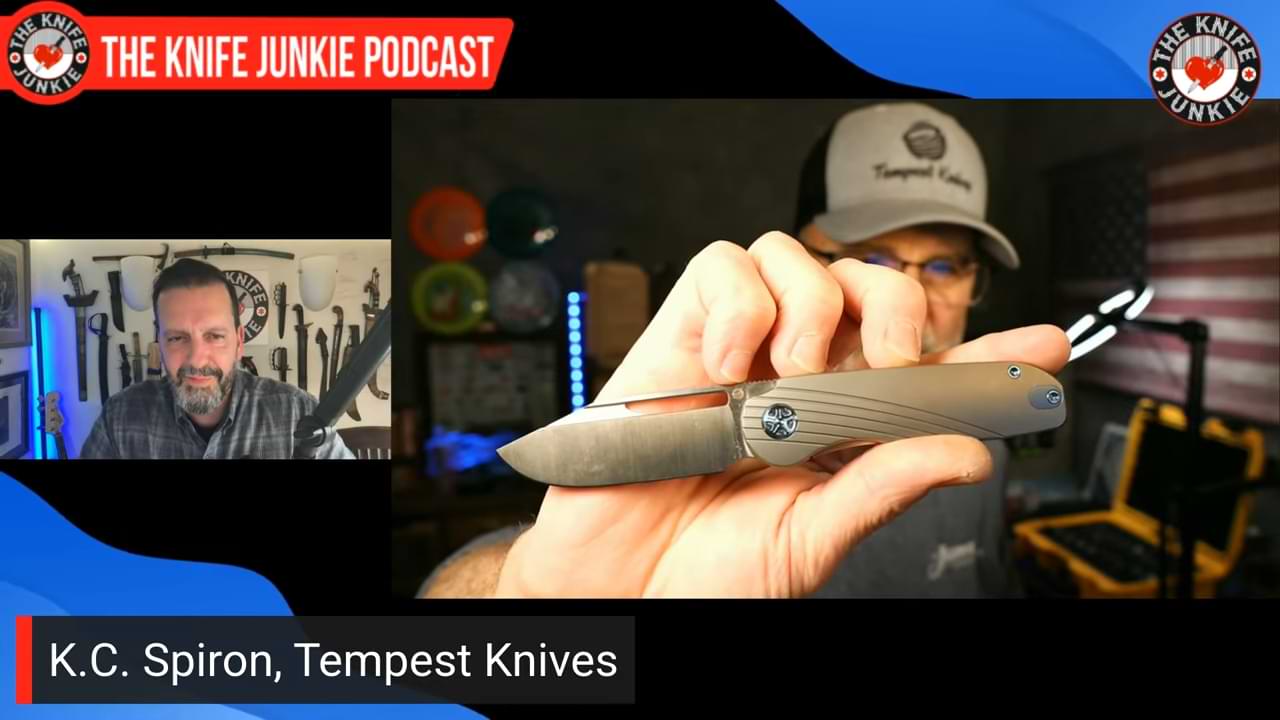
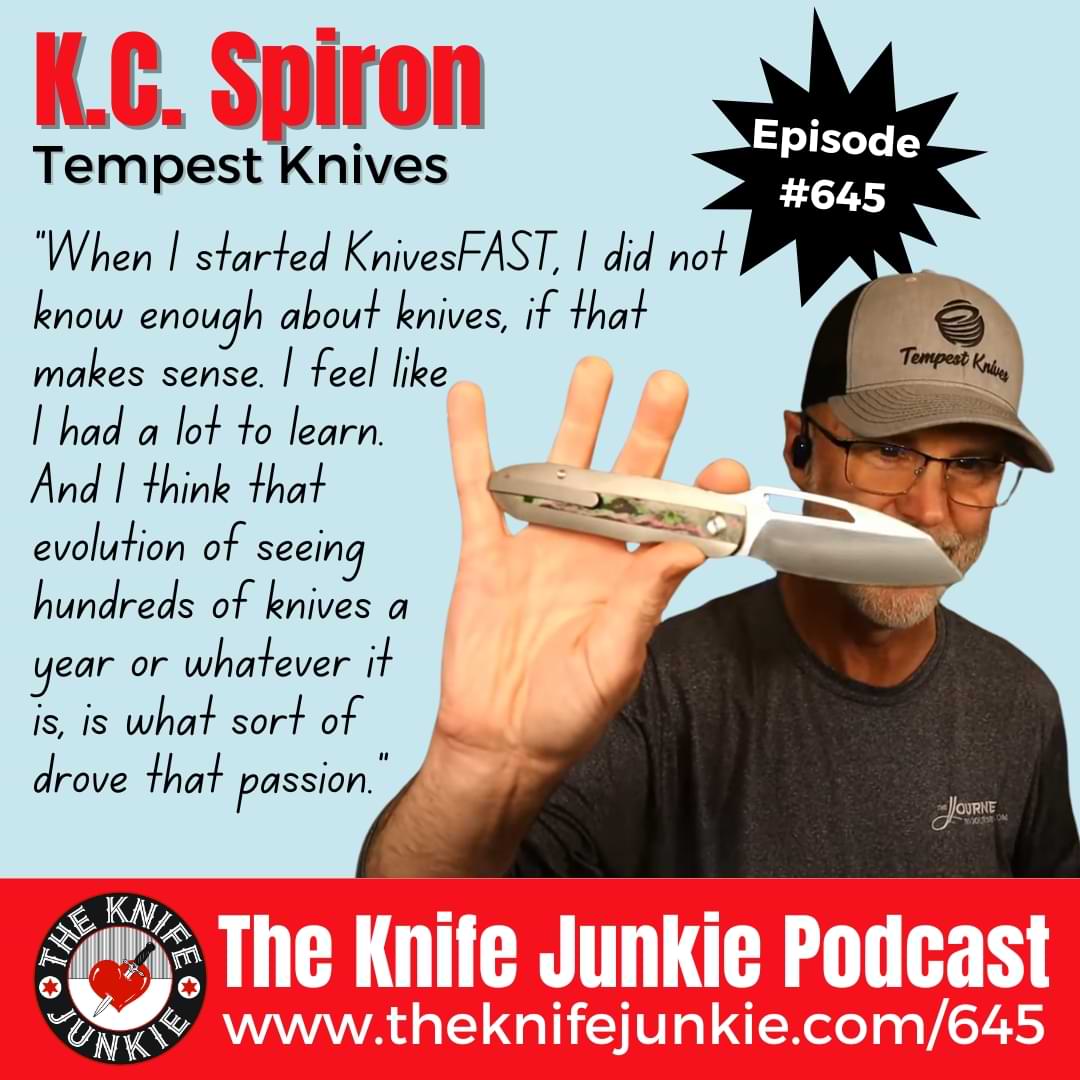
K.C. Spiron, Tempest Knives: The Knife Junkie Podcast (Episode 645)
K.C. Spiron knows knives. As the founder of Tempest Knives and the host of the popular KnivesFAST YouTube channel, he has reviewed hundreds of production folders and turned that hands-on experience into a growing knife company. On this episode of The Knife Junkie Podcast, Spiron shares how his reviewing background shaped his design philosophy and what makes Tempest Knives stand out in a crowded market.
He started KnivesFAST with a simple mission: create shorter knife reviews for people who did not have time for long-form content. But as he handled more knives, his perspective changed. “As I saw more, it became clear to me what I really liked and what I did not like,” he explains. That led him to start designing knives that matched his ideal specs.
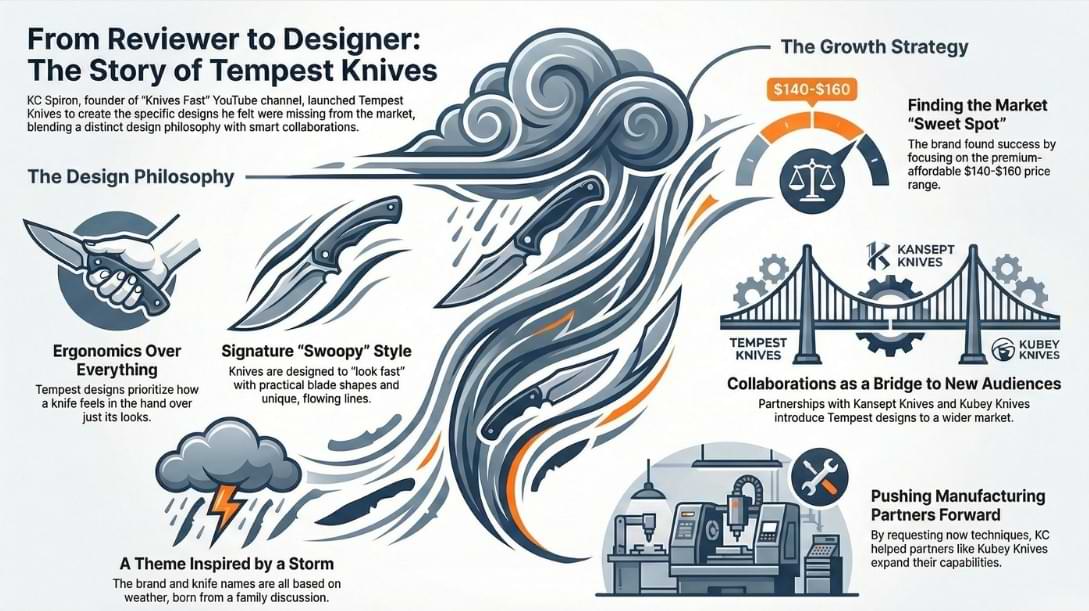
The result is a line of EDC folders that focus on ergonomics and practical design. Most Tempest models feature contoured handles and nested liner locks, elements Spiron believes make for better everyday carry. “The majority of my knives are contoured in some way on the handles just because I enjoy the way they fit my hand,” he says.
 The Tempest Design Approach
What sets Tempest Knives apart is the thought process behind each design. Spiron noticed that many production knives followed trends rather than focusing on what worked best.
“When there is a fad… button locks became the fad, and suddenly everybody is doing button locks. Now it is axis- or bar-style locks. They are everywhere,” he observes.
Instead of chasing trends, Spiron designs what he wants to carry. That means practical blade shapes, comfortable clips, and handles that fit the hand naturally. This approach originates from reviewing hundreds of knives and understanding what is effective in real-world situations.
New Collaborations and Upcoming Releases
During the episode, Spiron reveals a new fixed blade collaboration with Kubey. The company is now producing a fixed blade version of his popular Microburst design in 14C28N steel, available in four different configurations with blue or brown micarta handles and stonewash or blackwash blade finishes.
Looking ahead, Spiron teases new releases coming in mid-January, including the Tornado model. Collectors can stay updated by signing up for the newsletter at tempestknives.com or following K.C. on social media.
Supporting American Business
Spiron also addresses the debate around overseas manufacturing. While his knives are produced in China, he points out that he uses American steel (154CM from New York), American carbon fiber (from California), and works with American dealers like Blade Binge. “There is plenty of this money that people are spending staying right here,” he notes.
Beyond the business side, Spiron talks about the pure excitement of seeing his designs become real products. “Can you imagine cutting open a box and something you designed, something you came up with, you get to pull it out of a box and realize, wow, this is real,” he says. That feeling, combined with seeing people carry his knives daily, keeps him motivated to keep creating.
Connect with K.C. Spiron and Tempest Knives
Follow K.C. Spiron and Tempest Knives on Instagram at @tempestknivesus for product updates and behind-the-scenes content. Subscribe to the KnivesFAST YouTube channel for knife reviews and live shows, and follow @knivesfast on Instagram for quick updates. Visit tempestknives.com to browse the current collection and sign up for the newsletter to get alerts on new releases.

Be sure to support The Knife Junkie and get in on the perks of being a Patron, including early access to the podcast and exclusive bonus content. You also can support the Knife Junkie channel with your next knife purchase. Find our affiliate links at theknifejunkie.com/knives.
From YouTube reviews to designing knives people carry daily - K.C. Spiron of @tempestknivesus shares how hundreds of reviews taught him what makes the perfect EDC blade. New episode of The Knife Junkie Podcast. Share on XThe Knife Junkie Podcast is the place for knife newbies and knife junkies to learn about knives and knife collecting. Twice per week Bob DeMarco talks knives. Email Bob at theknifejunkie@gmail.com; visit https://theknifejunkie.com.
©2025, Bob DeMarco
The Knife Junkie Podcast
https://theknifejunkie.com
Transcribe Your Podcasts and Videos: https://theknifejunkie.com/magic (affiliate link)
Announcer [00:00:03]:
Welcome to the Knife Junkie podcast. Your weekly dose of knife news and information about knives and knife collecting. Here's your host, Bob DeMarco.
Bob DeMarco [00:00:16]:
Welcome to the Knife Junkie podcast. I'm Bob DeMarco. On this edition of the show, I'm speaking with K.C. Spiron of Tempest Knives and the Knives Fast channel. Casey started his YouTube channel with the goal of cutting out the noise and focusing on the signal of your run of the mill knife review, delivering quick takes on the newest and most relevant folding knives on the market. In the process, he built up a following from his live shows, which pushed him to prominence. But somewhere along the line, he turned his mind to the ideal and what he wanted most out of the knives he reviewed. And that's when his company, Tempest Knives, was born. We'll talk with Casey all about the evolution of his knife obsession and what's new with Tempest Knives.
Bob DeMarco [00:01:01]:
But first, be sure to, like, comment, subscribe, hit the notification bell, and of course, download the show to your favorite podcast app. That way you can listen on the go. Also, if you'd like to help support the show, please share it or you can go to Patreon and join us there. Become a gentleman junkie. Save 12% when you get a whole year from. Scan the QR code on your screen or join right here on YouTube again, the knife junkie.com Patreon, that is. Then, if junkie.com.
Announcer [00:01:31]:
Ever visit the knives.
Announcer [00:01:32]:
Online in the hopes of satisfying your need to possess them in the real world, then you have a problem. You are a knife junkie.
Bob DeMarco [00:01:40]:
K.C. Good to see you, sir. How you doing?
K.C. Spiron [00:01:42]:
Doing great, Bob. The beard's looking good, man. I mean, come on.
Bob DeMarco [00:01:46]:
Oh, thank you, thank you. It's my winter shag.
K.C. Spiron [00:01:49]:
There you go.
Bob DeMarco [00:01:50]:
Well, I want to congratulate you first and foremost on the fast growth of Tempest Knives. It's been dizzying to watch and, and to be around. It's always cool to see you at Blade Show. You seem elated from the reception you get. So when you started the Knives Fast channel, did you ever see this happening?
K.C. Spiron [00:02:10]:
No, not at all. I had, I had no intentions of. Of that. As a matter of fact, Bob, I would say when I started Knives Fast, I didn't know enough about knives, if that makes sense. I. I feel like I had a lot to learn. And, you know, I think that evolution of seeing hundreds of knives a year or whatever it is, is what sort of drove that passion. Because as I, as I saw more, it became clear to me what I really liked and what I didn't like and it was time to.
K.C. Spiron [00:02:47]:
Again the same thing. You know, when I started my channel, it was, there was all these channels that were doing really long form videos and I didn't have time. So my solution was, oh, I'm going to do reviews and make short ones. So I guess my solution, you know, for Tempest knives was I wasn't seeing as much of what I really had honed in on as what I hope. So I just said, I'll design some. So, you know, it was it. But it took a long time to really learn that, you know, what I really liked, why I really liked it, why I didn't like certain things, if that makes sense. And, and hone it, like you said, into, into something that I am elated to have going.
K.C. Spiron [00:03:31]:
So. Yeah, absolutely.
Bob DeMarco [00:03:33]:
Well, and so during that period of time, you're, you're, before Tempest knives came around, you're reviewing all these knives. What, what were you honing in on? What were you deciding that were musts in knives that you weren't seeing elsewhere?
K.C. Spiron [00:03:50]:
Wow, that, that, that's crazy. And that's a really big topic. But, but we'll, we'll see what we can do here. But you know, I guess the things that, that really, as I started seeing more and more and more knives, ergonomics became way more important to me. It's, you know, how does the knife fit my hand, why does it fit my hand like that? You know, and, and it, it became a lot about that and then it became just about certain shapes I liked and, and, and the types of clip and the types of lock. I mean, I love, I, I'm a frame lock, liner lock guy, mostly lighter locks. You'll see most of the Tempest knives are, are inset or nested liner locks and you know, things like that, it's just, just kind of honed in on the things that I really liked. But yeah, ergonomics is a big one.
K.C. Spiron [00:04:42]:
And that's why the majority of my knives, not all of them, but the majority of my knives are contoured in some way on the handles just because I enjoy the way they fit my hand. That makes sense.
Bob DeMarco [00:04:54]:
Yeah. Yeah, yeah. So, so do you think that, or did you think leading up to making your own designs, that people weren't designing knives, they were designing knives more on looks and less on feel and usability?
K.C. Spiron [00:05:10]:
Boy, I don't, I hate to answer this question, Bob. I'm, I'm one of these people that has a lot of opinions on stuff. So I think a lot of people that design knives or were at the time. So, so it's changed quite a bit. But we're designing knives that they thought would sell. Does that make sense? Yes. Now, now I don't, I don't think that's a terrible thing. I think that's smart business.
K.C. Spiron [00:05:35]:
That's absolutely the way it should be. And in, in the large space, meaning if, if you're Kershaw, of course you're gonna, you're gonna be designing knives that you think approach the masses more. And I think that that's why like for example, Bob, when there's a, when there's a fad. But locks became the fad and suddenly everybody's doing butt locks. Now it's axis or bar style locks. They're everywhere. It's almost overwhelming to me.
K.C. Spiron [00:06:14]:
I think I had started to cross over between just a guy that had a few knives and cut things at work to a guy that wanted to collect certain things and wanted to enjoy them and create a collection. And at that point there were just certain things that I wasn't seeing enough variety in. And so I don't think anybody was designing anything bad. But it wasn't what was fitting me, if that makes sense. A lot of flat scales, a lot of, you know, clips that aren't super comfortable and things like that. And it's just, and blade shapes. You know, I'm kind of, you'll, you'll see like I could just pull out, you know, one of my middle of the pack. You know, this is probably my third, third night, fourth knife.
K.C. Spiron [00:06:57]:
You, you remember Bob remembers the, the very first Tempest knife.
Bob DeMarco [00:07:56]:
Well, the knives you design, I have two of them right here.
K.C. Spiron [00:08:00]:
There you go.
Bob DeMarco [00:08:01]:
You design are very practical and, and, and, but they're also very unique looking. They take very practical blade shapes and.
Bob DeMarco [00:08:13]:
And you know, make very functional tools. But they're also good looking and unique and, and in a way you're lucky because some of the knives I've designed and drawn, you know, as you can tell from the knives behind me, I knives I've made some swoopy, aggressive, weird looking. Why isn't anyone making this? And a couple of years later I'm like, thank God no one ever made.
Bob DeMarco [00:08:37]:
So, so in a sense like your, your sense of practicality having handled so many great EDCs, maybe it's lent itself to your design language.
K.C. Spiron [00:08:48]:
by the way, Bob, I got to show you something while we're, while we're here.
K.C. Spiron [00:09:40]:
Check this out. This just came out.
K.C. Spiron [00:09:45]:
Two, three weeks ago. It's, there's four versions of it. This is the Kubi. I sold the, the fixed blade design of the microburst to them. And so this is the Kubi microburst fixed blade in 14C.
K.C. Spiron [00:10:00]:
And these, these are available from them as we speak. And there's, I think they're blue micarta and brown micarta with stonewash blades and blackwash blades. So there's four versions, but yeah, I just thought, you know, hey, maybe it might be a pretty cool fixed blade. And they agreed.
Bob DeMarco [00:10:18]:
So.
Bob DeMarco [00:10:20]:
Congratulations on that.
K.C. Spiron [00:10:22]:
That's an excellent, just came out. So, so when you showed the microverse, I'm like, I gotta show him that. So.
Bob DeMarco [00:10:29]:
Well, wait now this begs a different question. You find it okay, so so far, you've done mostly your designs uncompromisingly, having them oem.
Bob DeMarco [00:10:44]:
And. And you're responsible for delivery and all that. If I've got your model correct, what's it like going from that to selling a design and watching them take it and it becomes theirs?
K.C. Spiron [00:10:58]:
It's definitely tougher. It's. It's. And it depends on who you're working with, so I'll give you a couple of examples. So I. I had the. The supercell with Kubi. This is a folder that I did.
K.C. Spiron [00:11:16]:
And you can see it definitely has Tempest lines to it. And. But, you know, they. Kubi does things very much in the realm of they put the materials they want, they pick the colors they. So that's a little tougher for me because it's like, I would love to be able to pick the materials, the. The blade steel, all those kinds of things. Whereas here's another model that I did. I don't.
K.C. Spiron [00:11:46]:
I. I don't know if you've seen this guy or not, but this is the concept Thunderhead. And. And I actually got to pick the variations on the. The Thunderhead. So, you know, it just. It's kind of. I'm a control freak if nobody realizes that, and so it's kind of tough to just turn it over and do that.
K.C. Spiron [00:12:06]:
But I will tell you what. It's done, Bob is it. It's brought my knives to a lot of people that had no clue, because, for example, at Blade show, you were saying, you come find me and you know where I am. But. But I would assume there's a lot of people that don't. And they end up going over to the concept booth. And I had this happen this last year. They go to the concept booth, they see this, and they're like, wait, who's that guy? And.
K.C. Spiron [00:12:30]:
And somebody says, oh, is Bruce over there? And they end up coming over, and I sold. I sold a bunch of my stuff that way. So I think it's. It's a bridge, you know, to a part of the market that. That I don't know. So I've. And I've got more collaboration knives coming very soon.
K.C. Spiron [00:12:52]:
This is the KB knives, which is Kubo Zephyr. The Zephyr is the first Tempest Integral.
K.C. Spiron [00:13:09]:
And. And so these are pretty pricey. I'm just gonna be honest. For those that are gonna look it up, they're gonna go, there are codes and things like that out there. But just, just gives you an opportunity to maybe do things. For example, I don't know that I would do a Tempest Integral simply because they're very, very pricey and I don't know how well I would say sell them. So if that makes sense.
Bob DeMarco [00:13:37]:
Yeah, it sure does. Man, that is. That's beautiful. That's.
K.C. Spiron [00:13:41]:
Thank you.
Bob DeMarco [00:13:42]:
And it's, you know, you can see your signature lines in it. But it's also a little bit of a departure from.
K.C. Spiron [00:13:50]:
And it's, you know, you can see your signature lines in it. But it's also a little bit of a departure from.
Bob DeMarco [00:14:18]:
Well, let's talk about this one since you have it out.
K.C. Spiron [00:14:20]:
Yes, sir.
Bob DeMarco [00:14:22]:
Let's look at the first of all. Flip it around. The lightning holes. Yeah. That you set our inlays on the, on the sandwich concept structure. Is there any significance or symbolism in that?
K.C. Spiron [00:14:37]:
No, they. So, so again, originally it was, it was drawn by me as a standard knife, not as an Integral. When they did the Integral, they said it was coming up a little heavy. And they asked me if I minded if they did some speed holes. And they, they drew these out and I said, you know what, let's go with it. That's pretty cool. I mean, I would have just done holes. And I was actually thinking about like small to large, like having a large.
K.C. Spiron [00:15:04]:
If there were, you know, this like, large hole and then small, small, small, small, small, small on either side. And then when they showed me this, I was like, yeah, we're just gonna go with that because it kind of gives it that playful kind of, you know, almost like video game vibe or something. I don't know. I don't know if that's what they were going for, but it looks like.
Bob DeMarco [00:15:23]:
A language of some sort.
K.C. Spiron [00:15:25]:
That could be true. Yeah, that's. So no, it was literally to give it some weight reduction. It's, it's already in this form. It's a 8 and 8.3 inch knife. So it's already a 5 ounce knife. And if you didn't do that it's probably more like 5.5, 5.6, something like that. It's just trying to control weight.
K.C. Spiron [00:15:46]:
That's, that's what you're trying to do.
Bob DeMarco [00:15:49]:
So that blade is about three and a half. You.
K.C. Spiron [00:15:53]:
Yeah, you asked me this and that's. Well, though that's the other issue about having so many knives out there. It's like. Yeah, so the cutting edge is three and a half. The blade itself is about three and three quarters.
Bob DeMarco [00:16:04]:
Just.
K.C. Spiron [00:16:04]:
Like the Tornado I was showing is. Well, no, I haven't showed the Tornado yet. So we'll get to that in a minute. But.
Bob DeMarco [00:16:29]:
Well, I have it written down here. Tornado.
K.C. Spiron [00:16:31]:
But. But before we go to that, I'm early.
Bob DeMarco [00:16:34]:
Let me ask you this. Well, first of all, you said that things have changed since you first started designing knives. And I know that, that things change pretty quickly and tastes change and people are obsessed over what, what has changed in the period of time since you designed your first knife.
K.C. Spiron [00:16:53]:
Wow, that's. That's. Well, okay, so if, if you take the, the Mach 51, that was a premium knife, this was going to be like a shoot, I don't even remember, like a $300 knife, I think. And so when that didn't go well, I went to the Pinion, which was the budget knife. And I guess in this day and age, if you're gonna play in the budget space.
K.C. Spiron [00:17:22]:
...occurred to me and people, you know, immediately, Bob, people were like, we need a, we need a titanium version of that. We need a titanium version of the microverse. We need. They still ask me about that...
K.C. Spiron [00:18:10]:
And so this was able to be like a $140 knife. And so I kind of settled, you know, in that the majority of my, my knives right now are in that 140, 150, 160 range. It's a good range. And, and that kind of seems like. So when I say it changed, I think my mindset changed of who Tempest should be now. We did do, we did the, we did the fractus which was a 200 knife. So we have, we have played in the higher end of the pool but not way up there. Right.
K.C. Spiron [00:18:48]:
Like some of these companies have done. I'm, I'm, I've got some coming that are going to be a little more high end. But I think where my bread and butter is going to, my bread is going to be buttered, if you will, is going to be that 150 range. If that makes.
Bob DeMarco [00:19:05]:
Ben Belkin has talked, you, you talked a lot on the show about well, Jack Wolf knives and you know how he's diversified.
K.C. Spiron [00:19:14]:
Yeah, absolutely.
Bob DeMarco [00:19:15]:
And I love, I mean he's one of the best businessmen I've ever met, let alone knives or whatever he's doing, I would imagine.
K.C. Spiron [00:19:22]:
Super smart guy.
Bob DeMarco [00:19:23]:
Yeah, yeah. He, he commented last time he was on the show about how he found it easy. Not easy, but.
Bob DeMarco [00:19:34]:
It made sense for him to start high end with the slip joints and then start introducing.
Bob DeMarco [00:19:42]:
Going down market from there. Have you found any difficulty in switching spots in the market?
K.C. Spiron [00:19:51]:
But I think literally Bob, what changed for me was just getting my name out there more and you know, the mark. I am not like you. You know, our buddy left edc, he is the marketing genius, that guy. He knows how to get his name out there. He knows how to.
K.C. Spiron [00:20:22]:
I'm not that guy. I'm, I, I do a channel. I'm very. No nonsense. I'm not like in your face, you know, that kind of thing. I'm, I'm very. And so it's, it's a little more difficult for me. So it just took more time for Tempest, I would say and it took those collaborations.
K.C. Spiron [00:20:42]:
So what I would say is since I'm still small batch.
K.C. Spiron [00:20:47]:
It is. Well, I mean between 3 and 503 and 600 knives. This, this next knife that we're going to talk about, the tornado is 600. It's, it's pretty crazy to think I'm doing that many, but it's, you know, living in that space, I haven't really had a hard time finding enough people that want to buy them in that price range. Now if I was doing $300 knives every time, it probably would be a lot more difficult, I would think.
Bob DeMarco [00:21:17]:
I feel like. And this is in no way minimizing the amazing work that Ben has done, but in a sense, you know, making modernized and, you know, updated versions of knives that people are already familiar with. The Barlow, the Swayback, that kind of thing.
K.C. Spiron [00:21:39]:
Almost as yes, sir or the equal.
Bob DeMarco [00:21:41]:
You know, you're introducing people to your design language and, you know, you have then, well, your name Tempest Knives and you have a whole theme, which I think is great because I could see how it could be difficult from knife to knife floundering around. I'll call this one, you know, the Ass Kicker and this one's the Assistant.
K.C. Spiron [00:22:12]:
But, but I like, I love ridiculous. Yeah. And it's much easier with a theme. Yeah, absolutely.
Bob DeMarco [00:22:17]:
Yeah. And you locked in on such a great theme too.
K.C. Spiron [00:22:21]:
And it happened, I told you last time it happened so weirdly. It was just, you know, we're sitting on the beach trying to come up with a name. We kept shooting down everyone and looking at Storm. And I said, ah, there's a tempest to brew. And he goes, that's it. And I'm like, and I love weather. I always talk, I always talk about storms. I mean, I used to very, I, in the very loose sense of the word, sort of chase storms a little bit.
K.C. Spiron [00:22:46]:
So it just as soon as he said, Dad, that's it. I'm like, oh, crud. You know what I think of that? You know, and then we all sat there for an hour talking about a list of names that could be on knives within the theme. And it was just like, okay, yeah, this is gonna work.
K.C. Spiron [00:23:16]:
So there's, you have had to stay away from. Because other people already had them. But other than that, it's been, it's been really, really easy.
Bob DeMarco [00:23:25]:
And they all have a formidable sound to them too, you know?
K.C. Spiron [00:23:29]:
Yeah. Every time I show up for Thunderhead, people are Like Thunderhead, everybody wants Thunderhead to say. And plus it makes such, such a crazy sound. It's got that ting to it. And then you just say Thunderhead, you know, and it's just like, it's just, it's fun.
Bob DeMarco [00:23:44]:
So since we're on the Thunderhead, let's talk about this for a second because.
Bob DeMarco [00:23:50]:
Because in, in my knife collecting, here's a little preface. In my knife collecting, I started off fixed blades, spent a little, a long time obsessing about folders, but over the past few years I've just kind of naturally drifted back towards fixed blades and a lot of custom fixed blades, just given the, my taste in the people I interview. But concept here, I'm carrying one right now.
K.C. Spiron [00:24:13]:
Ah, the bison. Yes, sir.
Bob DeMarco [00:24:15]:
I love it. Concept has consistently been one of my, even, even through my fixed blade obsession. Concept is one of the companies I keep coming back to because they're always impressive with their builds and they have so many cool collaborations and designs. Tell me a little bit about working with Bob. And did you have, did you design the Thunderhead with DeMarco in mind?
K.C. Spiron [00:24:42]:
I design every, everyone that I do is designed with Tempest in mind. And then I sit down and I make a decision.
Bob DeMarco [00:24:49]:
I meant with concept in mind, right?
K.C. Spiron [00:24:51]:
No, no, no, no. I sit down and I draw all of them in, in something I would want. Now, I will say there's one exception. I'm working on one collaboration knife and I might as well say with, with concept, but that they came to me and asked for something specific, a budget knife, basically. And, and I'm like, okay, so I drew that one for them and that's the first time I've done that. Everything else I've done has been I.
Bob DeMarco [00:25:18]:
I create a catalog of designs.
K.C. Spiron [00:25:21]:
I then once I get them where I want them, which usually involves Bob, I draw them, I draw several different views of them and then I, I, I write out all of my specs, what I want everything to be, and then I get together with a friend of mine who is a CAD artist and we work on it together. And once I do that, then I will think, okay, what company would this work, work well with? And then I farm it out and, and ask, hey you, are you interested? And to see if they, if, if they're interested and go from there. So what happened actually was I had only worked with Cougie, I, I decided to do the, the fractus. Now, at the time.
K.C. Spiron [00:26:08]:
Kuby had not really done inlay work. You remember, back maybe two years ago, Kubi had not done inlay knives at all. And so I'm like start asking around who's good with inlays. It's not going to be no offense to certain companies out there, but I didn't want to do certain companies because I didn't want to be outside my price range, you know, too, too far. And so everybody was like, well, DeMarco would do good within that, that structure. So I got, I was started working on the fractus. Well, somewhere near working on the fractus, I drew the Thunderhead. And you can see there's some similarities to a degree, but obviously a totally different blade shape.
K.C. Spiron [00:26:46]:
And, and so I just asked him, I said, hey, I drew this one. Would you be interested? And what was cool with them is we did some collaborating on the design, we tweaked a few things together.
K.C. Spiron [00:27:00]:
We added some different clip, we changed the milling. We, you know, and, and so I will say DeMarco is, is they take a little bit longer than some, but they are, they're awesome when they get it going. They do great work, they market it well. They, so they, they're an absolute pleasure to work with. The answer to your, your question is no. I, I just draw Tempest designs and then once I get them to that quote unquote finish point, I, I think in my head, okay, I've got Tempest structured out for the next year. I got this one, this one, this one, this one. So I got some extras here.
K.C. Spiron [00:27:40]:
What do I want to sell these, you know what I'm saying? That kind of thing. And then I end up picking a partner from there, depending on if they want or not. Yeah. Do you?
Bob DeMarco [00:27:50]:
Well, all of that was to say I love concept. I'm so happy that you're working with them because I just think their stuff is so great. But do you feel any sort of loyalty to any of these companies, OEMs or companies that you're licensing to or, or is that not really a thing?
K.C. Spiron [00:28:09]:
It is for me. I, I, I, I'm, don't get me wrong, I'm going to be doing work. I've, I've already started talking to some other companies. There are, there are two or three more companies that, and then I'm going to get prototypes for Tempest done from a company I've never worked with since in, because I, you know how I told you, I said most of my stuff has been in the 150 range, but there's a knife coming up that's going to be ultra primo. I'm going to try another company for that one. Just not, not that I Don't think Kubi or Concept could do it. I just, I feel like if I'm going to go all there, we're going to go all there, you know what I'm saying? And so with someone who's known for that. Yeah, so, but loyalty wise, I guess what I would say is for the, for the most part, I feel okay.
K.C. Spiron [00:28:59]:
What happened was between myself and Kevin, from Left to EDC or Devo, pushing them to try new things, they realized, hey, we're pretty good at this. So now what's happened is, is their there. And, and so I do, I do feel a connection with them, if you will. Not, not necessarily. I don't know if I call it loyalty because I'm going to shop around and do some other stuff, so if it makes sense. But I do feel connected with them in a really cool way because I feel like I've watched them go from a company that did really good work but, but pretty basic stuff to a company that could do whatever they want right now. I mean, they're just, they're, they're, they're knocking it out of the park for sure.
Bob DeMarco [00:30:13]:
Kind of mirroring your, your growth in a way.
K.C. Spiron [00:30:17]:
Yes, sir.
Bob DeMarco [00:30:19]:
Which is pretty cool.
K.C. Spiron [00:30:21]:
And then next thing you know they turn it around and they put it in some of their knives and you're like, wow, that's, that's really cool. And so you do, you do feel that kind of loyalty because you feel linked if you know yeah, yeah.
Bob DeMarco [00:31:03]:
And, you know, you're kind of with them earlier on, too, right? There's something to be said for that. Yes, sir. Another thing that there's something to be said for is with concept, you're in some incredible company as a designer, and that's got to feel great, too.
K.C. Spiron [00:31:20]:
Actually doesn't feel real because I. I look up to Ray. Ray Loconico is. He's not just a good design. I mean, the guy's a great dude. He's. He's a fantastic human. Love talking to him.
K.C. Spiron [00:31:33]:
And then you throw out names like Jonathan Stiles and. And, you know, they've had stuff from Paul Munko.
Bob DeMarco [00:31:39]:
They've had.
K.C. Spiron [00:31:40]:
I mean, their list of designers is. Is absolutely crazy. Even some of the newer designers they've. They've brought out recently, like Jesse Pauley and. Shoot, I'm. I'm blanking on his name right now. But the guy that made the site, the Concept Silo, and excuse me, that's the Kubi Silo. But anyway, he's done some work with.
K.C. Spiron [00:32:00]:
At Blade West, I. My picture and a picture of the Thunderhead were on their banners in their booth, and I wasn't there, but people sent me pictures, and I'm just like, what in the heck? It doesn't.
K.C. Spiron [00:32:31]:
That doesn't even feel. Feel like it should be happening, you know?
Bob DeMarco [00:32:35]:
But it.
K.C. Spiron [00:32:36]:
When you see the. I love the. The bison.
K.C. Spiron [00:32:41]:
But the saber tooth. I mean, it. It was from Monterey Bay knives.
K.C. Spiron [00:32:53]:
I love how Ray has a. Has a type of. But then all of a sudden, he breaks out of his type, and you see this crazy knife and you're just like, wow, okay. So, you know, again, it's that. It's that I just look up to Ray so much, and it pushes me to see his work. So that is very cool. He does.
Bob DeMarco [00:33:10]:
80% of his knives are identifiably Bob Laconico.
K.C. Spiron [00:33:22]:
Concept sent me one and I'm like, wait, wait, who designed this? And, and I looked it up and I'm like, there's, there's no way.
Bob DeMarco [00:33:51]:
It must have been a fever dream.
K.C. Spiron [00:33:53]:
Yeah, that. And, and like I said, the Monterey Bay Saber tooth is, is in that, is in that category as well. It's just an angry looking knife. And it's like, you're used to like the, the ECC and the, and the old Guard and, and they're very.
K.C. Spiron [00:34:10]:
You know, like a kitty cat. You can pet them, you know, and it, that thing looks like a mean dog, you know, it's like, okay, all right. Yep, very cool.
Bob DeMarco [00:34:20]:
Before we get to the Tornado, because I want you to show that off.
K.C. Spiron [00:34:23]:
I want to talk about Bob, but.
Bob DeMarco [00:34:24]:
I, I have a question from before that that I think you, you could answer for me in the last, say, I don't know, five to eight years in knives or however long you've been in it, let's say.
Bob DeMarco [00:34:41]:
How much of the popularity of knives, because we've seen it explode.
Bob DeMarco [00:34:48]:
Not as popular as guns or bicycles or other things, but we've seen the popularity of knives and knife collecting explode. How much, in your opinion, is that due to things like fidgetiness and, you know, lock type? You were talking about bar lock and button lock and you know, as, as trends and as. But to me that's, there's a lot of visceral joy in opening and closing a knife. We all get that fidget factor. How much do you think is that responsible for the growth in the knife industry? And does that have a diminishing return effect?
K.C. Spiron [00:35:24]:
Number one would, would be, like you said, the fidgetiness. We've gone from a place where a knife was a, a utilitarian tool that you pulled out, made a cut with, and put back in your pocket, you know, or, or if it was my dad peeled your apple, wiped it off with your handkerchief and then put it back in your pocket, if you know what I mean. But now it's, it's exactly that. You've got that, that a couple of things I think it's important to not just hang up on the fidgety ness, but it's the, it's the show and tell factor is what I like to call it. So it's, for example, sorry, I had reach over here, but this is the knife that came out earlier this year, the downdraft. And you know, it's this stuff, it's camo carbon. People love this stuff. And you love to pull this out of your pocket and hand it to your buddy to cut.
K.C. Spiron [00:35:34]:
Number one would, would be, like you said, the fidgetiness. We've gone from a place where a knife was a, a utilitarian tool that you pulled out, made a cut with, and put back in your pocket, you know, or, or if it was my dad peeled your apple, wiped it off with your handkerchief and then put it back in your pocket, if you know what I mean. But now it's, it's exactly that. You've got that, that a couple of things I Think it's important to not just hang up on the fidgety ness, but it's the, it's the show and tell factor is what I like to call it. So it's, for example, sorry, I had reach over here, but this is the knife that came out earlier this year, the downdraft. And you know, it's this stuff, it's camo carbon. People love this stuff. And you love to pull this out of your pocket and hand it to your buddy to cut.
K.C. Spiron [00:36:32]:
And he's like, whoa, what is that? You know? And so I think what happened was we went from a place where you had two or three knives. One was in your drawer that you put in your pocket every morning, one was in your drawer beside the, where you get your mail every day, and maybe one in the kitchen, you, you know, and then a kitchen knife or something. And, and now we're at the point that people are collecting these because it's that enjoyable almost status thing of, of the collection of. I can carry a different thing every day and post it on social media and I can hand it to my friend or show it to my friend. And I think. So I, I think the answer to your question is that now it, the diminishing returns part.
K.C. Spiron [00:37:21]:
I think we're going to reach a point where we've done it at some point, if that makes sense. I think I, I, I think you can only reinvent the wheel so many times, so I think eventually we'll reach a point where.
K.C. Spiron [00:37:37]:
You know, the saturation will have to go down a little bit. But I don't think, I don't think new handle materials, new steels, new lock types, I don't think that kind of stuff is, is going away. I'm reviewing a knife right now from a company called Numb Knives, and they got this brand new lock called the pinch lock, and it's super cool and it works really well. And it's like having two detents on either side of the blade instead of one and two lock bars in front of the blade instead of one. And you're like, wait a minute, what the heck? And, and so I think, I think to some degree you're right. I think we'll see a saturation of some of this stuff and, and eventually, you know, like, stuff like this is 80s camo carbon. Some people love it, some people hate it. And I think at some point, you know, they'll, they'll either be something else or people will just be like, kind of tired, you know, I think, yeah, yeah, that's great.
Bob DeMarco [00:38:37]:
So that's material issue. But the profile of that knife is, is always beautiful like that, that will never not be beautiful. And that's, that's the thing, like, because I, I, I wasn't pushing for any, any.
K.C. Spiron [00:38:49]:
No, I knew you weren't. I just didn't answer because I, I.
Bob DeMarco [00:38:52]:
Kind of vacillate personally, I think sometimes. Like, how many more of these holders can. Oh, that's nice. You know what I'm saying? Like there, there's a couple of things to it. It's been around, you know, longer than trees. Not really. Right. I mean, they're like super old tools.
K.C. Spiron [00:39:08]:
Yep. Everyone loves them.
Bob DeMarco [00:39:09]:
Everyone's got a personal connection to them in one way or another, whether it's your grandpa or your experience working in the restaurant, whatever it is. So everyone's got a love somewhere in.
K.C. Spiron [00:39:20]:
There or.
Bob DeMarco [00:39:23]:
But I don't know, I was just, just curious from a designer's perspective, you know.
K.C. Spiron [00:39:27]:
Yeah, and you're right on what you said a minute ago. You said, you know, it's time to how many more of these I can have. And then you get, you know, a whole haptic in your hand and, and you're able to buy one of these for the first time ever. And you're like, oh, my gracious. There is, there's, there's some really cool stuff out there if I can just afford it, you know. And then now you're, now you're down a totally different rabbit hole and you're like, what have I done? Oh, man. And so, yeah, there's, I, I think there's so many options out there. And, and you know, in my case, I've been selling some to buy more expensive, expensive stuff.
K.C. Spiron [00:40:02]:
can you, Bob, can you ever think of a time, I mean, think about it. In any given month.
K.C. Spiron [00:40:55]:
There might be A hundred new models or, or more. And I just think to my. That is, I did. There was nothing like that when I started doing this channel. There was. It's, it's every day it feels like there's something. Here's something that's coming next week, here's come to something that's coming in two weeks. And you're just like, wow, this is crazy.
K.C. Spiron [00:41:17]:
And you're right, you do that. Oh man, I gotta have that. Yeah.
Bob DeMarco [00:41:21]:
So I feel like as long as enthusiast designers such as yourself, you mentioned Lefty and so many others. As long as there are enthusiast designers working with great companies, like guys like me, we're good. We're taken care of. When it becomes just another task for an industrial designer to make another knife, then, then it starts to lose its soul. But I, I kind of feel like, you know, there's no telling where this spiral ends. If people are, people like yourself are, are still like engaged and designing knives from an enthusiast perspective.
K.C. Spiron [00:42:02]:
Keep asking myself how many more things I can design and not have one look like the last one, you know, and they all hearken to each other. They're all like in the family, if you will, all my stuff. So it's, but it's, you know, it still keeps happening. I've got two right here that I drew last week that I'm sitting here thinking, wow, that's totally different.
K.C. Spiron [00:42:24]:
So, you know, it's you. I'll keep working on it for sure.
Bob DeMarco [00:42:28]:
Well, you know, like, like any artist or design or designer, you know, you, you go through periods, you know, Picasso had his Blue period and then he became a Cubist and then he was doing crazy paintings for a long time and then, you know, and then he came back to his childhood self. So, yeah, like things move in stages and those stages all have, you know, echoes of, of the last work.
K.C. Spiron [00:42:50]:
Right, I, I totally agree with that. And some, you know, sometimes you'll hear a comment from a, from somebody that's like, all your knives look the same.
Bob DeMarco [00:42:59]:
And I'm like, oh, okay.
K.C. Spiron [00:43:01]:
And then, you know, you look at something like I said, like the, the, the supercell and it's got this really classic looking drop point blade. And then, and then you look at the, at the, the, at the Thunderhead and I'm like, how does this look anything like that? So again, they're in the family, but it's, it's you, you find ways to make stuff different and interesting at the, at the same time, if that makes sense.
Bob DeMarco [00:43:31]:
Yeah, totally. All right, so let's talk about the Tornado. There was a, there was some foreshadowing about this and you showed me before we started rolling. Let's take a look at this.
K.C. Spiron [00:43:41]:
Well, okay, so here, here's the deal. You asked at. Yeah, I think when we were first talking about getting together what's new? And, and the answer is the Tornado. So my, my latest model will be coming in January.
K.C. Spiron [00:43:57]:
And they literally. It's funny, Bob, we're doing this today. Obviously we're recording this in advance and, and some of my boxes came in today. Thank you UPS for not bringing the rest but, but I have, I have one of each of the seven variants. But I'm gonna hold off on showing the, the dealer exclusives. But yeah, this is just a six and a half inch knife. First clip point blade that I've done. Very contoured scales on this guy.
K.C. Spiron [00:44:30]:
You can flick it real easily. It does have the, the low profile back flipper that I like to do. A little different shape this time, but it, it works like a charm. And, and there's a bunch of versions. I'll tell you. I always try to do some firsts in a run. And this is, this is, this runs first. It is a black PVD coated handle with man, I'm sorry about the focus and, and bronze accents, but this is the first DLC coated black blade.
K.C. Spiron [00:45:04]:
And what you get there is you get that belt satin underneath that dlc and I just think, I don't know what it is about this one. This thing just looks absolutely killer. I wish I had made more of these. I was, I was seeing when I saw it today, I'm like, oh my goodness. But there's a bunch, there'll be camo carbon versions. First time there's been a purple Tempest knife. So this is the purple flow camo carbon.
K.C. Spiron [00:45:36]:
Really nice. So yeah, I won't show them all, but there's, there's definitely some really cool. There's seven different versions to it. Dealers and the rest on Tempest knives. And we're shooting for the middle of January I think, I think around the 15th, but not in stone just yet. We're waiting, waiting for the dealers to confirm that they're good with that date. But if they are, that's, that's where we'll be and yeah, and we'll be announcing the dealer exclusives very soon.
Bob DeMarco [00:46:04]:
So this is your smallest so far, I believe. What, what inspired this design and, and why a clip point?
K.C. Spiron [00:46:12]:
My favorite place. Boy, that's. Yeah. Okay, cool. Very interesting question. What inspired. Well, I, I had most of My knives had been bigger, and so I had a lot of people begging me for a really cool, small knife. Now, I, I'll be honest with you.
K.C. Spiron [00:46:32]:
You talked about.
K.C. Spiron [00:46:34]:
Names. I have wanted a Tornado sound since the beginning of Tempest. I'm like, it has to. I couldn't. I, when I designed these knives, they, it's like if you get a dog and you've had the puppy for a couple days, you know, whether a name fits them or not. You know what I'm saying?
Bob DeMarco [00:46:52]:
Yeah.
K.C. Spiron [00:46:52]:
It's like when you draw a knife, draw a design, to me, it feels like it should be something or it shouldn't. And so I just started scribbling out. I'm like, I actually said, first of all, I want a small die. Second of all, that's the Firestorm version here.
Bob DeMarco [00:47:08]:
That's gorgeous with that, all that acid.
K.C. Spiron [00:47:12]:
Stonewashed is killer in the anno as well. So, yeah, it's, but, but I started drawing it. I'm like, well, I haven't done a clip point, so I'd like to do a clip point. So I drew that.
K.C. Spiron [00:47:22]:
And, and then I wanted it small and then the rest just came together. So it is actually a little more contoured than some of my knives. Even, even more. And that was because I wanted to do this sort of, I call it the top of the tornado milling. It's just kind of like bands there like you, you might see in a tornado, you know, and, you know, it's just, I, I guess it was just inspired by that. But more than anything, I just, I, I again, sometimes I just start off with a blade shape or a size or whatever, and, and I knew I hadn't done a clip point, and I really wanted to. So that's, that's kind of where that one started. And then we've got.
K.C. Spiron [00:48:06]:
Bob, if you don't mind, I'll, I'll, I'll show a couple more. We've got more.
Bob DeMarco [00:48:10]:
Wait, wait, wait, Hang on.
K.C. Spiron [00:48:11]:
Before you do.
Bob DeMarco [00:48:12]:
Yeah. I just want to say those, those milling lines, what you call the top of the tornado. Yeah, I would, I was thinking that, that they look, that they're reminiscent of, of a closeup on your company logo.
K.C. Spiron [00:48:25]:
Oh, yeah, absolutely. That's, that's exactly where that came from. Now, I, I can't really talk about this right now, but I have a collaboration that I've come out that's going to have similar lines on it, and, and you'll see how they tie in when it happens. I, I, I kind of have some ideas of, of how this, this milling is going to become a thing that kind of lives on down the road because I do agree with you, it does look a lot like the logo, which is again why I thought I couldn't just do, you know, I couldn't just throw the name Tornado on any old knife. It had to be one that kind of fit that if that makes sense. Yeah, totally. I'm kind of a weirdo. But no, I just want to show you a couple, couple more real quick that yeah, I think you'll find interesting.
K.C. Spiron [00:49:13]:
Now this will probably.
K.C. Spiron [00:49:18]:
Be mid-2026 and I showed the. Well, where'd it go? I showed the, the practice moments ago. This is going to be the mini Fractus. And so I have been asked for that. And believe it or not, the bottom one is concept. The top one is actually Kubi just to kind of prove how far they've come down the road. This is, is absolutely gorgeous, by the way. I think I'm going to call this the vintage sports car.
K.C. Spiron [00:49:50]:
...and then, you know, Bob, I love, I am huge.
Bob DeMarco [00:50:08]:
Into.
K.C. Spiron [00:50:11]:
...of the Mach 71. And I wonder what that's going to be. And so this is going to be the next knife after the tornado. I'm hoping April, May, June, somewhere in there of 26. And this is the Blackbird edition, as I'm calling it, of the SR of the Mach 71.
K.C. Spiron [00:50:46]:
It is modeled after the black and red of the SR71 Blackbird. It's my homage, if you will, to that.
Bob DeMarco [00:50:56]:
And airplanes are made.
K.C. Spiron [00:50:59]:
...but there'll be different versions of it as always. And, and just I. These, this is also Kubi and this is probably for its size it's about seven and three quarters. And for its size, this is one of the lightest titanium folders I've ever experienced. The milling we did inside it is just, it's super light.
K.C. Spiron [00:51:35]:
So hollow ground blade. First time I've Done a hollow ground. Well actually I'm sorry the mini practice is also hollow ground but this, this will be the first production knife I've done with hollow. I just prefer flat ground. I'm weird but people have been asking me for hollow. So here it comes.
Bob DeMarco [00:51:54]:
That is really cool. I'm a sucker for a hollow ground.
K.C. Spiron [00:51:57]:
Yeah, me too. I like light.
Bob DeMarco [00:51:59]:
It does lighten up the blade. I mean it lightens up the whole thing 100%.
K.C. Spiron [00:52:04]:
Yep, it's it and it's. It's just I've been carrying those protos a lot and I can't wait to get them to market. It's just things have been slow this year just because of shoot the production cycle and tariffs and everything else. We got war stories that you wouldn't believe but it's just you keep fighting through it and, and everything's coming out on the, on the good side. So I love it.
Bob DeMarco [00:52:30]:
Well, we only have a few minutes here but I want to ask you about the tariffs a little bit. Like how, how did you see that on the ground? How did that affect you?
K.C. Spiron [00:52:39]:
Well thankfully at the tornadoes, even though we're late, it came out on the, on the right side if you will because we have a deal in place now. Whereas I had friends having knives come out during the middle of the height of the China tariffs and they ended up having to ship their knives on a boat and it was like two months to get here and customs took forever and everything else. So thankfully I came out on the good side. But the part that was tough for me was just shipping timing. Everything changed with, with, with shipping. So when I, I bought for example, whoops, here it is right here. When I bought the camo carbon material that's made in California and so it had to be sent over to China and it just took longer to get there and longer to go through customs and I had to pay a tariff on it and you know, as it went into China and, and you know that just, that kind of stuff just made things a little less clean. But thank thankfully it hasn't been brutal and the timing worked out that the knives came after the deal got put in place place.
K.C. Spiron [00:53:52]:
I mean can you imagine these are going to be around 150 and it would have been terrible if I had to sell this same thing for like 200, 250, because of the tariffs. You know, I, I don't even know how you. I don't know how that works. You know what I'm saying? Are people still going to buy it or are they not? And thankfully, I don't have to discover that, so. Right, right.
Bob DeMarco [00:54:26]:
It's.
K.C. Spiron [00:54:26]:
But. But I will tell you, some of the manufacturers and Kubi did this too. They're just eating the tariffs because we have paid. We have had some tariffs and for stuff coming this way, they're just either building an enterprise up front or eating some of it themselves. And, you know, that's, that's what a good business partner looks like. So that's been good. Yep.
K.C. Spiron [00:54:57]:
So.
Bob DeMarco [00:54:57]:
So thankfully not terrible on your end of things, on the operations end of things. This is something I've always wondered, and I guess I've. I haven't really asked you or others in a similar position, but you receive all these knives and then you ship them. You are the company. I mean, we talk a lot about who makes this, and that's super important, but who designs this and who ships this is also, you know, you're. You're bookending the, the manufacturing process.
K.C. Spiron [00:55:31]:
Well, and I think that's why I sometimes. I'm sorry, I didn't mean to cut you off there, but, um, I think that's. Well, I don't know if you want to get into this topic, Bob. This could be a whole podcast to itself, but you hear a lot from American manufacturers about those of us that use Chinese manufacturers, and we're taking money out of America. And I would beg to differ with that. My, my stance on that is, yes, I'm sending money to China.
K.C. Spiron [00:56:00]:
I am, and I would love to find an American manufacturer that would work with me, period. And, and second of all, would work with me and price things in such a way that it would make financial sense. Right. But I think what I, what I would like to say is if you think about it. So let's, let's take the Tornado, for example. This is 154cm steel. Bob, where's that steel made?
Bob DeMarco [00:56:24]:
Pennsylvania or New York?
K.C. Spiron [00:56:26]:
Okay, it's New York. This is camo carbon.
Bob DeMarco [00:56:30]:
This is.
K.C. Spiron [00:56:31]:
Is made in California. I have myself and my family, which is a business. And so American money, money coming into America. I have two dealers on board. For example, my last night, the downdraft, we had blade binge on board. And they are an American company. So that's money staying right here. And who knows? I mean, there's other parts in here that I'm sure.
K.C. Spiron [00:56:53]:
As a matter of fact, I'm working on a knife right now where with the steel we're working with, they had to get American sanding discs to be able to. To. To grind the steel. And so it's. I guess what I would say is, yeah, I mean, there is a small portion of the money that is going to China, but there's a portion going to me go. And I'm shipping through American companies and I'm buying boxes from Uline and, you know, tape from an American company. So there's plenty of this money that people are spending staying right here.
Bob DeMarco [00:57:28]:
Well, not only that, but if it weren't for Tempest knives or. Or a company like yours, that money wouldn't be generated at all for anyone. But the fact that some of it's going to China, you know.
Bob DeMarco [00:57:40]:
That'S a part of it, but it's a small part of something much bigger.
K.C. Spiron [00:57:44]:
Yeah, it's just an interesting topic because I hear that a lot. And, man, we could get into, you know, the different misinformation that tends to be out there in that. In that realm, but we won't, you know, we will save that for another day.
Bob DeMarco [00:57:58]:
Code made that you're leaving that comment on.
K.C. Spiron [00:58:03]:
I. Look, I love American Eyes. I got a lot of them and, and I review a lot of them, and I love them. And I would like. I said I would love to do some stuff, some collaborations with American companies. I'd love to do OEM work with American companies down the road. But I think it is important to remember, like you said, that, you know, it's an American guy sitting here with a dream, drawing this out, trying to turn it into something. And the best, the best part, people, now, look, I do make money off of this.
K.C. Spiron [00:58:32]:
I'd be stupid to do this and not. But can you imagine today, Bob, cutting open a box and something you designed, something you came up with, you get to pull it out of a box and realize, wow, this is real. I designed this. I came up with this. Spent blood, sweat and tears trying to make this happen. And here it is. And, you know, that's. That's an incredible feeling.
K.C. Spiron [00:58:59]:
When I was opening the boxes, my wife's just like. They're like that little kid, and she's laughing at me and picking on me, like, well, you. You get more excited about that than you did, you know, the day we got married. I'm like, oh, no, that is not.
Bob DeMarco [00:59:13]:
I Have to live that joy every day, honey.
K.C. Spiron [00:59:15]:
Not true. Exactly. That is not true. But it is, it is, it's, it's incredible. And, and again, the support I get from people.
K.C. Spiron [00:59:26]:
You know, it's just, it, it makes you, definitely makes you feel good and keep, you know, because there are, like you said, there's times where I'm just like, man, this stuff is tough. Do I want to keep this going long term? And then you see, you know, like you said, the reactions and the comments from people on my knives fast YouTube channel. And then you see, you know, the comments and the people posting your, your knives and I'm sure you get it. Like on a Thursday night, people night, people saying, I'm carrying the Tempest this or the Tempest that. I mean, that's crazy. It's, it's crazy. I, I, I don't think I will ever get over that feeling of, I can't, I just can't believe that.
K.C. Spiron [01:00:07]:
You know, that people carry something.
Bob DeMarco [01:00:09]:
I came up with knowing, knowing your background, you're obviously a creative guy, but to see something go from zero point energy or whatever, just go from zero to a knife in every pocket has got to be something really intoxicating. Before I let you go, Casey, let everyone know how they can A, keep up with you and B.
Bob DeMarco [01:00:33]:
Find out what's newest with Tempest knives and how to get your knife perfect.
K.C. Spiron [01:00:36]:
So I would suggest I'm going to be posting, like I said, the middle of January, the tornadoes are coming, and other stuff. I would just say two things. If you're on Instagram, go to tempest.tempest knives us.com. yeah, there's the US because there was already somebody with Tempest times on Instagram. But Tempest dives us at. Tempest dives us and then.
K.C. Spiron [01:01:04]:
And then obviously Knives fast. Just watch my, you know, check out my YouTube channel because I'm going to be doing videos on these knives and talking about what's coming and where they're going to be and what the price is and what the composition is. And then I haven't, my website has been refreshed. It's tempest knives.com and if you go there, you can sign up for the newsletter. And I'll be sending out a newsletter saying, hey, Knives are coming. And so that, that's probably in any of those ways, but like I said, whatever's most convenient for somebody. I, I got a big mouse and spread it around everywhere, so.
Bob DeMarco [01:01:42]:
Amen. Gotta, gotta do that. Hey, Steve, thank you so much for coming back on the show, man. It's been great talking with you.
K.C. Spiron [01:01:49]:
I love being on here with you, Bob. Thank you.
Bob DeMarco [01:01:52]:
All right. You got it. Take care.
K.C. Spiron [01:01:53]:
All right.
Announcer [01:01:54]:
Adventure delivered your monthly subscription for handpicked. outdoor survival, EDC and other cool gear from our expert team of outdoor professionals.
Bob DeMarco [01:02:03]:
The knife junkie.com battlebox There he goes.
Bob DeMarco [01:02:08]:
Ladies and gentlemen, K.C. Spiron of Tempest Knives and the Knives Fast channel. Also, he's got some great lives. Be sure to check those out and and keep up with him@tempestknives.com all right. For Jim working his magic behind the switcher, I'm Bob DeMarco saying until next time, don't take dull for an answer.
Announcer [01:02:27]:
Thanks for listening to the Knife Junkie podcast. If you enjoyed the show, please rate and review@reviewthepodcast.com for show notes for today's episode, additional resources and to listen to past episodes, Visit our website, thenifejunkie.com you can also watch our latest videos on YouTube@thenifjunkie.com YouTube.
Share This With a Friend >>>
For early access to The Knife Junkie podcasts and YouTube videos, receive Knife Junkie stickers and be entered into the monthly knife drawing giveaway, join The Knife Junkie’s Patreon group of awesome supporters.
Let us know what you thought about this episode. Please leave a rating and/or a review in whatever podcast player app you’re listening to. Your feedback is much appreciated. Email theknifejunkie@gmail.com with any comments, feedback, or suggestions on the show, and let us know who you’d like to hear interviewed on an upcoming edition of The Knife Junkie Podcast.
To listen to past episodes of the podcast, visit theknifejunkie.com/listen.

Shopping for a Knife?
Support The Knife Junkie Podcast and YouTube Channel by Buying Through My Affiliate Links
 3 Dog Knife (25% off hardcore Alaskan-made knives with coupon code ‘knifejunkie’)
Angle Pro Knife Sharpener
Artisan Cutlery
Bamba Forge
Civivi Knives
eBay
Jack Wolf Knives
James Brand
Knives Ship Free
Off-Grid Knives
Sencut
Smoky Mountain Knife Works
Tiger Edge
T.Kell Knives (Get 10% OFF with coupon code: knifejunkie)
Vosteed Knives
WE Knives
Other Products and Services
1Password
16-in-1 Multipliers
Dark Age Defense
Podcast Hosting
Groove (Replace 17 Apps and Services in Your Business)
Groove.ai (All-in-one AI solution)
Knife Books
Rakuten (Cash Back for Shopping Purchases)
Shockwave Tactical Torch
StreamYard
Upside App (Cash Back for Gas Purchases)
SOS Emergency Sleeping Bag
Survival Saw
Wilderness Survival Skills Course
Work Sharp
Work Sharp Rolling Knife Sharpener
“The Essential Skills of Wilderness Survival” Book
Follow The Knife Junkie
Visit The Knife Junkie website
Email The Knife Junkie
Follow The Knife Junkie on YouTube
Follow The Knife Junkie on Instagram
Follow The Knife Junkie on Twitter
Join The Knife Junkie Facebook Group

Affiliate Disclosure
In the name of full transparency, please be aware that this website contains affiliate links, and any purchases made through such links will result in a small commission for The Knife Junkie channel (at no extra cost to you). If you use these links to make a purchase, TKJ will be rewarded with credit or a small commission on the sale. If you don’t want to use these links, no problem. But know that I truly do appreciate your support.