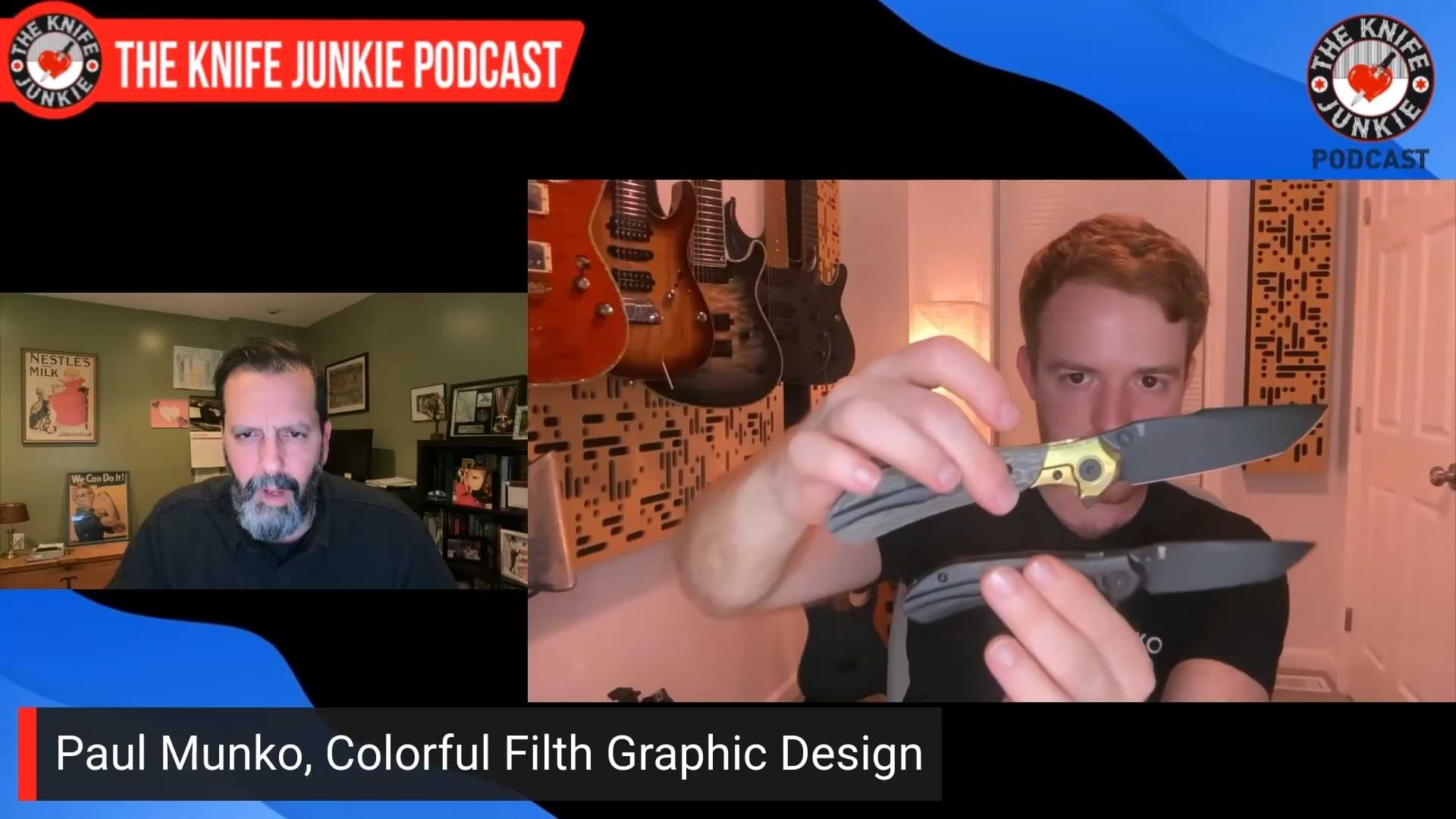
Paul Munko, Colorful Filth Graphic Design: The Knife Junkie Podcast (Episode 648)
Knife designer and graphic artist Paul Munko returns to The Knife Junkie Podcast to discuss his growing collection of production knife designs, the inspiration behind his work, and what the future holds for Munko Knife Designs.
The Mystic: A Love Letter to New England Whaling
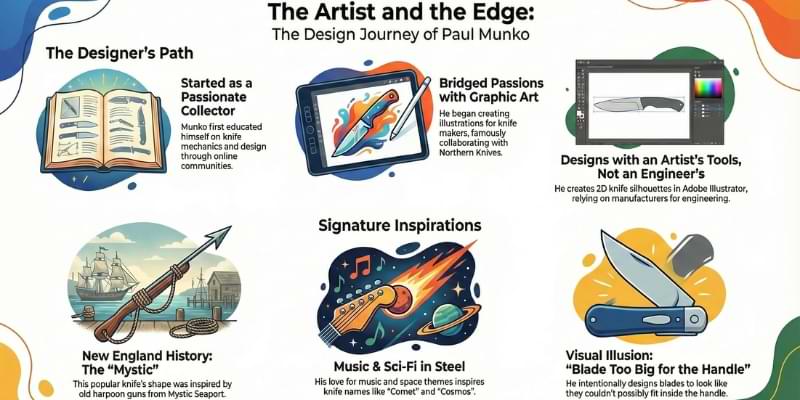
Munko draws inspiration for his third production knife, the Mystic, from a location that holds special meaning for him. The town of Mystic, Connecticut, is home to Mystic Seaport, a preserved whaling museum that Munko visited as a young person. The old harpoon guns on display there directly influenced the knife design, from the handle shape to the blade profile.
The Rex 45 steel blade develops a beautiful patina over time, adding to the historical feel of this modern folder. Bob DeMarco calls it his favorite knife of 2023 and carries it regularly, praising how it looks like an authentic piece of whaling kit from the 1800s.
Connecticut Roots and Future Goals
Based in Connecticut, Munko is part of a growing New England knife-making community. While much of his networking happens online and at events like Blade Show, he plans to visit the Connecticut Knife Show this year to connect more deeply with local makers.
“There are a lot of custom makers around here,” Munko explained. “There is actually a pretty strong community, based on what I have seen.”
His recent collaboration with Kansept on the Quasar shows his continued growth as a designer. The knife features a crossbar lock and hole-opening mechanism, and launched with an impressive eight different configurations to suit different budgets and preferences. Options included everything from high-end Timascus scales to more affordable G10 versions, plus a unique Glow Fat Carbon option that actually glows in the dark.
A Designer Who Thinks Differently
What sets Munko apart is his unique design philosophy. He intentionally creates blades that look almost too large for the handle when the knife is open. This visual trick creates the impression of getting more blade than handle, which has become a signature of Munko knife designs.
“I always like for the blade to almost look like it is too big for the handle when it is open,” he shared during the interview.
With nine production designs currently on the market, Munko keeps knife design as a passion project alongside his full-time work in graphic design. However, he has clear goals for the future. Eventually, he wants to do an OEM project completely on his own, creating a knife where Munko Knife Designs is the brand on the blade.
“When I do eventually take that next step to OEM a product, I want to make sure that it is really special for all the people who have actually been there from the very beginning,” Munko said.
Watch and Listen
Check out the full interview to hear more about Paul Munko’s creative process, his collaborations with Northern Knives and designer Jonathan Styles, and what inspires him as both a musician and visual artist.
Follow Paul Munko’s work at Colorful Filth on Facebook, and on Instagram at @colorfulfilth and @paulmunko.

Be sure to support The Knife Junkie and get in on the perks of being a Patron, including early access to the podcast and exclusive bonus content. You also can support the Knife Junkie channel with your next knife purchase. Find our affiliate links at theknifejunkie.com/knives.
When a knife designer draws inspiration from 19th-century whaling harpoons and turns it into modern folders collectors carry daily, you get Paul Munko's Mystic. Listen to Episode 648 of @TheKnifeJunkie Podcast to hear the story. Share on XThe Knife Junkie Podcast is the place for knife newbies and knife junkies to learn about knives and knife collecting. Twice per week Bob DeMarco talks knives. Email Bob at theknifejunkie@gmail.com; visit https://theknifejunkie.com.
©2025, Bob DeMarco
The Knife Junkie Podcast
https://theknifejunkie.com
Transcribe Your Podcasts and Videos: https://theknifejunkie.com/magic (affiliate link)
This is the full transcription of The Knife Junkie Podcast (Episode 648) with host Bob "The Knife Junkie" DeMarco and guest Paul Munko.
Episode Transcription
Announcer: Welcome to The Knife Junkie Podcast, your weekly dose of knife news and information about knives and knife collecting. Here’s your host, Bob "The Knife Junkie" DeMarco.
Bob DeMarco: Welcome to The Knife Junkie Podcast. I’m Bob DeMarco. On this edition of the show, I’m speaking with knife designer and artist extraordinaire, Paul Munko. Paul started his knife designing career with the 2022 blockbuster hit, the Kizer Comet, an Art Deco-inspired modern gent's folder, and then really turned it up for his Mystic—his third production knife and my favorite folder of 2023. I’ve actually been carrying it all day. Paul is a prolific musician, graphic designer, and collaborator on unique projects with the likes of Northern Knives and designer Jonathan Styles. We’ll catch up with Paul and all that he’s been creating. But first, be sure to like, comment, subscribe, hit the notification bell, and download the show to your favorite podcast app so you can listen if you have to continue this on the go. Also, if you want to help support the show, you can join right here by joining on YouTube, or you can join us at Patreon. Go to theknifejunkie.com/patreon. If you join for one year in advance, you get 12% off—that’s pretty awesome. Scan the QR code on your screen or go to theknifejunkie.com/patreon. Again, that’s theknifejunkie.com/patreon.
Commercial Segment: The GetUpside app is your way to get cashback on your gas purchases. GetUpside is an app you put on your smartphone, and whenever you need to get gas, search your area for savings, claim your discount, fill up your tank, and then take a picture of the receipt with your phone. And that’s it—you’ve just got cashback. Visit theknifejunkie.com/saveongas to get the app and start saving. Again, that’s theknifejunkie.com/saveongas.
Bob DeMarco: Paul, welcome back to the show, sir. Good to have you.
Paul Munko: Bob, thanks so much for having me, man. Excited to be here again.
Bob DeMarco: It’s my pleasure. And as I mentioned just right up front, shortly after you and I spoke last time in 2022, I got your third knife design, the Mystic. And I’ve been—this was my favorite knife of 2023, and I carry it with regularity. I love this knife.
Paul Munko: You're welcome.
Bob DeMarco: I'm going to wax poetic about it for just a quick sec. You mentioned it’s all about, or inspired by, the New England whaling culture. And I have a soft spot in my heart for New England and the coast there—my sister used to live up there. And this, to me, really does look like a piece of whaling kit. And it’s evocative of a whale and everything else. So first of all, thank you for this.
Paul Munko: Yeah, of course. I’m so glad that you like it so much. It’s funny too, because when we first talked about it, neither of the knife designs that I came out with were really larger models. And then like as soon as we had done that, the Mystic comes out and I think it’s still probably my biggest design, like blade-length wise, to date, 100%. For now.
Bob DeMarco: For now. Yeah, right. Exactly. There’s time enough. But as I mentioned, you mentioned that it was really inspired by whaling culture. You’re from New England, and I believe Connecticut, and everything there. And part of the thing about this is that Rex 45 steel that patinas so beautifully and really makes it look like an old piece of kit. Tell me about the New England school of knife making, which you now roundly fit into.
Paul Munko: Yeah, so I know there’s a lot of custom makers around here. Weirdly enough, I don’t tend to speak with anyone on the regular basis outside of like Instagram. So what really happens is my—most of my networking, even if people are from Connecticut, happens at like Blade Show and at these kind of in-person events. And I actually am planning on going to the—not exhibiting but visiting—the Connecticut Knife Show. I believe it’s in Mystic, actually, this year, just to kind of like engulf myself in that community a little bit more because—it’s funny you mention it, I did kind of have that thought this year where I was like, "You know what? There’s a lot going on here, but I’m just not super ingrained in it on a like a face-to-face level, right? In-person level". So in Mystic, of course, being where that knife design kind of was inspired by... Are you familiar with the town of Mystic at all?
Bob DeMarco: No. I do know they have great pizza, but that’s '80s movie stuff, right?
Paul Munko: Yeah, so Mystic Pizza, that whole movie, like that little spot is still there. And what kind of inspired the Mystic in general was—it’s called Mystic Seaport, which is essentially like an old—it’s like a museum slash old whaling town that’s been preserved. And you can kind of go around and see different things. You can go to the blacksmith shop. It’s like a little Sturbridge Village almost type thing, if you’re familiar with that. And I used to love going to Mystic when I was young and just like seeing like the big boats that they have out in the water and everything, and seeing the things like the harpoon guns that they had on display. And that was really kind of where that design silhouette and aesthetic came from. Is actually—on my website for the Mystic, there’s a—there’s a photo of like the actual old harpoon gun that sort of inspired it with that sort of like the shape of like the butt of the handle and then the actual harpoon itself. And that town in general is just super cool. So if you’re ever in Connecticut or anybody who’s, you know, in here is ever in Connecticut, it is just—it’s a really cool spot and definitely would recommend checking it out.
Bob DeMarco: Something I really love hearing... Well, A, that there is sort of a Connecticut—loosely, a New England school of knife making. Not that—not that people are all studying the same thing or making the same thing, but it’s an age-old tradition there. It’s our oldest—the oldest part of this country, at least as a settled nation that it is today. And to me, I don't know, something about that really is exciting.
Paul Munko: Oh yeah, definitely. Definitely. And I believe there’s a couple of people who were like on Forged in Fire and stuff I know are in Connecticut, and they have like cool classes and stuff you can go to for their custom forging and things. And there is actually a pretty strong community from what I’ve seen. It’s really cool. It’s really cool. And it is like definitely one of the oldest tools, one of the oldest skills that people developed was just making a sharp object. So it’s really cool to kind of get ingrained in the history of that.
Bob DeMarco: So obviously from your surroundings, we can tell that you’re—you’re a multi-faceted artist. You’re not just in the knife lane. You play guitar, you’re a graphic artist—that’s, I believe, where you cut your teeth. How did you get into the knife making, knife designing?
Paul Munko: Yeah, so I—I started really as a—as a collector. I got super into it super quickly. And then I just really started educating myself through, you know, YouTube videos, going to like Reddit—different Reddit communities and things—and just just kind of learning like what—what makes a good knife, what makes a bad knife. Like what is the general consensus as far as like, you know, lock mechanisms and blade shapes? What do people like the most? And I was a super passionate collector. And then I started doing artwork for people in the community—so that custom makers, other knife designers, things like that. Usually things that would end up being on like stickers or T-shirts. And it really just ended up turning into a situation where a few people were like, "Hey, why don't you try to actually just design a knife itself? Like you're already kind of working within this realm". And then I was like, "You know what? That sounds fun". So I went for it and—actually, I just skipped a huge part of that. The Colorful Filth knife stuff. So doing the actual artwork on the knives was kind of like another stepping stone in that same timeframe that I was doing designs for other designers, you know, doing artwork that I collaborate with—so far, like Northern Knives. I collaborated with Ben Petersen from Knafs to basically put my drawings on knives as a modification. And ultimately all those things just culminated in "let's design a knife from the ground up".
Bob DeMarco: Okay, so you're talking about Northern Knives and the knife that Jim has up on screen right now. We gave one of those away, and we also gave a Bailout away, and a pry bar, as he's going by these right here on Thursday Night Knives, our live Thursday show. And just in talking with Mike of Northern Knives, it’s a real intense creative collaboration to get your illustrations onto those knives. So first I want to ask you about the illustrations. Where do they come from, what are they inspired by, and tell us about them?
Paul Munko: Yeah, definitely. So a lot of the knives I try to draw inspiration from the knife itself. So like the Bugout "Spaced Out" just kind of made sense in my head. The "Fallen" because it’s a Paramilitary 2 kind of had this like war type theme that was also alien and zombies—that was a really weird one. And the Bailout is somebody like bailing out of a helicopter. So I try to get as creative and also bouncing ideas back and forth a lot with the Northern Knives team to see like what really makes sense for this model. Because I feel like there’s something that I love about knives—that there's always really cool names attached to them. So if we can sort of emphasize that and kind of have that be a piece of the story of the artwork, that always just kind of end up feeling like a win. Like the Scuba Chef on the SpydieChef type thing—it just keeps it fun.
Bob DeMarco: Well, okay. So in talking with Mike about actually anodizing these pretty complex images onto titanium, what does that take?
Paul Munko: A lot of work, for sure. And it’s interesting too because—it’s funny every time I talk to Mike and the team about it, it’s like every drawing I do, every time we do a new project, it’s like I—not even on purpose, but I just inherently make it harder. But I think it is a little bit on purpose because I’m like, "All right, can we get this much detail on this thing?" Or "How small can we get this little tiny color in here?" Because it’s a lot. And I know it’s a super involved process with like, you know, different masking and obviously there’s anodizing. Cerakote is a big part of the process now in the last few that we’ve done. And it’s really just like finding that balance of how much detail can we get a laser to do, how realistically how small of a chunk can we anodize without it being some sort of issue. And it just—it’s a ton of fun. I mean, there was actually a whole project that we had to—for a number of reasons that we ended up having to scratch and do various things. But it’s fun. It’s a fun challenge. I think it’s definitely more fun for me than it is for them for the most part, but it’s a great time. And they’re always like—no matter what I send them, they’re always wanting to try it, and that’s what’s so fun about collaborating with them.
Bob DeMarco: So hold that handle up again real quick vertically, please. So when I saw this, the first thing I thought of... I nerded out on helicopters. There’s one helicopter—it’s a Russian one called the Kamov Black Shark that has an ejector seat. And apparently like two different rotors—it’s got that two counter-rotating propellers, the blades are supposed to fly off right before you’re shot through the canopy. And I just think that’s a serious gamble ejecting out of a... So is this something you made up yourself or is this a real thing here?
Paul Munko: This I totally made up myself. Yeah, we were just like "What would be cool, somebody bailing out of something." And we kind of—I don't want to say overdid—but the last couple things we did were a little bit more like space themed. So we wanted to keep it more—just like something different this time around. And then eventually we were like "Oh, helicopter would be cool." Yeah, that would be kind of crazy. And then the other side, there is still a little bit of space going on. There’s a—under the pocket clip there’s a UFO over there. Still a little bit of weirdness. But yeah, no, it was—yeah, definitely an organic idea of how can we speak to the Bailout name as much as possible, and it ended up in a guy jumping out of a helicopter.
Bob DeMarco: All right. This is a relatively small amount of what you do for your knife designs. Obviously, you design a lot of knives. I’ve been showing off the Mystic. Let’s talk about the Comet for a second. That was the one that you first came out with. What inspired that, and why do you think it was such a big hit?
Paul Munko: Yeah, let me pull that one up here too real quick. So yeah, this was my first design, my collaboration with Kizer, the Comet. And honestly, I think a lot of it was just that my real goal when I was coming up with the Comet was I wanted to do something that was interesting in the budget space at the time. And honestly, since then, I feel like there’s a lot more options in the budget space—like there’s always new things coming out, and it’s only been a few years. But I think that combination of like the Micarta and the brass and just kind of that overall like gentleman’s carry sort of luxurious, I guess, sort of silhouette... it was just kind of different. And I think that it worked really well, and it just was able to kind of give people a reason to look at this design as something that stood out in some capacity, right? That isn't just like your typical like G10 maybe assisted flipper type thing that was, you know, more prevalent in the budget space at that time.
Bob DeMarco: Well, I think I speak for every single knife collector here... but I probably don’t. But that is to say that we all want to carry the 110, the Buck 110. But it’s not easy. It’s a boat anchor. You have to have it in a sheath on your belt and all that. This—I always thought that the Comet had—just little things. Maybe it’s the brass bolsters, but I believe it’s a little bit more than that, that harken back to that kind of traditional era of lock-in folders.
Paul Munko: Exactly. And that was really my goal is I was really—I wanted to kind of bring in that sort of like traditional look, but it is still like a modern folder. So being able to have, you know, the flipper tab and like the super snappy bearing action on there, but still maintain that sort of like silhouette where realistically I think it would be just as cool as a slipjoint as it is a standard flipper tab deployment knife. That’s a super, super cool observation because I definitely wanted to have that traditional identity kind of baked into this original design.
Bob DeMarco: So for you personally as a collector, what are the knives that you're most compelled to collect and to gather around you?
Paul Munko: Yeah, so I love—my favorite knives have always been—always been since I saw them is Olamic. And I’m good friends with Eugene now as well, and it’s just like seeing kind of them almost like taking the same concept of like they have these base model knives but then they modify them and they do these really cool things to make them custom and one-off. Like it’s just super—it’s just super cool. And you know all the models they have—I have a Whippersnapper, a Wayfarer, a Busker, and I just am in love with all of them. So definitely my favorites. It’s funny too, though, I’ve—my collecting has slowed down a little bit because I’m always carrying like a prototype of something that we’re working on. So when I buy something, I always like make an effort like when I’m at Blade Show I get something like pretty cool or, you know, somebody who I’m friends with in the community comes out with something I always try to support and get something. But something about those Olamic designs and like the crazy milling and stuff that they do—it’s just awesome.
Bob DeMarco: I do not have an Olamic and that’s an aspirational knife for me. There are a couple of the very large ones, large folders that I like—one’s kind of a Wharncliffe-y one. I can’t remember what it’s called at the moment. But with that as inspiration, let’s move forward from—you’ve got the Mystic was your third design. What are you thinking as you move along? What are your goals as a designer in terms of differentiating from the last design?
Paul Munko: Yeah, so that’s a great point and that’s always something I’m thinking about. Because like even when it came out after the Mystic, I was like "I want to do a Wharncliffe design". So what I came up with, I can pull the right one, was this one. This was one with Kansept.
Bob DeMarco: That's a beauty.
Paul Munko: Thank you. Yeah, this is a fun one. It’s called the Kansept Cosmos. And it’s a very kind of weird shape. I’ve had people compare it to like the shape of a Canadian belt knife, which I can kind of see with that sort of curve in the Wharncliffe. But I tend to sort of like fixate on like one sort of defining thing about the knife first and kind of build around that. So like this one, I went into like "I want to design a Wharncliffe". Another one that I’m prototyping with Kansept right now is kind of the opposite and I was like "I want to make a really small knife". So this one is going to be called Pluto. Super small, super fidgety. It has a top flipper, it has a front flipper on there too. Kind of an interesting silhouette going on. But the goal of this one was "small knife," right? Like I wanted to make something that was kind of chunky and kind of felt like pocket cleaver sort of vibe.
Bob DeMarco: So did they come to you and say, "We want something smaller from you," or do you approach them with designs?
Paul Munko: So far, everything has been me approaching people that I have for the most part collaborated with before. I don’t know if that’s like normal in the industry, but I definitely will come up with a design and kind of send them over to who I think would be the best fit for that one. And I’ve only had a couple of them really get declined ever. Some of them were completely my fault because there was some sort of oversight I had as far as actual functionality. The way I design is—I’m designing them in Illustrator, and there’s just certain technical things that sometimes don’t come through when you’re designing that way. But I always design something, kind of sit on it a little bit and see like, okay, of who I've worked with, who do I think this makes the most sense for? And then I’ll send it over to them first and see if they’re interested, essentially.
Bob DeMarco: Okay, wait. I want to back up to how you design. You said you design in Illustrator, Adobe Illustrator, which is kind of a layout program, isn't it? It’s a two-dimensional—we, I think of it more as a two-dimensional layout program. Do you design things—I know you’re an artist across many different dimensions—do you design things in pencil first and migrate over? How does that work for you?
Paul Munko: So it kind of—it kind of depends. There’s a couple things where like if there’s a very specific lock geometry that I have to keep in mind, if it’s like a—like when I do like a button lock, I’ll usually request like "Can you show me kind of where that lockup needs to be so I can kind of plug that into Illustrator and design around it?" But yeah, all of it does happen, and it is a very 2D process. Illustrator itself is really meant for vector artwork, so in my day-to-day, my normal job is kind of using that to create logos and things that people can use in branding. So I’m very familiar with the software and I really just create like a 2D silhouette of it open, make sure it closes okay, then I'm like, "Okay, here's what it should look like from the top, here's what I want the details on like the backspacer to be or something like that". And it’s—so it’s very—it’s definitely not the best way to do it, but it’s how I know how to do it.
Bob DeMarco: Well, I mean, that’s an artist’s approach. It’s not an engineer’s approach. So what’s it like as an artist working with engineers? Because you’re sending this design to people who are all about the workings.
Paul Munko: It honestly—it has been really great. It’s been really awesome. Like there’s been a very—there’s always very open communication about things, and I’m very receptive to when people tell me, "Hey, like this is—we can't do this, it's technically impossible". But honestly, I’ve also been kind of fortunate enough where a lot of the things that I’ve sent over because I kind of am designing with that lock geometry in mind even though it’s not to scale entirely... a lot of the times what I end up getting back as far as 3D models and 3D renders is pretty much dead on to the design itself, maybe with a couple of, you know, small tweaks—thickening where the pivot is or something just so that there's room for the bearings and everything. But yeah, no, it’s a really cool process, honestly. And it kind of feels like I’m learning something every time I do it, too, because I can kind of see, "Okay, this is an issue. Now I know to look out for this next time," designing them in this, you know, not-so-traditional way.
Bob DeMarco: Yeah, well, that’s what I was going to ask you. I mean, you work with Kizer, Kansept, Bestech. I mean, these are my favorite manufacturers, some of my favorite manufacturers from overseas or anywhere. I bet there’s a lot to learn from them.
Paul Munko: Definitely. Definitely. Like it’s so cool and like just them giving me suggestions for certain things and getting ideas back and forth. It’s cool. And I think also the same way that it works with Northern Knives when we're working on like those collaborative art pieces and things is I—I think there might be some sort of element of like what I send over being not necessarily like 100% right from the beginning is also a little bit of like a challenge to push what they can do from like a design standpoint and from an engineering standpoint. So I think it’s just really cool because that what can be friction I think also kind of pushes everybody, including myself, to like push a little bit harder and put in that extra 10%, kind of see what could we do that maybe isn't the norm, in whether it be design on a knife or the design of the knife itself.
Bob DeMarco: So far this sounds all very collaborative. I'm also looking at the beautiful guitars in your background, and that is also, chances are, a collaborative art—you're working with other musicians, that kind of thing. How much of this knife designing to you has to do with working with other people?
Paul Munko: I think, I mean realistically, it wouldn’t be possible if I wasn’t. Just because, you know, they have that technical aspect of it that is so important. And like I try to think of the things that, you know, beyond just visual aesthetics—like I’m very conscious of ergonomics and making sure things look like they will feel comfortable. But ultimately, I mean, I would be nothing without these manufacturers who are willing to kind of work with me and, you know, realistically probably have to put in a little more effort than they do when working with a designer that sends over like a CAD file that they can pretty much just run with and prototype, right? There’s a lot more kind of R&D on their side. But I appreciate that a ton, right? Because it gives me the opportunity to pursue something that is just like such a passion project for me. Like it is just so much fun to have the opportunity to work on these things and to go to Blade Show and like see people get all excited when they come up to you and like, "Oh, I have your knife in my pocket," kind of thing. Like that's like the best thing ever. So very grateful for all of my collaborators. It’s just—it’s great.
Bob DeMarco: I would imagine, just—not that I’m an engineer or not that I’ve ever assembled a folder, but I would imagine from an engineer’s perspective, it’s great to be working with someone who is primarily focused on the aesthetics and the ergonomics and what you know as a knife collector, so that I can do what I know best, which is engineering. Because when those streams cross, that’s where you might have some conflict.
Paul Munko: Definitely. Yeah, and I even see it like across different industries. Like a big part of what we do is—in my normal job—there's kind of like—honestly, the developers we have are very good designers too, but there is sort of a stigma of like the person who's doing the back-end development is probably not the person who should be designing the front-end element, right? You have this like structural knowledge and then you have this visual knowledge. And we are fortunate enough that the people that we have are kind of full-stack in that sense, but there is sort of a left-brain, right-brain way of thinking when it comes to that stuff. So I think it’s really cool to be able to just kind of mix those things together. It always works out really well.
Bob DeMarco: So recently you worked with another right-brained person, if I can call him that—Jonathan Styles. I have one of his early knives from when he had Newfoundland Knife Company. He’s done so many beautiful designs recently for Kizer. Tell us a little bit about that collaboration, how it came about?
Paul Munko: Yeah, definitely. So that is this one here, the Aura. So this was the first time I’ve ever actually collaborated with another designer on a project, which was super cool. This is my favorite version of it because Kizer just does this really cool like polished DLC sort of thing with the blade and then the Timascus there. So yeah, this was a really cool thing, and really what this was supposed to be is sort of a combination of both of our design languages. So you could see there is some of the Mystic in there with the harpoon and then, you know, a lot of like the inlay styles are very obviously Jonathan Styles, the way that there’s those sort of break points by the screws there, as well as like the flatter handle shape in the back. And the way that this came about was actually so funny. I was—Kizer was doing a lot of live streams, and I was on one and then he was on one, and then we were always kind of like just in the comments on them. And I think somebody in the comments was like, "Oh, you guys should work on something together!" And then right after I was like, "Dude, honestly, yeah, that’d be sweet." Because the Militaw, which is kind of, you know, similar to where you kind of see the DNA in this knife a little bit... that might have been the one that came out when the Mystic came out. It was either that or the Torngat. Either way, there was some sort of synergy with our releases that made a lot of sense. And we got to talking and we just clicked, like instantly. And I got to meet him at Blade Show like right before the Aura came out, which was super cool. And yeah, YouTube comment really kind of is what prompted that.
Bob DeMarco: Torngat. All right. I saw the word Torngat in one of your—I was looking up the Mystic and I saw Torngat in a description on one of the retailers. That must have been a mistake because I looked it up and it’s like a mountain range in Canada.
Paul Munko: That’s his design, yeah.
Bob DeMarco: Yeah, so that must have been a mistake on their end. But what about your design senses do you think are sympatico?
Paul Munko: I, you know, I think it’s interesting because I feel like finding a balance was an interesting kind of process, right? Because he has a lot of like straighter lines, especially when it comes to, you know, the back end here, the butt of the knife, and then, you know, the Militaw itself has like a very straight profile—very ergonomic, but it’s a very straight one. And mine kind of tend to go in the opposite direction where it is sort of like wavy and S-curves and kind of out there. So I think that sort of like opposites attract sort of thing is kind of what made it so cool. Because if I take—let's see, here's the Mystic—so you can kind of see here that there's that similar kind of curvature to like the faux bolster I guess on both of them. But then it’s kind of flat in the back, which is more similar to like the stuff that he does. And I think just finding where we could have that middle ground is kind of what led to it being a really interesting design that isn’t something that I think either of us would just like come up with on our own.
Bob DeMarco: This is something I’ve always wondered as someone who works in a creative field. How is it when you’re working on your own design—it's not something for a client, I guess it is in a way, it's for Kizer—but this is your design, your personal expression. And then it’s meeting someone else’s personal expression. Is that a personality thing that makes that work, or what?
Paul Munko: So I—I would say definitely that’s definitely a big part of it. And but really the only personality trait that you need is you have to be open to other ideas. And it kind of does draw back to like being in a band, right? Like you’re in this group of five people, if you’re writing a song and there’s not one songwriter, like you have to be used to taking other people’s feedback and getting their information and things like that and respecting it too, not just being like "Oh, that idea sucks, I don't want to do it". So with the Aura, kind of the basic platform actually he created first after we had talked about like which—like some of our design cues that we wanted to go in there. And then we kind of sent the sketch back and forth like, "Oh, maybe let’s do the bolster this way," or "let's add this bevel into the clip" and things like that. And it was just—I think him and I both just really were thinking of it as like this is a joint effort, right? There’s no right or wrong in something like this, it’s just how can we get both of our identity into this singular design. And as long as you can go at it with that mindset, thinking of it like you’re writing a song, I think that it works really well.
Bob DeMarco: And as a design—now I don’t have one myself—but as a design, it looks very unified. It looks like something from a singular force, maybe that’s one designer or two very coordinated designers, but it really seems harmonious in its design. And it doesn't always work out that way. Sometimes you’ll see a design be like, "I know who designed the blade, I know who designed the handle," and they just kind of came together. But this seems pretty harmonious.
Paul Munko: Thank you. That was definitely a goal. And I think a lot of that too had to do with him kind of coming up with that initial silhouette of both blade and handle and then us kind of tweaking from there. Because yeah, same thing. I’ve even made designs myself where I designed the handle, I designed the blade, and I'm like "These don't look like they're in the same universe". And that's just me, you know. So I would imagine it’s even harder with collaboration in that kind of sense. But yeah, there’s definitely like a flow that needs to happen between the blade and the handle, because it sticks out like a sore thumb if those things don’t look connected somehow.
Bob DeMarco: Well, you just said "universe," and you have a knife called the Comet, you have one called the Cosmos, you have one called the Quasar. What are the things that inspire you? I mean, it sounds like space, but yeah.
Paul Munko: Yeah, so I love—I love that sort of spacey kind of vibe. Like a lot of the music like we were talking about earlier, like prog-metal stuff is usually very kind of space themed. Like Djent is that, you know, kind of sub-subgenre of progressive metal and it’s always very kind of in that realm. So I love that stuff. And then some of the recent knives I’ve been doing have actually been—I’m trying to incorporate not just the music I like but music in general into the names. So like this one, this is a prototype for my first slipjoint actually that’s coming out with Kizer. This one is called the Melody. Basically the idea behind this one is, again, kind of has that music theme. But this inlay here is rosewood, like a guitar neck. Basically what I’m going to try to do if we can get, you know, the proper materials is I’m kind of basing it off of this guitar. It’s like my favorite one—there’s spalted maple in there, there’s rosewood, there’s some like toasted maple and stuff like the flaming and everything. So I want to see if we can make kind of all of those into the inlay and just really have this be like, you know, this is a guitar-inspired knife, right? And the Melody, it has those different, you know, boutique sort of like guitar woods in it. And music has always been such a big part of my identity that I was like "I want to put that more into my knife designs". Even my logo is a guitar pick.
Bob DeMarco: Okay, hold up the Melody up to the camera. Now another thing that jumps out to me, besides that beautiful inlay—I love the shape of that—is the compound-ground clip point blade. Tell us about that.
Paul Munko: Yeah, so the compound ground is something that we’re actually still debating because one of the things that I noticed about it is it was a little—it kind of got a little uneven on this. Attached is the prototype too. But I’m honestly still not 100% sure if I want to keep the compound just because I don’t know if it kind of goes against the kind of the rest of it. And that kind of took me into "I don't know if this fits," right? Like the blade having a compound ground and then kind of the rest of it is this sort of elegant, swoopy thing.
Bob DeMarco: I love it. Personally, I love it. And I don’t know if it’s just because I love the intersection of the hollow grind and the flat grind on a lot of compound-ground blades, but personally I love it. And it also kind of echoes the lines of the handle, you know, the different swoops on the chamfers and such.
Paul Munko: Yeah, but that’s good to know. Because I mean this was—maybe we will keep it, honestly. I’m not sure yet. And what’s funny about this one too... and again, I have so much love and respect for Kizer for kind of sticking with me through it because like realistically, comparing this to something like this—this is the Fornax that I did with Orbital Knives—this is like a way more complicated knife. This might be one of the most simple silhouettes I’ve ever designed, but I’ve had more visions for me personally of prototypes with this one than anything I’ve ever worked on. Like I don’t know, you know. I think the more simple you make something, the more perfect every single detail needs to be because there’s less to distract, so to speak, right? Like if something feels even a little bit off about the silhouette to me, I like hyper-focus on it because there’s not—there’s nothing super complicated. Like it’s got these cool contours and stuff, but like those little things stick out to me way more during the design process, especially like holding it in hand. And the same thing happens when I’m doing like logo design. Like the more simple type of logo I’m working on, if it’s something that’s super minimalist, that’s the hardest for me. You know, it’s easier for me to draw like this than it is to do the super minimalist logo that doesn’t look like clip art.
Bob DeMarco: I got to say that reminds me of school. It also reminds me of my high school daughter who complains that when she’s got to write—you know, prove her point in a paragraph or one page, it’s a lot harder than when she has time to wax poetic and dazzle with her language. It’s kind of the same thing, you know? There’s no hiding with a sleek and simple design like that.
Paul Munko: Exactly. Yeah, every—because there’s only, you know, maybe there’s five details as opposed to like 15—random numbers, right? But like there’s just these like specific things that like, "Oh, the bolster look is like one thing, inlay is one thing, contours are one thing". And that’s kind of it. So if those things aren’t perfect, or as close to perfect as they can be, then you’re going to like see it because there’s nothing else kind of swaying you.
Bob DeMarco: Well, let me ask you this. In the design of the Melody, your slipjoint that’s in prototype right now with Kizer, did you decide that it would be a modern slipjoint where it has a stop pin, which it looks like it does, or whether it would be a more traditional slipjoint with a kick? Is that up to you or is that a them choice?
Paul Munko: So that—that was really a them choice from a functional standpoint. I was very specific about wanting to make sure that we have, you know, that nice clicky sort of half-stop on there. So that, I’m sure, had some sort of relevance in their decision on how the actual construction works. But it was interesting for me because even as a collector, I have a handful of slipjoints, but most of my stuff is modern folders. So even in the slipjoint world, I don’t know a ton about the differences and like those types of things. So that was one of those situations where I know what I want to make, but I need to kind of rely on the engineers who have that technical know-how of how we’re going to make what I’m thinking of turn into something that’s actually viable and not just a sketch in Illustrator.
Bob DeMarco: Yeah, I feel like a lot of our current silhouettes require a stop pin in a way. And then if you want to do something that’s much more traditional in a slipjoint, then you design in that kick and all that. But yeah, just you opened it up and you can’t tell if it’s a slipjoint or a modern folder from the silhouette. And I like that. I also like that it’s got a clip and it’s convenient, which to me means convenient like most of the time. I love slipjoints—I have a vast collection—but they’re a pain in the butt to carry because you have to have them in a slip and that kind of thing. But the vanishingly few that I have that have the clip on them, I can just stick them in my back pocket. I do love that.
Paul Munko: Definitely. Yeah, and I think that was one of the big points that I wanted to do with it too, because I was thinking like, as somebody who really enjoys slipjoints but doesn’t carry them that much, like why don't I? And that was a big piece of it there was just the, you know, how do I have it not scratch up like my phone’s doing or something? I needed something predictable.
Bob DeMarco: How about some of your more recent... I know the Quasar, that’s pretty darn recent, right?
Paul Munko: Yeah, let me pull one of those. So that was—one of the recent ones with Kansept, the Quasar there. And this was their version of the sort of crossbar lock. And that was kind of what I was designing around with this one. I wanted to do the crossbar lock and then I also wanted to do something that had a hole-opening mechanism as opposed to thumb studs because everything before that was either a flipper or a thumb stud. So those were kind of my two things for this. And the cool thing about the Quasar actually is if you look at the silhouettes of both of these, especially the handle with the Pluto prototype I showed you before, they’re kind of like big brother, little brother in a way—especially that like bolster section in the front. But yeah, the Quasar I just wanted to create something that had this really big kind of choppy blade. One of the cool things about this model is this was the most variations of the knife I’ve ever had come out on a release. There was like eight of them, I think. So there’s this one that has like the Timascus scales, which is super cool. This one with like the bronze finishing and then it has this Glow Fat Carbon, which is super cool.
Bob DeMarco: Does that glow in the dark?
Paul Munko: Yeah, I wonder if I shine a light if it would be visible here at all. My phone light’s unfortunately not bright enough, but there’s some photos of it that you can find online where there’s these little kind of, you know, rivers that kind of go through it that are this glowing material. And it was just really cool because the most prior to that I think I’ve done is four. To have them just be like, "We made eight configurations of this"... that’s crazy! And it was cool because we were able to kind of touch each budget with that too, right? Because you have like that full Timascus one of course—that was the largest investment. But then we also have this one which is Jade G10 or some... This is actually the one that my girlfriend carries. It was cool. So we kind of had like three price tiers in one model at release, which was really nice to have that be an option for like really anybody to get in the door, so to speak, if they liked the design.
Bob DeMarco: So hold up anyone of them, actually the one with that one, yeah. So to me, this knife is interesting because it’s very modern. You look at the handle, it’s very modern, you see the locking mechanism. But the blade seems elemental. It seems like a very ancient design. Something about this knife is interesting in that way. What were you thinking about? You said you wanted a choppy blade, but...
Paul Munko: Yeah, so I wanted a blade that was kind of tall, you know, kind of going in that sort of drop point direction and something where I could really use this hole to make—obviously be functional—but also make kind of a visual statement, lining it up with this sort of cutout in the bolster there. And then also kind of the ability to like choke up on it, which is really nice, so you kind of have a bunch of different carry positions for it. But one of the things that’s kind of part of my guess design language or something I try to focus on is I always like for the blade to almost look like it’s too big for the handle when it’s open. Yeah. So like the Clairvoyant is a really kind of good example of that. Like the blade looks like it just shouldn’t fit in a lot of ways, right? When it’s actually open, but then obviously it does, it’s fine, there’s no clipping or anything. So that’s kind of why this blade is so tall, and then I got a little bit more slender with the actual handle itself. Because that sort of "How does that close properly?" sort of thing is—I try to achieve that as much as possible.
Bob DeMarco: So do you think it’s the height of the blade that tricks the eye?
Paul Munko: Yeah, exactly. Because like you can—there’s a good amount of it obviously sticking out when it is closed, so you could tell like, "Okay, there’s a big blade in there probably". But when it’s open and you kind of have that scalloping in the handle under it, it just gives the impression that like... if you think of it more traditionally with something like this where there’s not a ton of blade sticking out of the handle, it’s like, "How does that—does it close properly?" or you know it just—it kind of tricks the eye into just seeing like more knife for your knife, more blade than handle.
Bob DeMarco: And as we wrap up here, you were talking about building two brands: Munko Knife Designs and Colorful Filth. What do you want to see Munko Knives the brand become moving forward?
Paul Munko: Yeah, so I think my biggest goal—and it’s not a super short-term goal—but I would love to eventually get to a point where I’m doing an OEM project completely by myself. With mostly obviously with one of my collaborators I've worked with. But it would be really cool to take that next step and create a model that I’m kind of like "I am the brand on the knife" and I’m sending them out to people and doing that stuff. That’s definitely a big goal. But I also really love kind of where it is now where I can collaborate with all these different companies and like work with like licensing designs and stuff. Because it allows me to keep it like a passion project. And a part of me is a little too afraid that I’m going to take that next step and now I’m doing warranty, I’m doing inventory, I’m doing all these things that obviously you need to do, right? But it becomes like there’s more work than just for the love of it, which, you know, it’s still a goal but it does scare me a little bit, especially since I do have like a full-time job.
Bob DeMarco: Yeah, well, I was just going to say, you've got your full-time job. But it seems to me like you’re sitting in a pretty sweet place. You’ve got the respect of all these great companies, you’ve got a fan base who loves your work, and you’re an artist meaning you have limitless creativity. So it seems like for now, anyway, you’re in a great spot.
Paul Munko: Yeah, and that’s why I feel so just—again, just so appreciative of everybody who is supportive of like keeping track of who I’m collaborating with and just really like keeping a pulse on what designs I’m coming out with. And I do think that when I do eventually take that next step to OEM a product, I want to make sure that it’s really special for all the people who have actually been there from the very beginning. Because I know it’s a big step for me and if I’m actually able to get to that point where I can do that, it’s obviously only because of the people who have supported me all the way through who are able to make it so I could purchase an OEM run of something, because it’s not a cheap process, definitely. And yeah, so I would say for the Munko Knives side, that’s definitely one of my biggest goals is to get to the point where that makes sense.
Bob DeMarco: Paul, thank you so much for coming by The Knife Junkie Podcast, man. It’s always a pleasure to see you at Blade Show, but to actually sit down and talk with you, it's a great pleasure.
Paul Munko: Absolutely, thank you. Always happy to be on.
Bob DeMarco: All righty, sir. Take care.
Conclusion
Bob DeMarco: There he goes, ladies and gentlemen, Paul Munko of Colorful Filth and Munko Knife Designs. Definitely check him out. He’s got some outstanding, beautiful knife designs. I think nine floating around out there. This one’s my favorite, but you choose your own. This is the Mystic, by the way. All right, for Jim working his magic behind the switcher, I’m Bob DeMarco saying until next time, don’t take dull for an answer.
Announcer: Thanks for listening to The Knife Junkie Podcast. If you enjoyed the show, please rate and review at https://www.google.com/search?q=reviewthepodcast.com. For show notes from today’s episode, additional resources, and to listen to past episodes, visit our website, thenifejunkie.com. You can also watch our latest videos on YouTube at thenifejunkie.com/youtube.
Share This With a Friend >>>
For early access to The Knife Junkie podcasts and YouTube videos, receive Knife Junkie stickers and be entered into the monthly knife drawing giveaway, join The Knife Junkie’s Patreon group of awesome supporters.
Let us know what you thought about this episode. Please leave a rating and/or a review in whatever podcast player app you’re listening to. Your feedback is much appreciated. Email theknifejunkie@gmail.com with any comments, feedback, or suggestions on the show, and let us know who you’d like to hear interviewed on an upcoming edition of The Knife Junkie Podcast.
To listen to past episodes of the podcast, visit theknifejunkie.com/listen.

Shopping for a Knife?
Support The Knife Junkie Podcast and YouTube Channel by Buying Through My Affiliate Links
 3 Dog Knife (25% off hardcore Alaskan-made knives with coupon code “knifejunkie”)
Angle Pro Knife Sharpener
Artisan Cutlery
Bamba Forge
Civivi Knives
eBay
Jack Wolf Knives
James Brand
Knives Ship Free
Off-Grid Knives
Sencut
Smoky Mountain Knife Works
Tiger Edge
T.Kell Knives (Get 10% OFF with coupon code: “knifejunkie”)
Vosteed Knives
WE Knives
Other Products and Services
1Password
16-in-1 Multipliers
Dark Age Defense
Podcast Hosting
Groove (Replace 17 Apps and Services in Your Business)
Groove.ai (All-in-one AI solution)
Knife Books
Rakuten (Cash Back for Shopping Purchases)
Shockwave Tactical Torch
StreamYard
Upside App (Cash Back for Gas Purchases)
SOS Emergency Sleeping Bag
Survival Saw
Wilderness Survival Skills Course
Work Sharp
Work Sharp Rolling Knife Sharpener
“The Essential Skills of Wilderness Survival” Book
Follow The Knife Junkie
Visit The Knife Junkie website
Email The Knife Junkie
Follow The Knife Junkie on YouTube
Follow The Knife Junkie on Instagram
Follow The Knife Junkie on Twitter
Join The Knife Junkie Facebook Group

Affiliate Disclosure
In the name of full transparency, please be aware that this website contains affiliate links, and any purchases made through such links will result in a small commission for The Knife Junkie channel (at no extra cost to you). If you use these links to make a purchase, TKJ will be rewarded with credit or a small commission on the sale. If you don’t want to use these links, no problem. But know that I truly do appreciate your support.