
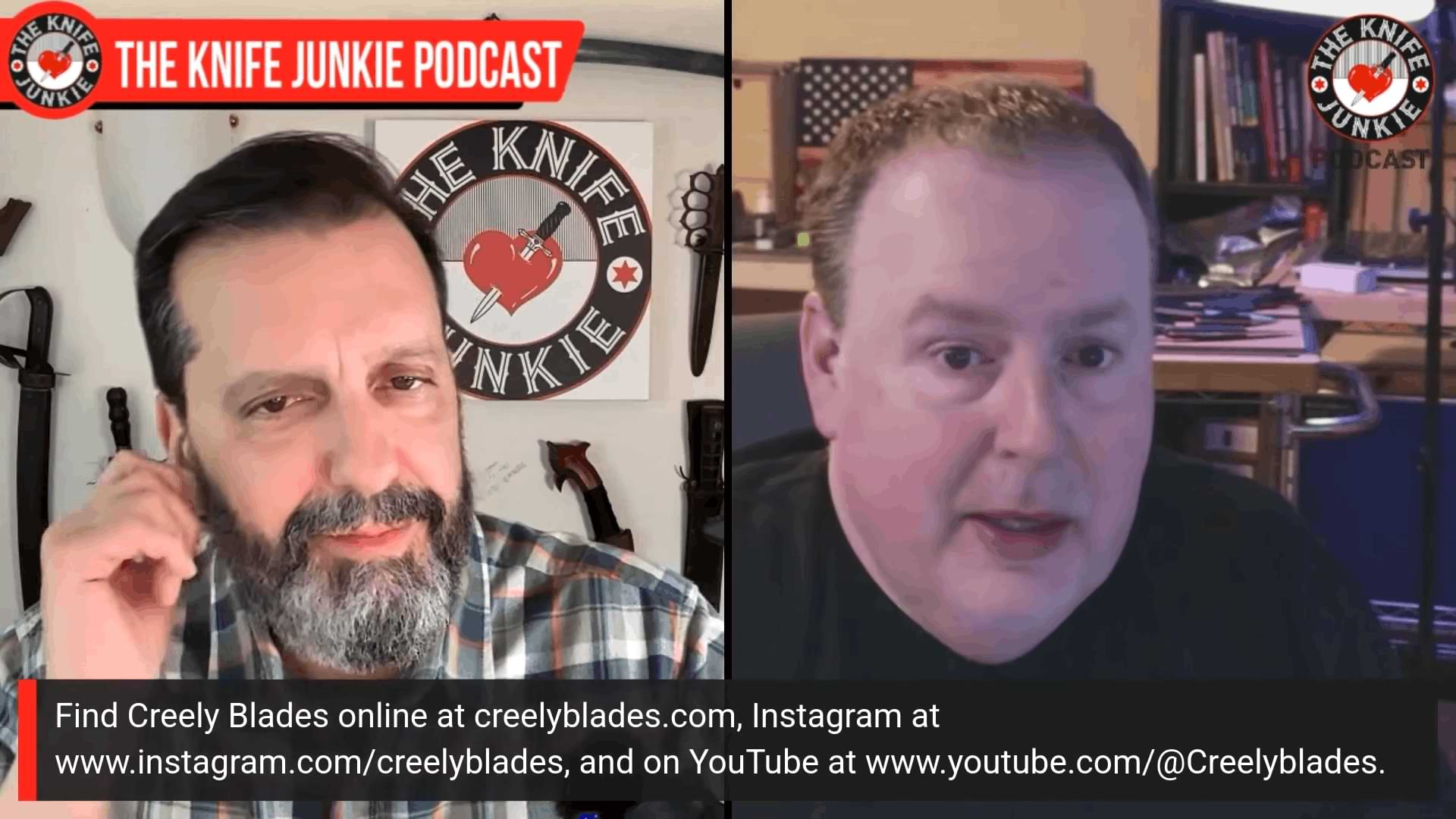
Gary Creely, Creely Blades: The Knife Junkie Podcast (Episode 663)
On Episode 663 of The Knife Junkie Podcast, Bob DeMarco welcomes Gary Creely of Creely Blades to the show. Gary, a custom knife maker and pastor based in Pennsylvania, is working to grow his operation from a one-man shop into a small but serious American knife company.
From Fishing Knives to Knife Making
Gary fell in love with knives as a kid, fishing the Schuylkill River outside Philadelphia. A cheap Japanese carbon-steel toothpick knife taught him how to sharpen, and the skill stuck. In college, he convinced the Blue Ridge Knife catalog that he ran a knife store and began reselling blades to friends at dealer cost. About 12 years ago, he picked up a grinder and started making his own knives after watching a video from Cut Brooklyn.
He learned through YouTube tutorials from makers like Sandy Jack and Walter Sorrells, backed by plenty of trial and error at the grinder.
 Steel, Heat Treat, and Geometry
Gary is serious about material science. He favors high-carbide powder-metallurgy steels such as MagnaCut, MagnaMax, and Rex 121. He does not chase maximum hardness, preferring to stay about two points below the ceiling to preserve toughness. He also discussed the transition from CPM to Era Steel for MagnaCut production, calling the new material a modest improvement.
His philosophy is simple: match the steel to the task, grind the blade thin, and make the ergonomics comfortable so the knife gets used rather than shelved.
Growing the Business
Gary has a clear target of two thousand knives per year. He has invested in a laser cutter, uses CNC grinding services from Larkin Precision Grinding, and has introduced 3D-printed PETG carbon-fiber scales and Kydex sheaths to lower prices. The Mako dropped from $280 to $210 as a result.
He also makes his own diamond-stropping compound, born of frustration with existing products. The compound uses diamond abrasive suspended in leather conditioner and is available in 0.5-, 1-, 3-, and 6-micron grits.
What Is Next
Gary teased two upcoming models: the Omnivore mini chef knife, moving to CNC production for a lower price point, and a new clip-point fixed blade with the working name “The Medium.” He also expressed interest in producing a folder design through an OEM partner.
Find Gary and his knives at creelyblades.com, on Instagram at @creelyblades, and on YouTube at Creely Blades.

Be sure to support The Knife Junkie and get in on the perks of being a Patron, including early access to the podcast and exclusive bonus content. You also can support the Knife Junkie channel with your next knife purchase. Find our affiliate links at theknifejunkie.com/knives.
Pastor and blade maker, @creelyblades tells @theknifejunkie how he is building a high-performance knife company in Pennsylvania, one Mako at a time. Steel science, smart heat treat, and a $210 price point. Share on XThe Knife Junkie Podcast is the place for knife newbies and knife junkies to learn about knives and knife collecting. Twice per week Bob DeMarco talks knives. Email Bob at theknifejunkie@gmail.com; visit https://theknifejunkie.com.
©2025, Bob DeMarco
The Knife Junkie Podcast
https://theknifejunkie.com
Transcribe Your Podcasts and Videos: https://theknifejunkie.com/magic (affiliate link)
Announcer: Welcome to The Knife Junkie Podcast, your weekly dose of knife news and information about knives and knife collecting. Here's your host, Bob "The Knife Junkie" DeMarco.
Bob DeMarco: Welcome to The Knife Junkie Podcast. I'm your host, Bob DeMarco. On this edition of the show, I'm speaking with high-performance custom knife maker, Gary Creely of Creely Blades.
Creely Blades first came on my radar through the videos of the Cedric & Ada Outdoors channel, where Pete rigorously tested knives, putting their steels, heat treats, and edge geometry to the ultimate test. The Creely Blades Mako was a golden child of those tests, as I recall, dominating in all categories and looking good while doing it.
Gary Creely lives and works in the great knife state of Pennsylvania, but the reach of his knives is truly worldwide. We'll meet Gary and talk all things Creely Blades, but first, like, comment, subscribe, hit the notification button, and you can download this show to your favorite podcast app. So do that so you can continue this listen on the go.
And if you want to help support the show, you can do so by going to Patreon or becoming a member right here on YouTube. Go to theknifejunkie.com/patreon or scan the QR code on your screen. Again, that's theknifejunkie.com/patreon.
Announcer: Why pay full price for gas and food? With the Upside app, you don't have to. Just open Upside, find your by-offers, and earn cashback when you buy gas or eat out. Pay like normal and get real money back in the app. No coupons, no hassle, just easy savings on things you already buy. Download Upside today and start putting money back in your pocket. Learn more at theknifejunkie.com/saveongas.
Bob: Hi Gary, welcome to The Knife Junkie Podcast, sir.
Gary Creely: Hello, it's good to be here. And by here, I mean my office.
Bob: Yeah, I'm here in mine, and it's really nice to meet you finally. I've, like I mentioned, I've known of your work for, I don't know, maybe going on ten years or a number of years, anyway, and have admired it from afar, especially for its performance and also looks. I'm a shallow guy; I love the way knives look, that is important to me. I love the look of the Mako.
Before we talk about your knives and stuff, let's first find out how you got into knives enough to make it your main passion.
Gary: So, as a little kid, I was into knives pretty early, probably around ten or eleven. I was born and grew up until about sixth grade in Norristown, Pennsylvania, which is just outside of Philadelphia. And then as I got to about middle school, my parents moved to Royersford-Spring City area, which is now like a big suburb, but back in the day, that was like the wilderness, or so we thought. And there's the Schuylkill River, which runs through there. I would fish almost every day in the summer, and that's where I started sort of appreciating knives, you know, snagging lines and using it as a functional tool.
And the knife that I remember the most, it was like a bigger Texas toothpick, but it was like a knockoff; it was Japanese and it was a carbon steel. So like the side panels, rather than being wood, they were like a paper and like a wood sticker. So it was not the most expensive knife, and it was carbon steel, it was super thin, and it was on that knife that I really developed sharpening skills on really crappy stones back in those days.
Yeah, and then from there, when I went to college, I got a—I don't know if you're familiar with the Blue Ridge knife catalog—but I was able to convince them in college that I had a knife store. And so I would get—you had to make a $100 minimum order. I went to college in the '90s, so a $100 order was like a little bit of money back then. And so I would get a bunch of friends that wanted knives, collect the money, get enough for a $100 order, and order knives from Blue Ridge, and swords, and blowguns, stuff that they sold at dealer cost.
Bob: Your folks have no idea how good they had it. You could have been selling drugs, you could have been the guy who buys beer for all the underage kids. Instead, you were buying knives and selling them; that's pretty cool.
Gary: It's true. I was going to college to be a pastor, so there is that.
Bob: Nice. You have this love of knives from an early age. I think it's funny that you described a large toothpick. I remember having a large toothpick that was—it had a scaler in it as well, and it was a knockoff, not a Case fish knife. Just like that, it had that big scaler. It was impossible to get sharp. I don't even know if it was real steel, but it's so funny. I had such a hard time when I was a kid getting stuff sharp, but here you were as a young'un getting it super sharp.
Gary: It was a carbon steel because it did patina, and it was really thinly ground. And so it wasn't a China knife, it was a Japan knife. And looking back, it was a really easy knife to sharpen if you weren't super skilled. Like I had some other knives that I had trouble getting sharp, but this one sharpened well, you know, a basic carbon steel on like just—it probably was an aluminum oxide. It was like aluminum oxide, an Arkansas stone, I remember that, they made a big deal out of that, and like another finer ceramic stone. And then I got a diamond plate, like about that size, and that really removed material well. And I sharpened knives, I sharpened my parents' knives, sharpened all kinds of knives. I had a knack.
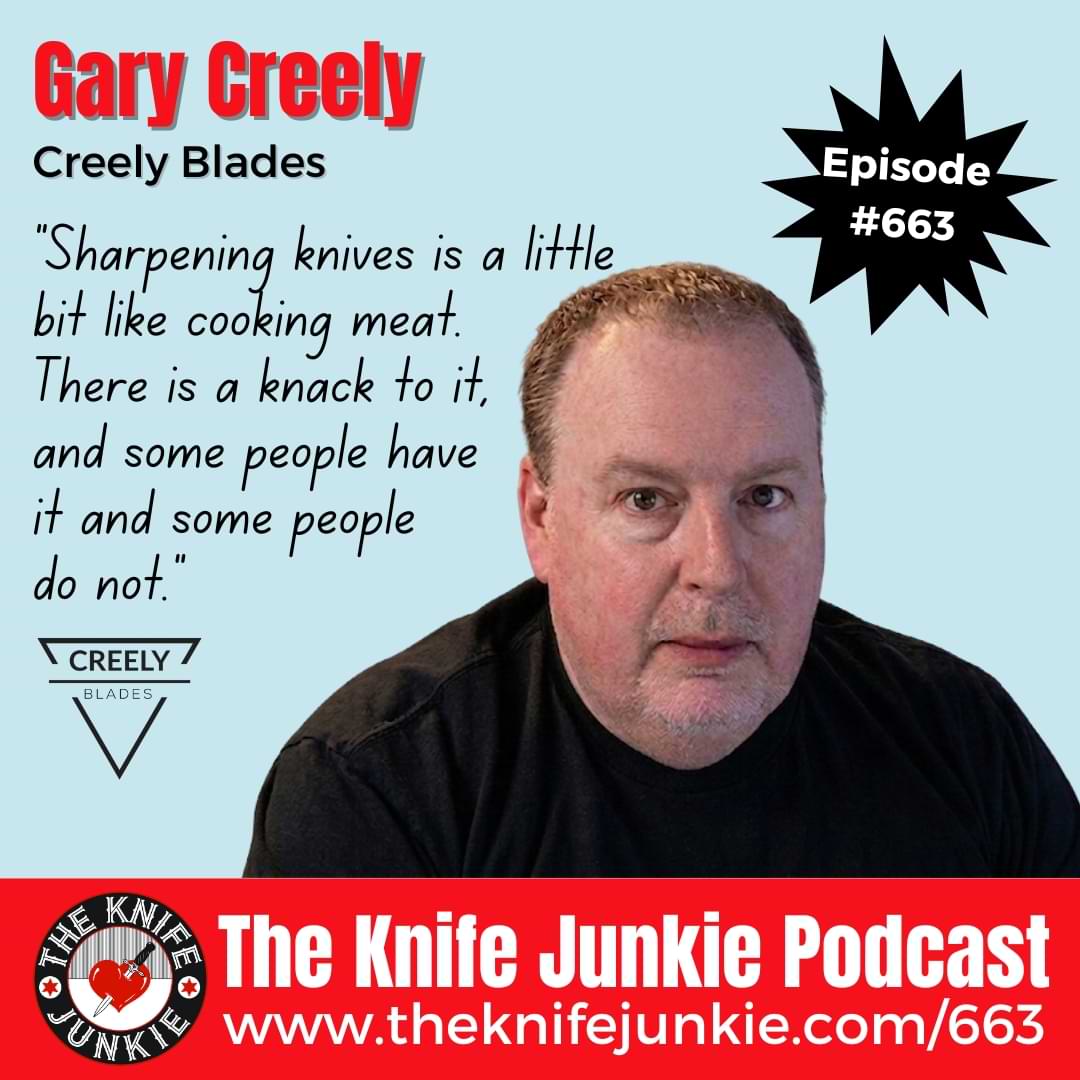
Sharpening knives is a little bit like cooking meat. Like there's a knack to it, and some people have it and some people do not.
Bob: Do you think that knack can be developed?
Gary: Yeah, but it's easier for some people to develop than others, you know, there's just an intuitiveness to it.
Bob: Yeah, I remember being at odds; my grandfather showed me one way to sharpen a knife, and then I had an art teacher show me a different way to sharpen a knife. And I remember just kind of being at odds at how to do it and then just kind of figuring out my own way of doing it. And eventually, I just ended up buying sharp knives and barely using them because I'm kind of a collector, you know, and I'm not much of an outdoorsman. But I know knives, which we will get to, knives and the steels and in the ways you make them, the way you heat treat them, don't require tons and tons of sharpening, and that's part of the point.
But we'll get to that in good time. So you're in college, you're selling knives, you're kind of a low-level dealer of knives, if you will.
Gary: Legal quantities.
Bob: Legal quantities, of course. And you are studying to be a pastor. Tell me how that fleshed out.
Gary: Well, I went to school to be a pastor, Eastern Nazarene College was the college in Boston, which has since recently closed, which saddens me, but... and then I took a church right out of college as a youth pastor and worship leader, so I kind of run the worship band and whatnot, pick out the songs, that sort of thing. And then about ten years after that, I took the church that I'm still at, I've been here about sixteen years, Brookside Community Church in Macungie, which is near Allentown, Pennsylvania. And so, yeah, so that was that path, and that is a challenging line of work, I will tell you that.
Bob: Tell me, tell me why.
Gary: You know, any time you're in a sort of something that is dealing with a lot of people and volunteers, churches can be kind of... one of the things is my church merged with another church, and that is not easy. So it was a little easier before that. It's just challenging, there's really high expectations, and one of the freeing things about knife making is: You don't like my knife? Here, I'll give you your money back, go away. You can't really do that at church.
So it's just freeing in that way, whereas, you know, sometimes you deal with some challenging things and some challenging people. And so it's tough, and you deal with people in their best moments and their worst moments.
Bob: Oh yeah. Here, I have a question for you; it's on the pastor topic. And that is: I've started going back to church recently with my family, my daughter kind of got us back into it, and it's been great. But I noticed that the church isn't as crowded as I remember it being. And I wonder if you've noticed a—because of people like me who stop going—and so I'm wondering if you're noticing a dip.
Gary: There is a very strong headwind for churches right at this moment. Now of course people try to map it out and be like, "Oh, the church is going to be dead in so many..." No, I don't think so. Like everything, there's seasons of growth and seasons of decline. And right now has been a season of decline, and it's not just churches, I think it's organizations in general, like the Rotary or the local fire hall or, you know, VFW or all of these sort of institutional things have struggled. People are just online, and it has been challenging.
And I think something's missing. You know, it's interesting, for all this online community, there's a great deal of loneliness. And so, you know, that's been part of the problems, just sort of a sociological thing that those kind of organizations... and it's a matter of the rich getting richer and the poor getting poorer as far as churches go. Larger churches have an economy of scale with everything they do. My church is relatively small, maybe seventy to a hundred.
So, larger churches have an advantage of economies of scale and everything they do. So, yeah, it has definitely been—and COVID was a gut punch, especially to certain churches in certain states. We didn't have to stop meeting here in Pennsylvania. So we did actually what we did was: I quick went on eBay and bought one of these FM transmitters, so I was like pirate radio. And so what we set up—we have a big field, we have like nine acres—so we have a big field, so we had people drive into the field and then we broadcast the audio on that FM frequency and they could just tune into the radio and stay in their car and then go home. It was really cool, it worked out well.
Bob: So I've always been sort of naturally suspicious of online community, as you mentioned, but one thing that has turned the ship for me at least in a small way is the online knife community. I've met a lot of really great people like Shane, for instance, who introduced me to you, and so many great knife makers and knife enthusiasts. I think it really is a pretty close group of decent people, I'd say.
Gary: I think there's some good online communities, and the knife community can be one of them. But one of the challenges—and that's because the knife community is so spread out globally and even across the country—but if there were a knife... like for instance, there was the Lehigh Valley Knife Collectors Club. They had meetings once a week, I would always say to my wife, "You know the first rule about knife club? Don't talk about knife club." But anyway, that was my little joke.
But it was a cool—it was mostly older guys, and they just got too old, some of them since passed. But I enjoyed going to the actual knife meeting and like I remember I did a sharpening class for them one time, and it was just a good—it was just a good time, something different. And I would much prefer that to online community, but it's not available. And so it's the same thing with online church. You know, if you're like for shut-ins or people that can't get to church, it's a great substitute, but it's not ideal. You know, it's the best thing to get people together between knife shows, between Blade Show or whatever. So yeah, no, there's benefit and value to it, but it is not a one-to-one replacement, that's the nuance to the conversation.
Well, tell us how this lifelong love for knives and then, you know, your college-day knife sales and all that, how did that lead to actually making knives? Tell us about that process.
Gary: You know, it was interesting. One of my regrets in knife making is that I did not start sooner. I probably started about twelve years ago, give or take, something like that. But I certainly could have been doing it a lot sooner. And I watched this video by a knife company called Cut Brooklyn. And Cut Brooklyn was this guy in Brooklyn who made chef's knives. And I was into higher quality chef's knives, I like to cook. And so I wanted one of these, but they were $500. $500! Come on, $500 for a knife? You know, I was like, "$150 chef's knife..." Now granted, this was ten or twelve years ago before everything got really expensive.
So anyway, I bought all this equipment, I probably have fifty or eighty thousand dollars worth of knife making equipment now, and I made my own. I made my own knife. I was like, "For that much money, I can..." you know, I got a cheap grinder and I started making knives; they were terrible. I don't have it here; I have one that I made, it was so bad it's embarrassing.
But slowly but surely improved, and it's interesting, I bought a horizontal—not horizontal, a vertical... yeah, horizontal grinder, and it came with some knife blanks, like these were drops from like New Jersey Steel Baron or something that they had. And one of the drops was a blank from this Cut Brooklyn guy that I wanted a knife from. No way! It was a ten-inch—you know, today he would charge a thousand dollars for that—it was a ten-inch chef's knife, French chef's knife. And I finished it out, so now I do have a Cut Brooklyn knife that I made, but it's his design.
So, yeah, and I enjoy—you know, I make a lot of the EDC knives, but I also enjoy cooking knives also, because those are the ones you use the most.
Bob: So how did you learn? I mean, did you watch videos? Did you have a mentor?
Gary: You know, as a young person, I was always interested in taking things apart, but unlike some, I could put them back together. And similarly, I just had to figure things out. My dad wasn't around; I didn't even know my dad until I was in my twenties, or thirties maybe even. And so I figured things out, and Generation X also helps kind of being self-reliant that way.
But there were two guys I watched a lot on YouTube. One was this guy from England named Sandy Jack and Jacklore Knives. I watched a lot of his videos and they were very detailed, he's very meticulous. I finally got one of his knives, but they're mostly bushcraft, Scandi-ground bushcraft knives. And then the other person I talked to a lot—not talked to, I didn't talk to him at all, but watched his videos, a lot of his videos—was Walter Sorrells. And I learned a lot from him, and honestly, these videos are instructional tutorial videos. I mean, how much more are you going to have if the guy's there?
So I was able to learn a lot about what I cared about, about what I didn't care about in terms of making a knife and what was important. So, you know, I had a lot of instruction from—and odds and ends, other guys online that I watched make knives also. So that was my training and I just trial and error and getting better. And here's the long and short of it: The hardest part of making a knife is grinding it. And when you learn to grind knives, you have to burn through a lot of steel in order to get proficient at it. And by that, I mean you ruin knives. Well, you don't ruin them; as they say, knife makers don't make mistakes, they make shorter knives.
And so that's what it was, and I got proficient at freehand grinding. Of course, I don't do as much freehand grinding, and I also use jig grinding. I do a fair amount of jig grinding; some guys are very proud of not jig grinding like it's a bad word.
Bob: Seems like jig grinding could be an excellent way to, you know, make things uniform and kind of speed the process up if you're trying to make a bunch of handmade knives. But you said something and it makes me wonder: What is your idea of the perfect knife? Like, what's the recipe as you go into kitchen knives, outdoors knives, EDC knives? You make all three of those kinds of knives, but going into them, what makes it a perfect knife?
Gary: So my values in knives—you know, there's all these communities and all these corners of the knife world, and each one of them has a different set of priorities. And, you know, you have the art knife crowd and that's a particular set of priorities; you have sort of the guild knife building group, that's a little different; you have your forging sort of ABS master smith; all these corners of knife making. And each one of those has different sets of values.
My values are different than most of theirs. Firstly, I'm very interested in the material science that's available with the steels. And it doesn't always have to be the most exotic newest steel, but matching a steel's strongest properties to its task. An example of that, for instance, is I watched JoX videos and I was like, "You know what? I can design a knife around that test and do well on that." I probably could have used 3V, but I used 8670. It's a basic carbon steel. And he didn't break it, and it was his knife of the year.
So, yeah, and so it was a matter of matching the task to the design and the steel. So what I value: I value the steel and that it's matched to what that knife was supposed to do. I do favor higher carbide content, high-tech powdered metallurgies that are very cleverly designed. So that's one. Secondly, the heat treat. Now there are a lot of guys out there that run the heat treat all the way up to the top of what it can do, but I don't find that—one of the things: When you run a steel at its maximum hardness, you end up giving away a big chunk of toughness. You could just bring it back a little bit from there and then gain 90% of that toughness and have the top edge.
There's sort of a sweet spot, generally about two points below its max. And that's so for heat treat I try to be in that neighborhood. You know, when MagnaCut came out, you had people that were heat treating that at like 58 and 59—like, what are you doing? Especially MagnaCut. Interestingly, this new MagnaCut's heat treating a little bit harder, so like I'm doing that at about 64, which is pretty hard, whereas MagnaMax that I've been doing in the same heat treat protocol is 62; it doesn't heat treat as hard as MagnaCut, believe it or not, even though it probably has double the edge retention. Hardness isn't the whole conversation.
Secondly, geometry's super important. At the end of the day, geometry cuts. That's why Opinel knives can continue to cut even when they're dull because they're so thin. So trying to grind them as thin as I can. And then I care about ergonomics. I care that it's comfortable, I care that it is not laborsome to use. And because the geometry's right, it cuts well. And so all these things add together to be sort of my priority in terms of a perfect knife: the ergonomics are good, the geometry's good, the steel is high quality and well heat treated. So it functions as a tool. I don't want somebody to buy my knife and put it into a closet or not use it; I want it to get used.
Now, unlike say the Essees or the Tops or some of these other companies that have like these no-limits warranties—dude, if you abuse the knife, I'm not going to warrant it. I'm just not. I am not going to encourage you to have poor knife habits. So like if it fails for some other reason that's something about how it was made, yeah, lifetime warranty in that regard. But one guy sent me a knife back once with the tip stuck in a chunk of oak. And it was a Mako, so it was like, you know, thin geometry. He's like, "Is this covered in warranty?" Not really. It's like, I'll reshape the tip for you, but no.
Bob: You mentioned before that some people are crazy to take certain steels up to a certain heat treat. Do you think that people just push it so far just so that the number is high, the HRC number is high, or what do you think the reason for doing that is?
Gary: I think sometimes for some of them, there is this sense that like if you do this extreme number, you are doing things that other people cannot. But really you're doing things that other people will not. And so, you know, I think it's and I also think it's just to chase the maximum and the extreme, but I have just learned that that extra couple points is not worth what you pay in toughness. So, yeah, so for that reason I don't chase the super extreme high. Like I was running the Era steel—Era steel hardens probably a point harder than CPM MagnaCut did.
And so like I was doing like 62 before. Now I'm like between 63 and 64, and it's really nice. I think the Era steel MagnaCut is nice. I sent Pete two MagnaCut knives, two Makos, one in CPM MagnaCut and one in Era steel MagnaCut, and he's going to do his cut test with those two steels, same protocol, heat treat protocol.
Bob: Okay, so there are two companies making MagnaCut now? Is that what you're saying?
Gary: Well, no. So CPM went out of business and closed their doors. Right. Okay, and now Era steel, which is a French company that has a Swedish mill, is now making the steel. Niagara Specialty Metals is the one who is rolling the steel into sheets and selling it in the US. Okay, alright. I need a thorough going-over that situation just to internalize it.
It's interesting. I mean, this was steel that was made in upstate New York, and now it's made in Sweden. It's the same recipe, but it's not—you know, different machines, newer process. CPM was really getting—their machineries getting dated and sometimes there were inconsistencies. But now Era—this Era steel is not a downgrade by any means, it's an improvement, a modest one, but improvement. I can tell when I'm sharpening it, you know, the way the burr comes off in a big piece or big chunks; it's really nice, especially at 64. So it's been selling well, too.
Bob: Because I specified Era steel. Oh, okay.
Gary: I'd like you to show us some of your knives and tell us as someone who loves super steels and exotic—or as you said high-tech, high-carbide steels—what was it like when MagnaCut came out and what about it do you love as a maker as opposed to as a user?
So when MagnaCut came out, I was early to that party. I got some of it to Pete, and I got some of it to DBK. This was like in the middle of the pandemic. And so they did their video, and it was really significant. Now it was a bushcraft and I put in a Scandi—like a 23-degree Scandi grind, and I really took some extra time in sharpening it. So they were liking the sharpness. And so MagnaCut's like kind of a stainless Cru-Wear. So it's a real nice sharpener steel. It's not the highest edge holding; S30V probably beats it a little bit in edge holding.
Although S30V doesn't get as hard usually, so it usually ends up being pretty similar because the MagnaCut ends up being a couple points higher hardness. But they're similar in edge holding, but MagnaCut brings the toughness really high for a stainless steel, like approaching one of the toughest stainless steels out there. So you can run better edge geometry and get away with it. And that, yeah, and it sold really well. It's been a—from a maker's point of view, it's a marketing, you know, boon. But it's a good steel. It's not the best steel, and it's not the best steel for everything, but it's a really good steel and it's a really balanced steel. There's not too many contexts it would not work well in.
Can we see a couple of knives? I see Makos over your left shoulder, I think.
Yeah, let's take a look. So these are Minnos. What's interesting, one of the new things that I've been doing is I have been doing 3D printed scales to try to help get pricing in line, also supply chain for me and different things. So these are actually 3D printed scales. This is a MagnaMax Minno, there we go. That is a sweet little knife. And it's got the same profile as the Mako.
It's very similar in that regard, and then we have Kydex; my Kydex guy just does excellent Kydex work. Nice. And these 3D printed scales are a PETG infused with carbon fiber. They're super functional, they're super grippy, it's perfect. And I do have G10, it adds 30 bucks, but a lot of people don't opt for that. Now here's a Mako; these are G10 scales, although I'm making them in 3D printed too. Similar kind of deal. Oh, this one's in Rex 121.
Can see that or not? Yeah, I can see that towards the tip of the blade. That's a cool blade to mark it. Yeah, that's fun. Until Spyderco made them, I was like the only guy in the country making significant numbers of that steel.
Here's a model I haven't released yet in any large scale, but this guy... let me see here. I have some scales... oh, these are ugly scales. I'll put them on there anyway. This would be the scale for them. I don't think those are ugly. Go ahead, put that together and drop it in the mail, that ugly knife. No, I think that looks beautiful.
This is a hunting knife. This particular one, and this is hand ground, but you know eventually they won't be, but this is my drop point hunter. And this is in the very first sheets of MagnaCut that came out. So that's the research melt, like the very first ones. And honestly, it was some of the best.
Who knows what this knife is?
Bob: I don't know what that is, that's a beauty though.
Gary: Reserve your knives! They made some beautiful blades; it's unfortunate what happened. Or never available as the case... that's the Folklore, that's the bushcraft. So this is a normal one, the classic. This is in MagnaCut and at the time not many people were making this kind of knife in MagnaCut. And this beast with this logo... that is pretty. And this stock is a shade thicker, so that's quarter-inch stock. So this is the one that JoX tried to destroy.
Bob: What is your process? Take us through your process.
Gary: So the process is somewhat different depending on the particular knife. So the Folklores, for instance, they get cut out, and then they come back in the shop, we clean up the perimeters and we surface them. They go out for heat treat, they come back, we grind the bevels in, put the scales on. I have the scales CNC'd, but we finish them to the knife on-match. So that's—I would consider that—that one's pretty much an in-house custom, because there's a lot of hand work with that one, and that would be like the CU series for custom.
Now the Makos and the Minnos are what are the PG series. Now I did end up buying my own laser, so they're lasered in-house now, and we clean up the perimeters, send them out for heat treat, then they go to Larkin Precision Grinding in Kent, Washington to get double-disc ground to thickness and then bevel ground. Then they come back to us, we check them over, we clean them up, sometimes on some surface conditioning belts, we sharpen them, we laser them, we put the scales on, and that's the PG series.
Bob: My goal is that most things will be PG series because PG stands for...
Gary: Precision ground. So it's CNC ground, the bevel. As are a lot of knives. So for instance, Bark River, their process was they would have them CNC ground like that, and then rather than sharpen them with a V-edge, they would on a slack belt sort of surface condition them and bring them to a convex edge, including the flats, all in one fell swoop. Yeah, and then put the scales and do all that.
So a lot of companies do that, a lot of guys out there use these grinding services, and occasionally some of them aren't honest about it. But it just makes sense; I have to do two to three hundred knives at a time in order to use that service. So it's an investment, there's tooling setup costs, there's turnaround. And then there's if you're doing MagnaCut or MagnaMax or 3V or whatever you're doing, to buy enough steel to do 300 blades, that's an investment. So capitalizing this knife business is the challenge.
Bob: Am I correct in presuming that it started as a hobby and has turned into a business?
Gary: Yes.
Bob: When the hobby—when you started the hobby and it was all, you know, in its first blush and you were excited about knife making, did you have any inkling of what the business was going to be like and is it more complex than you expected?
Gary: I own another business, that's a pro audio sound light and video integration company. And so I had a sense of what it meant to run a business. I'm only 50% owner of that particular company, but I had a sense of what it takes to operate a business. I quickly realized that the amount of labor it takes to make knives by hand unless you're legendary and demanding top dollar for your knives, it's really hard to make a living making knives by hand.
Most of the guys that do it, you show me a full-time knife maker doing it that way, I'll show you a full-time knife maker with a wife with a good job. Or somebody who's just super frugal. I mean, unless you've kind of come to that point where whatever you can get top dollar for whatever you make, there are guys like that out there that have built up that kind of following. So I quickly learned and I really wanted to be a knife company as much as a knife maker, as a custom maker.
Like so I've got a couple guys that work for me that grind and do other finishing and eventually I'm going to need more. And so my hope is to develop an actual knife company, you know, small like Spartan or like TJ Schwarz or these kinds of guys, that's the sort of avenue that I'm hoping to take: being an actual company, get enough knives out there.
Because I have a goal, and the goal is two thousand knives a year. I think if I can make two thousand knives a year, I can pull most of my income from knife making, which takes a burden off my church, and I can pay my two guys close to if not full-time. Yeah, that's the goal.
Bob: That's amazing that you say I want to be a—because from the outside, from my perspective, you're already that. But, you know, I can't judge; I'm not in your spot. But, you know, it's just interesting. And it's also cool to see people who are already accomplished such as yourself still striving and wanting more and better. I think your—you're talking about maximizing efficiency for a handmade knife maker; it seems that with the people I've spoken with, it seems like that is the winning recipe. You handmade some knives, but you have to have a line of more easily producible knives going on the side. It just seems to be the winning recipe. You never want to give up the handmade stuff, that's the stuff you love to do probably more than anything, but still you got people wanting your blades.
Gary: Well, at the end of the day, like even our PG stuff, our hands are on it a whole lot. The model these days are guys make a few knives and then have knives made in China. Like that's a pretty common and that is a tempting model because I could probably have my Mako made in China for eleven dollars, maybe nine, in 8Cr or 9Cr or whatever. And my cost is an order of magnitude more than that to make it here. And now granted, I can be assured that the steels are what the steels say they are.
When stuff comes from China, you can't always be sure of that. Culturally there, changing out materials is pretty acceptable sometimes in their sort of manufacturing culture. And that's a really big deal when you're like into the knife steels. So doing it here is more challenging. Like I want to do a folder, I have a folder design, I actually want to talk to a company about OEMing. Now I've talked to some, but a lot of these companies are already almost at maximum capacity, and so bringing on somebody else's design is just challenging.
But I'd like to bring on one. I like folders, I like all kinds of knives. It wouldn't be as profitable as building fixed blades in-house, but it would just be an added—I like folders. For every one person that buys a fixed blade, there's probably thirty people who buy folders.
Bob: Have you noticed the trend in pocket-carry fixed blades? Well, I mean, that trend is there, has that affected your business at all?
Gary: Yeah, I was at the right place at the right time in that regard. I always preferred smaller knives. Like guys carrying big knives, I'm like, "Dude, what are you doing?" Especially here, it's sort of suburban and people are going to look at you. But yeah, you have a little in-the-pocket knife, who cares about that? And so yeah, I like them, I think they're practical and handy. One of the things about the Minno is, you know, you can just throw that right in your pocket. You don't even need a clip. I have pocket clips for them, UltiClips for them. And I used to do leather and now I'm doing Kydex.
Sales have really jumped with Kydex over the leather. Some guys love leather, I like the leather too, but the Kydex is and it also has cut cost out of it. So actually believe it or not in these days of—I just went to Chipotle for three of us and it was fifty-five dollars—in these days of expensiveness, it's like I was able to lower the price of the Mako and the Minno. At one point the Mako was 280 with a leather sheath and an UltiClip. Now it's the same steel, same blade is 210 with 3D printed scales and Kydex.
And the 3D printed scales are fine. And there are going to be people who say—and some of them have said—"Oh, that's cheap, that's junky," because people—now this material is better than the PLA most people print things out of. But they're perfectly durable enough, and I do have available G10 if somebody really wants G10s, that's 30 bucks. But the funny thing is very few people want to pay the extra 30 dollars for that.
Bob: And you also developed those strapping compounds, which are kind of interesting. Those are yours?
Gary: Yeah, I developed it because I didn't like the other stuff I was buying. I developed it because I didn't like what was on the market because it had a couple issues. Some of them were in pumps but they were thin and they just dribbled out and they were like they would dribble like off the side of the strop and you'd lose it. Others of them spray on there and then it's like going every which way and you lose some and this stuff's expensive. And they're usually in alcohol or glycol or something or water or a combination of those. And those aren't good for leather.
So I developed—I had this really high-quality—I used it for my Red Wing heritage boots—this really high-quality leather conditioner. And I was just like, "I wonder what would happen if I put diamond abrasive in that?" And so that's what I did. I mixed it up and happy accident but it really suspended the diamond really well. Most of these other ones, the diamond's all at the bottom after a little while. I still say shake it up, but it suspends the diamond really well.
It's about the consistency of shampoo. And so you just put a little line of it on, take your finger, rub it in. So that little half ounce goes a really long way, there's four carats of diamond in that half ounce. Rub it in there, and then the feeling on the strop is so nice because there's like tannins and stuff in the leather conditioner. We also put some cologne in there too to make it smell nice. But nobody's commented on that; I've sold quite a bit of it, nobody's commented on that yet.
But you can tell even with—it's one, three, and six micron and I have some collaboration with Scott Gunn where it was some of his polydiamond emulsion, mine's monodiamond. If you don't know what the names don't worry about it. But so I have half micron, one micron, three micron, and six micron. But yeah, it just was a product I use it for everything that I make gets sharpened and I do one grit and I've been lowering and lowering and lowering that grit, I'm down to 600 grit now and then just buff it with the compound.
And it's a really nice bitey sharp edge. I shoot for being a little sharper than a Spyderco because Spydercos are pretty sharp; that's a pretty high bar. And so that's my goal. Not all knife makers are good sharpeners; some get to knife making from different paths and sharpening isn't one of them. Some of them send them out to sharpeners even. But yeah, but anyway I developed that, that's been a big thing and it's been a—I thought it's a real good product, I mean I believe it to be the best product of that nature on the market.
And I thought everybody's just going to trip over themselves to get it and it has not been quite the response I had hoped in that regard. But slowly and surely every order from like Sharpening Supplies, they're one of the bigger dealers, each order and then more and more people are throwing it into a knife order and so slowly it's been growing. It's not cheap to make, but I didn't make it to make money and get rich on stropping compounds; I made it because I needed good stropping compound and I didn't like the stuff I was using.
And I really like this stuff, it doesn't—it just solves... and other guys use aluminum oxide which with these modern steels or the green stuff or the blue stuff with the whatever you happen to find... it does not cut carbides. Vanadium carbides are harder than the abrasive that's in there, so you're not able to—it's not as effective, it's not as aggressive on those kinds of steels. So yeah, it's really an effective product. And more and more people are trying it; Shane got some, he really likes it.
Bob: This brings me back to growing your company and having a knife company as opposed to being a custom knife maker, you want to be a larger operation. What do you want the philosophy behind Creely Blades to be? And what type of a knife company would you call it? An outdoors company? A do-all knife company? Tell us what you want the company to be and the kind of products you want to be putting out once you're larger.
Gary: You know, that's an interesting question because my interests are pretty eclectic as it relates to knives. And so there are some areas I'm not interested in, but there's a lot of areas that I am. And so I think ultimately, I just want to be known as a high-cutting tool knife kind of knife company that, you know, I'm not going to make a lot of mokuti, I'm not going to make a lot of Damascus, I'm not going to make a lot of Damasteel or these kinds of things.
It's going to be high-quality steel, high-quality design, like high-performance designs, and it's going to be that kind of company. To put it into perspective, I kind of grew up on and kind of what got me down this path was Spyderco and their use of steels and the way in which they had so many different steel options. That really interests me. So probably my niche will continue to be just offering blades... what I think's really cool is offering the exact same blade in different steels.
Because there's so many variables when you compare... like every Mako is ground with the same CNC file and should be almost the same geometry. And so if you have a Mako in LC200N and I just sent about 270 MagnaMax Makos that will eventually be PG series, or if you have a... whatever model, just to be able to have two of them and see how those steels actually compare when you removed a number of variables that would affect your perception of the steel.
Both of those steels are going to be heat treated, not exactly the same, but with the same philosophy. So it's just a really good way to compare the steels, and there's a segment of the market, a lot of the people that watch Cedric & Ada and are into that type of thing. There was a guy named Mike Christy, you heard of Mike Christy? He was big into sharpening and he was kind of big in YouTube eight, ten years ago. And actually I developed the Mako with him and developed Rex 121.
So the Mako started as this Rex 121 knife, then I started doing different things, then I got the CNC grinding and it is an undertaking. So to put it into perspective, so if a minimum batch is 250 to 300, by the time you buy the steel and buy, you know, all the things that you need to make that knife, one model is like a $25,000 plus-or-minus investment just to get it going with a minimum batch in the US.
But in China, you know, if you have $5,000 you can probably get them to make you a batch. And so it is more challenging to do stuff here, but I'm committed to do that and I don't, you know, I don't have anything against knives made elsewhere. It's just I want to try to make them here, I want to try to keep them here and it's not always easy to do. Like I was talking to a Benchmade rep at the New York Custom Knife Show and I was like, "Why are your knives so expensive? What are you guys doing?"
And he's like, "I know, I know..." See, what happens is if you make your knife expensive, you can't put that toothpaste back in the tube. When you've overstepped that far... so what do you do? So you come up with new models that are cheaper. And so I think that's kind of—they know that they did that, I think that they know that they did that. But I was saying to him, "See this Mako? If you made this, it'd be a hundred dollars more."
It's like a big lie that you can't go back on. You've already told it and you've already invested... not that I'm saying they lied, but yeah it's tough. If you sold that knife for a certain price, let's say a knife for $300, and like, "You know what? We should probably sell this for 220." Now you've got this whole group of people that feel totally slighted because now it's $80 less, "Why didn't I buy it then? I should have waited."
So that's why I'm always careful. It was very tempting during COVID because you could not make knives fast enough. People had those unemployment checks and they were ready to spend them. And so I could not keep up, most companies couldn't keep up, then you couldn't get materials and then all the vendors that you used were backed up. So it was really challenging to make knives then, but if you had them you'd sell them.
And so I assume Benchmade saw that and was like, "Alright, let's bring that price up until we get to where we can sustain it." But I think those of us that look down the road, a few chess moves down the board, it's like this is not going to stay like this. The world is not ending, perhaps. It's not ending, and there will be chances to buy knives in the following year. And so now we're well on the other side of that, and I think the knife industry is a little bit on a downslope a little. I won't say it's crashed, but back to normal levels, I would definitely say that.
I mean, it's a pretty saturated market, I would say. It is. And so to me, like I always—when I wanted knives, I would look for a company like mine, small, boutique-y kind of, a little more hands-on, something a little off the beaten path. And I think that's a little bit of what we represent now, until one day if we're bigger we wouldn't represent that. But at the moment...
Bob: Something with a little soul.
Gary: Something with a little soul, something that had more hands on it in the process and that kind of thing and a little variation from one to the next.
Bob: Gary, before I let you go, what do you have in the offing? What design ideas are you stewing over that you look forward to bringing out?
Gary: There are two models that—in fact I was just talking to one of my guys today—there are two models I really want to bring out, but I want to switch at least one of my models over to a PG series, that's the Omnivore, the small mini chef's knife. Right now they're hand ground and I have about 100 MagnaMax ones to hand grind, that's going to be exciting to people. But once I get through all that, I want to move that into a PG series because that's a really, really practical useful knife in the kitchen.
I might even make Kydex for it so you could take it out and be sort of a camp knife or whatever, perfect for that. So that's kind of moving one knife from this category, but then it would lower the price. So right now that knife is $350, it's hand ground. So if it were in MagnaCut, which is what it is in, and I had it CNC ground, it would go down to say $300. And if I did it in AEB-L, it might go down to 225 or 245.
And so what I'm actually probably going to do is I'm not going to do it in MagnaCut, I'm going to do it in MagnaMax and AEB-L. So if you want a cheaper one you get the AEB-L and I'm going to really push the AEB-L's hardness as hard as I can get it. That'd be a really nice functional serviceable nice relatively inexpensive knife and then do the MagnaMax. But that's a model I already have.
I've been working on this model and I actually wanted to—I had a 3D printed one that's in glow-in-the-dark blue blade with a black handle, but I don't know where it got to. Oh, wait, it's over here! I swear to you, I was looking all over for this thing all day. I'm going to switch to the knife cam here.
This guy. Ooh, that looks nice! Clip point, gorgeous. Yeah, I like the clip point. So it's a spot in my lineup that, you know, is that middle—that middle length.
Yeah, it has a really, really nice profile all the way around, handle included. It's just beautiful.
Gary: Thank you. So I'm excited for this, all the guys are. It's super comfy, it's just got right now the working name is "The Medium." I don't know that it will be "The Medium" ultimately, but perhaps it will. Perhaps it will.
It has a really nice profile. Well, Gary, thank you for showing us that. I know we're all excited to see it coming out whenever it does. I want to thank you for coming on the show. Tell people how they can keep in touch with you or keep up with your work more importantly and get one of your knives.
Gary: Yeah, so I work a lot out of the website. You know, as of late, a lot of guys know that Instagram and Facebook and even to a lesser degree YouTube really kind of has not shown knife content lately. But I am on Instagram, and you can find me there, @creelyblades. I am on YouTube, Creely Blades. I do have a podcast. And you can go to my website at creelyblades.com. And if you want the links to the YouTube and all that, just do creelyblades.com/links and there's links to the Instagram, to the podcast, to the YouTube, the Facebook, my vCard, anything you might want /links at Creely Blades. So, yeah, just working to check all the boxes you need to check these days to run a business.
Bob: Yeah, and you're doing a bang-up job so far and I can't wait to get my hands on one of your blades, especially "The Medium," that sucker looks gorgeous. Anyway, thank you so much, Gary. I really appreciate you coming on the show.
Gary: Thank you, thank you for having me.
Announcer: Adventure delivered. Your monthly subscription for handpicked outdoor, survival, EDC and other cool gear from our expert team of outdoor professionals: theknifejunkie.com/battlebox.
Bob: There he goes, ladies and gentlemen, Gary Creely of Creely Blades, making some of the most high-performance EDC, outdoor, and kitchen knives using the top steels, amazing heat treat, and blade geometry. So go check him out on Instagram and on YouTube. Alright, thanks for watching. For Jim working his magic behind the switcher, I'm Bob DeMarco, saying until next time, don't take dull for an answer.
Announcer: Thanks for listening to The Knife Junkie Podcast. If you enjoyed the show, please rate and review at reviewthepodcast.com. For show notes for today's episode, additional resources and to listen to past episodes, visit our website, theknifejunkie.com. You can also watch our latest videos on YouTube at theknifejunkie.com/youtube.
Share This With a Friend >>>
For early access to The Knife Junkie podcasts and YouTube videos, receive Knife Junkie stickers and be entered into the monthly knife drawing giveaway, join The Knife Junkie’s Patreon group of awesome supporters.
Let us know what you thought about this episode. Please leave a rating and/or a review in whatever podcast player app you’re listening to. Your feedback is much appreciated. Email theknifejunkie@gmail.com with any comments, feedback, or suggestions on the show, and let us know who you’d like to hear interviewed on an upcoming edition of The Knife Junkie Podcast.
To listen to past episodes of the podcast, visit theknifejunkie.com/listen.

Shopping for a Knife?
Support The Knife Junkie Podcast and YouTube Channel by Buying Through My Affiliate Links
 3 Dog Knife (25% off hardcore Alaskan-made knives with coupon code “knifejunkie”)
Angle Pro Knife Sharpener
Artisan Cutlery
Bamba Forge
Civivi Knives
eBay
Jack Wolf Knives
James Brand
Knives Ship Free
Off-Grid Knives
Sencut
Smoky Mountain Knife Works
Tiger Edge
T.Kell Knives (Get 10% OFF with coupon code: “knifejunkie”)
Vosteed Knives
WE Knives
Other Products and Services
1Password
16-in-1 Multipliers
Dark Age Defense
Podcast Hosting
Groove (Replace 17 Apps and Services in Your Business)
Groove.ai (All-in-one AI solution)
Knife Books
Rakuten (Cash Back for Shopping Purchases)
Shockwave Tactical Torch
StreamYard
Upside App (Cash Back for Gas Purchases)
SOS Emergency Sleeping Bag
Survival Saw
Wilderness Survival Skills Course
Work Sharp
Work Sharp Rolling Knife Sharpener
“The Essential Skills of Wilderness Survival” Book
Follow The Knife Junkie
Visit The Knife Junkie website
Email The Knife Junkie
Follow The Knife Junkie on YouTube
Follow The Knife Junkie on Instagram
Follow The Knife Junkie on Twitter
Join The Knife Junkie Facebook Group

Affiliate Disclosure
In the name of full transparency, please be aware that this website contains affiliate links, and any purchases made through such links will result in a small commission for The Knife Junkie channel (at no extra cost to you). If you use these links to make a purchase, TKJ will be rewarded with credit or a small commission on the sale. If you don’t want to use these links, no problem. But know that I truly do appreciate your support.