David Baker: The Knife Junkie Podcast (Episode 665)
The Knife Junkie Podcast Episode 665 brings host Bob DeMarco face-to-face with one of the most recognizable names in the blade world. David Baker spent years on Forged in Fire as both the maker of the example challenge weapons and a judge. Now he is taking his skills on the road for a new self-produced show called Baker’s Blades.
This episode covers everything from his unusual Hollywood origins to the new project he has been building toward for years.
A Career That Started on the Dance Floor
Before swords and steel, David Baker came to Los Angeles to be a dancer. He appeared in Grease 2 and a number of TV commercials before a knee injury shifted him toward acting. After about six years of acting work, he found himself teaching stage combat to actors in Burbank. That class is where everything changed. He started making swords because quality stage weapons simply were not available. He learned by watching legendary bladesmith Jody Samson, the man who built the original Conan swords, and eventually landed a gig designing and building weapons for the Spanish television production Queen of Swords.
Forged in Fire: Inside the Job
Baker was part of Forged in Fire from the very beginning. His job was to build the example weapons for each episode, often with only about 10 hours per build, and frequently doing the work in the early mornings and late evenings at the studio. The show expanded rapidly from an initial order of 10 episodes to seasons with as many as 50, and Baker was building weapons through all of it.
One of his favorite memories from the show is the salt trick used by a colorblind smith who sprinkled salt on his blade to judge heat. Since salt melts at roughly the same temperature needed to quench most blade steels, the method was both practical and brilliantly simple.
Baker also pushed hard to make the weapon tests appropriate to the type of blade being tested. He wanted the show to reflect honest weapon performance rather than just spectacle. Most of the time, he succeeded, and the blades held up.
Baker’s Blades: A New Kind of Knife Show
The new show is called Baker’s Blades, and the sizzle reel is already available on YouTube. The format pairs motorcycle travel with historical weapons research. Baker rides his 2016 Indian Vintage motorcycle, nicknamed Pearl, to locations across the United States associated with historically significant bladed weapons. He researches the history, gains access to the original or related artifacts, and then recreates the weapon in his shop.
The pilot was filmed near the National Museum of the United States Army. The subject is a famous American blade that he is keeping under wraps for now.
The show is a collaboration between Workaholic Productions and Compass Productions, the company run by his wife, who handles the organized production side of the project.
Where to Find David Baker
You can watch the Baker’s Blades sizzle reel and subscribe on YouTube at @BakersBlades. Follow along on Instagram at @bakerblades and connect on Facebook. To browse his work and learn more about his knife and sword making, visit davidbakerknives.com.

Be sure to support The Knife Junkie and get in on the perks of being a Patron, including early access to the podcast and exclusive bonus content. You also can support the Knife Junkie channel with your next knife purchase. Find our affiliate links at theknifejunkie.com/knives.
From dancing in Grease 2 to building swords for TV and judging Forged in Fire, David Baker has lived a life most of us only dream about. Now he is hitting the road on his Indian motorcycle to recreate historic blades. Share on XThe Knife Junkie Podcast is the place for knife newbies and knife junkies to learn about knives and knife collecting. Twice per week Bob DeMarco talks knives. Email Bob at theknifejunkie@gmail.com; visit https://theknifejunkie.com.
©2025, Bob DeMarco
The Knife Junkie Podcast
https://theknifejunkie.com
Transcribe Your Podcasts and Videos: https://theknifejunkie.com/magic (affiliate link)
Announcer: Welcome to the Knife Junkie podcast, your weekly dose of knife news and information about knives and knife collecting. Here's your host, Bob the Knife Junkie DeMarco.
Bob DeMarco: Welcome to the Knife Junkie podcast. I'm your host, Bob DeMarco. On this edition of the show, I'm speaking with historic weapons recreation specialist, knife maker, and Forged in Fire judge, David Baker. David has been in the entertainment world for most of his career, working on both sides of the camera in a variety of roles, but it was his love of knives, swords, and combatives that eventually made him a household name. As an integral part of Forged in Fire, David made all of the example challenge weapons featured on the show and got to test the work of some of the best bladesmiths around as a judge.
Bob DeMarco: Well, now David has a new blade-focused series that just wrapped shooting, and I can't wait to find out more about it from the sizzle reel. I can really say with certainty it's right up a Knife Junkie's alley. We'll meet David and talk all about his new series and so much more, but first, be sure to like, comment, subscribe, hit the notification bell, download the show to your favorite podcast app. Also, if you want to help support the show, you can do so by going to Patreon. Just go to theknifejunkie.com/patreon or scan the QR code on your screen. A year at once gets you 12% off. Just go to theknifejunkie.com/patreon. Again, that's theknifejunkie.com/patreon.
Announcer: Want to sell your custom knives online? With Launch Cart, you can easily create your own e-commerce store. No coding required. Launch Cart is designed for knife makers like you, with built-in tools to showcase your craftsmanship, manage orders, and grow your brand. It's fast, flexible, and even includes low-cost payment processing to help you keep more of your profits. Start your online knife store today at theknifejunkie.com/launch and turn your passion into a business.
Bob DeMarco: David Baker, welcome to the Knife Junkie podcast, sir.
David Baker: Thanks for having me. Good to see you. It's been a while.
Bob DeMarco: It's good to see you. It's a pleasure. Yeah, we were just talking right before we started rolling that we had the great pleasure of having a couple of beers and a burger with Dave just by chance at a bar at a restaurant after Blade Show. And it was so much fun to talk to you. And you were like an endless mine of stories and interesting conversational lines. I love it. Didn't get bored. Knife talk. Well, before you got into knives and swords and forging as a career, you were in entertainment in a different sort of way. Tell us a little bit about that and how you got in the door there.
David Baker: You know, as you do in the early 80s, I actually came to Hollywood pursuing a dance career of all things. It was in the 80s you could actually make money as a dancer. I was in the movie Grease 2. I was in a Mountain Dew commercial that was dance-oriented. It was a time that there was a lot of dance in the background of everything, as part of movies, it was part of television. I made some money out of it for a while. I managed to hurt my knee and stopped doing it, and then switched over to acting and had an acting career for mostly paid the rent for about six years or so.
David Baker: But when that ended or when I sort of decided that was over, because I was just tired of chasing the work, I was actually teaching actors how to fight. I had a class in Burbank where I was teaching actors how to sword fight and do stage combat. That kind of started the snowball. In the late 80s, there weren't a lot of places you could go to buy rapiers, broadswords, that were legitimate for stage combat that could take the beating. There were a couple of catalogs, like Museum Replicas, but most of those weapons, if you banged them together, they would be falling apart in minutes. The rest of the weapons you saw on stage were usually fencing foils or EPPE blades that were mounted on other things.
David Baker: I knew how to weld. I started just making my own. I was really lucky to run into a fellow whose shop was in Burbank, Jody Samson. Jody made the original Conan swords. Although Jody would never let me say that he taught me anything, he allowed me to show up with cigars and or beer, and I could watch him work. And I think I learned a lot from watching him.
David Baker: Then in the late 80s, a friend of mine, Anthony De Longis, got a choreography gig on a show called Queen of Swords, which was sort of a female Zorro thing, and they were going to Spain to do that, and he asked me if I would build the hero swords for that. So I designed the lead character's hero sword. When the show got picked up, I had the opportunity to do all the swords for that show, and that's really what launched my business making historical weapons or bladed weapons.
Bob DeMarco: I have a couple of questions here. First of all, where did you learn to dance, and how did you learn to fight?
David Baker: Well, it was related. Again, it was the 80s. You had Beastmaster, Conan, Willow, all of the fabulous fantasy movies that had sword fighting in them. And swords had always been a passion. Growing up, sword fight movies were what I watched as a kid. The dancing, honestly, the prettiest girls in high school were in the dance department, and the prettiest girls at Santa Monica City College were in the dance department, so...
Bob DeMarco: Good place to be.
David Baker: An opportunist. It was a long time ago.
Bob DeMarco: So how did you meet Jody Samson? And I know that, I mean, he's legendary, Conan the Barbarian, one of the greatest movies of all time, but also great movie swords. There's so many, I don't know if you saw the second one with, not the second one, but the one that came out in like 2010... with Jason Momoa... All the swords looked like blow-up play toys. They were ridiculous and the swords slung around did magic things or whatever.
David Baker: This is one of the things that I'm still very opinionated about. Is the idea that fantasy swords can't be based on real things. I think the Lord of the Rings movies did a really good job with most of the stuff. Game of Thrones... these are usable weapons, as opposed to the idea that a fantasy weapon has to have spikes on the handle. I mean, how do you carry this thing? Every time you put your arm down, the spike on the back of it stabs you in the forearm. Or they're just oversized. A small weapon will do plenty of damage. The amount of people killed by small swords in the 18th century is staggering. You don't need giant things to do damage. And it's just, to me, it's just bad storytelling and bad prop making and bad production design. Often I think that people who are hired to do these movies don't necessarily understand the weapons that would be appropriate to use.
Bob DeMarco: Well, how did you gain your knowledge? I mean, you're known for your historic weapon recreation and for your ability to design new weapons and swords based on historic stuff. Where did you get your knowledge?
David Baker: Kind of self-taught. Growing up, I hung around Ren Faires and performed at Renaissance Festivals. But there weren't a lot of places. It's not like the post-Forged in Fire world where you've got a lot of places to learn and a lot of places that are teaching. It was certainly not on the West Coast. In Southern California, I just didn't know anybody who taught that stuff. I grew up spending my summers on a ranch, so you kind of learn to weld, you kind of learn to bang metal around. Mostly self-taught, a lot of reading, a lot of books, a lot of going to whatever museum I could get myself to to learn more.
David Baker: And of course, when I started focusing on it career-wise in the late 90s, early 2000s, I had the opportunity then at certain points to travel some and go to Europe and see some of the amazing museums or go to the Met in New York and see their collection and start to realize that, okay, there are very specific things going on with a lot of these weapons. There was not a lot of great research. I mean, I've got some books that have some of the worst information, where you picture the two swords on the same picture on the same page, and it looks like they're the same size. But having seen the reality, one of them's a cutlass that just looks like an oversized saber, because they put it up against another one, they don't give you the measurements and the information. So I think a lot of the books that have come out over the past 15 or so years have so much more information.
David Baker: And museums are now, when you go online and check out a museum, they'll have the weights and measurements and things like that. I would love them to add more things like point of balance, the distal taper of the blade, all that kind of information would be fabulous to have. But a lot of those things are things that you don't get to experience until you go to a museum or even better, have the opportunity to handle a collection. And actually pick up, put your hands on some weapons, that's a game changer in my world.
Bob DeMarco: This is a bit of foreshadowing, and we're going to talk a little bit more about this very kind of subject and way to research and learn, but before we get to that, I want to talk about Forged in Fire. And how you were, how you came to that, and how that affected your view of ancient weapons and their usefulness now, how they're made, and I don't know, I just want to talk about your experience there.
David Baker: Well, a precursor to Forged in Fire was Deadliest Warrior. And I did all the weapons for Deadliest Warrior, well, the bladed weapons for Deadliest Warrior as well. Built the catapults and a bunch of other stuff. Built a chariot for that. But that opportunity on that show to do so many exotic weapons because there are plenty of things you can order out of a catalog these days, or go to Amazon and have a sword delivered the next day. But you can't run over to Toys R Us and buy a, well, not Toys R Us, whatever, and you don't want to do destructive testing with a museum piece. For at least I don't. So the mandate was for me to replicate the weapons as close to possible to reality. And then that carried over to Forged in Fire, which was ideal.
David Baker: When I got the call, I think they had cast it. They were talking to J., they wanted somebody that had forging experience, but also had camera experience, because J. and Doug had never been on a camera before. When they talked to me, and that poor girl who was doing the audition, I kept her on the phone for like, "Oh wait, wait, wait, you have to see this. Hold on, let me get..." It's a passion, and so I got very excited about talking about different knives and the aspects of different weapons and things like that. But yeah, so Forge came along. We sort of the pilot idea existed, but there was a lot of putting the show together when we actually wound up in Seattle shooting the pilot.
David Baker: And then, I guess it was a few months later, we got the word that the show had been picked up for 10 episodes, just 10 episodes. It was a replacement show, we're just going to be a filler for 10 episodes. Okay, great. So off to New York to film the show, and before we had finished the 10 episodes, they had ordered 10 more. So we wound up staying longer, and that was great. Then the second season they had ordered, you know, 20 shows, and we came back to do that, and before that ended, they had ordered 10 more, so now we're doing 30 shows. That was great. And then the I think it was the fourth season they ordered 50. So I think I was home for like three days that year. But yeah, it was a great experience.
David Baker: I mean, it was challenging in that a lot of the builds I had to do. One of the things that we had talked about when we started doing the show was the idea that at least I didn't want to judge people on things that I hadn't at least tried to make myself within the time constraints that they had to do it.
Bob DeMarco: That's one of the aspects that I really loved about it. I love about that show is that I know that you made that example piece. They're looking at that for guidance. You're not the coach who's barking orders from a golf cart, you know, you're doing the pushups with them.
David Baker: Well, yeah, and the big difference was I usually got a day. I usually got maybe 10 hours to work on any given weapon. And oftentimes the way it happened is, about a week or two weeks before after begging for months on what are we building, what are we building, I would get notification two weeks before. Okay, these are the weapons we're going to do. And managed to probably get four or five of them before I had to leave for New York, which invariably would then no longer be in order. So the four or five I'd done for the four or five first shows would then be, you know, 10 through 20.
David Baker: So oftentimes I spend a lot of my weekends and any day off I had, actually in the studio that we filmed in, building. So I built right there. I actually brought one of my grinders with me, and I had this rolling cart with a grinder and a lathe and a couple other things. So yeah, so I rolled my stuff, make a mess over the weekend, and everybody'd yell at me on Monday morning. Um, a lot of times I went in two to three hours earlier than the rest of the crew to work, and oftentimes when we were really pressed for time and I had to build things, I'd wait for everybody to clear out and then work in the evening. So there were some very, very, very long days.
David Baker: It was a, it was very it was great. I mean, don't get me wrong, it's what I love doing. And having those kinds of deadlines and that kind of pressure was fantastic. And then having all my weapons go through the tests, well, most of my weapons went through the tests, and we also often used my weapons to build the tests. So we'd do pre-testing with my weapons. And I mean, I've got an experience with a wide variety of weapons from very shows that I've done. Um, but not everybody has has done you know throwing out a non-benuulu but but various Indian weapons that we did on the show. Oh, the things that are outside of a broadsword and saber or katana, you start getting into the African stuff like the Mambele. Things, you got to be very specific in how you're using them. So we tried to build tests that were, I mean, some of the tests were kind of just destructively ridiculous, but, but we never, we never got to the end of a show without somebody making it through.
Bob DeMarco: Did you ever make, I'm sure you get all sorts of questions, what was the hardest build, this and that. I'm curious, did you ever get to build the weapon that you were hoping was going to come up on the list at the beginning of the season? Like, I never saw a barong. And I was like, how could that be?
David Baker: There were dozens of weapons that I would, because I would make lists and send them, I don't know where they went, they went upstairs somewhere in New York, much more rarefied air than I am allowed to breathe. Um, and then they'd filter their way back down, and somebody would say, "Oh, this is really cool, let's build that," or "This is really cool, let's build that," or "Oh, we can't build that, we've already done that." And I'm like, we haven't done that! And they go, "That's just another one of those saber things." I'm like... Oh, no it is not! A Turko-Mongol saber and a Polish saber are two different things! A Napoleonic officer sword and a, you know, so I get all fussy about things like that.
Bob DeMarco: So what would you, what would you say in that experience your forging, would you say it took a quantum leap? What kind of growth did you go through as a creator?
David Baker: Yeah, um, it was huge. Honestly, the things that I learned watching smiths on the show, doing... every once in a while somebody would come in and do something and you're like, "What is he doing? And why is he doing that? That's not going to oh, look at that, that worked great." They're like, "Jeez." I think one of the best was the salt trick. The fellow came in, he was colorblind, didn't see colors at all in the fire. So to temper his blade, he just sprinkled salt on it. Salt melts at like 1475, which is pretty much where you want to quench most of your blade steels. Wait till the salt melts, take a second, quench. So things like that were always interesting to watch.
David Baker: And we certainly had some unbelievably talented smiths come on the show and do stunning work. There were a number of times where I'm like, "Do I really have to hit this hard well with this blade or break pots with this beautiful, light, fast... just give me nice targets to cut, and I'll cut them all day." The show was a lot about, you know, stressing these things and pushing weapons and weapon making to, you know, to a point. And I understand that, but at the same time there were some arguments that happened about trying to keep weapons, keep the tests appropriate for the weapon. You know, with the first round stuff, with the knives, yeah, destructive testing, smash it into whatever, see if it breaks. That's fine. With the historical pieces, we really try and push hard to make tests appropriate, and somehow we always had people go through. We never had all the knives fail.
David Baker: So, you know, when people say, "Oh, it's all, you're just pushing them too far." Well, we weren't, we were certainly pushing the envelope, but the fact that blades always made it through, it was great. I mean, sometimes, there were times when you'd have that 10-inch knife that weighed 3.5 pounds, 3/8 of an inch spine with a secondary taper that looked like a cold chisel... nobody makes their best knife in five hours, period. We had some amazing knives made in five hours. Some absolutely beautiful pieces made in that short time by some incredibly talented smiths, and nobody makes their greatest sword in three days. But people did it. And it's not the point. The point is to see what can be made in that.
Bob DeMarco: Oh, yeah. Yeah. This was a straight up competition show, and when people say, "Oh, you know, you should have gone further into teaching this and teaching that." Well, that's not that show. I think there's room for a show like that, but it's definitely not that show. So I had a grand vision for Forged in Fire years ago, it wasn't a grand vision, but I used to work in the fashion industry and my wife and I used to watch Project Runway, and I used to love that show, and I was like, man, they need to make a knife-making version of this. And it'll never happen. And then years later, Forged in Fire comes out. This is so amazing. My wife is a big fan, she's a big fan of yours, and I told my daughters I'm going to be interviewing you, and they both knew who you were. One of them said, "Is he the one with the pocket watch?" And the other one said, "Yeah, he's the real sharp dresser." You know, he's the one.
David Baker: Got to have a little style. Yeah, exactly, you know. I'm allergic to colored clothing, you know, so he was always in black. Jay and Ben were casual over on the side, and I'd dress it up. Someone's got to maintain the grooming standards.
Bob DeMarco: So, so you are now doing a new show, and as I mentioned before, I got to see the sizzle reel, and it looks really exciting. Can I throw an ad out there for it?
David Baker: Please do, just right now.
Bob DeMarco: Go to YouTube, Baker's Blades, at YouTube @BakersBlades. The sizzle reel is there, subscribe, please.
David Baker: Yeah, this is a self-produced thing. This is an idea that I had for years, my wife and I talked about doing work together. We've written a couple of shows together, and it kind of came back up, and we had the time, and I figured, well, all right, just get this pilot done. So this is a self-produced pilot with Workaholic Productions, which is a production company that I've worked with a number of times, partnering up with Compass Productions, which is my wife's production company, and myself. It's just me doing the stuff that I would have done if I was unemployed completely.
David Baker: I love riding. I love riding motorcycles, I love traveling on my motorcycle. A number of years ago, I rode from California and back. I did 9,000 miles in 16 days. It was pretty amazing, I might have been a little crazy at the time. But I love the idea that motorcycle travel is one of those things, it's so much fun, you're such a part of the environment, and if you stay off the main highways, you will see America as it is. You'll see the small towns, the amazing places, the museums, the fun stuff.
David Baker: So the premise of the show is, you get on Pearl, right? That's your... Pearl's my Indian, so I've got a 2016 Indian Vintage. Basically, I kind of go out and find either a museum or a historical place or historical event that involved bladed weapons. And the idea is, get into the history of the event, get into the history of the weapon, recreate the weapon, the one I'm doing right now is actually for a museum, which is really exciting. We filmed in Yorktown. One of probably America's most iconic blades. I can't... I wish I could just tell you the whole thing, but I can't, I gotta keep some things under wraps. But getting access to that is amazing, absolutely stunning.
Bob DeMarco: So did you get to handle historical material and take measurements and everything else to work on recreating something?
David Baker: Yeah, and what often happens with iconic, historic blades is they go, okay, here it is, and it's in a case. No one ever gets to touch it, use it, or anything else. So by making a replica of, or something at least primarily inspired by the original, you get to see how it works. You get to take it and test cut with it. You get to get into the details of how, why, where. All these things that, well, as I was talking about before, handling a historic weapon, an original, is one of those things that will change the way you make weapons, because you start to realize the subtleties of how they're made.
Bob DeMarco: And I would imagine as a maker that becomes evident right away, and just from watching seeing your work so far, Forged in Fire primarily, and this I cannot wait to be a follower of and a viewer of the new show. But you're learning that in these historical designs, they weren't meant as wall hangers, they weren't meant to look cool. So the stuff that looks cool is also there for a reason, which to me personally makes it even cooler.
David Baker: So that's one of the things that excites me about a lot of weapons. I tend not to be drawn towards King so-and-so's weapon or Prince whatever's weapon. I have a tendency to lean towards the working weapons. The pieces that were on the battlefield. I like when I go to a museum, I love seeing weapons that have been used as opposed to the weapons that were court weapons or whatever that were never out in the field. And you can see, you can see when you start really looking at them, you can see where blades, the blade dimensions have changed a little bit because they've been resharpened or somebody has rubbed a ding out of the edge.
David Baker: When you get up close and personal with these things, oftentimes when you're looking at hilts, you can see file work. You can see actual hand work. Yes, and to me that brings these things to life. Because you can literally see where an artisan worked on this blade, whether it was a repair or whether it was it was just, you know, the file work, somebody didn't sand that one section. And those things, to me, bring these historical pieces to life and connect with a maker from several hundred years ago. And one of the big things I try to do is promote making things. It doesn't matter to me what you're making. If you're making things, you're contributing. If you're not making things, you're just a consumer.
Bob DeMarco: Let me back up real quick. In seeing these weapons, these historical weapons up close, being able to examine and seeing file work and becoming aware through that kind of work, evidence of handwork, do you learn anything about the original makers? Have you been able to find out anything about the original makers, or do you learn anything by scrutinizing looking so up close at these weapons about them?
David Baker: Yeah, I think you learn a lot. Books have a tendency to show you a picture of the outside of a guard. Okay, great. And then you can draw a lot of inference from what you see in a book, and even when there's multiple angles, they rarely turn it up this way and show you what's inside that guard. And then you realize there's a set at the top of the handle there's this big splayed out piece that has a thumb ring on it. I don't know that weapon had a thumb ring on it until you, you know, even in museums oftentimes, they're in a glass case, they're like this, you can't get around them, this is the story I was telling you about being at the Met. On a number of visits, I set the alarms off. We were shooting in New York, so I just spent a lot of time just kind of going over to the Met and looking at stuff.
David Baker: But yeah, little things like a lot of the classic Highland hilts. The copies will have the top guard is flat like this, you know, you've got your hand and then the guard's flat like this. Well, on the Highland hilts, they lean back. They follow that angle of your hand. But it's very subtle.
Bob DeMarco: Are you talking about like basket hilted swords?
David Baker: Yeah, so a basket hilt, like a Highland basket hilt. Most people, a lot of smiths are making copies of copies. They're looking at a book or they're looking at something that, here's an example or here's somebody else's work, and don't get me wrong, beautiful stuff, and there are plenty of hilts that are like this. But a lot of Highland hilts are really interesting because they drop back, they follow that contour of your hand. The shoulders of the blade aren't squared off, they're kind of at a slight angle. I feel like you can see that in old pictures from like from sword fighting texts, where you see basket hilted swords, they look like they're more round, they look like they almost fit the hand in a different way.
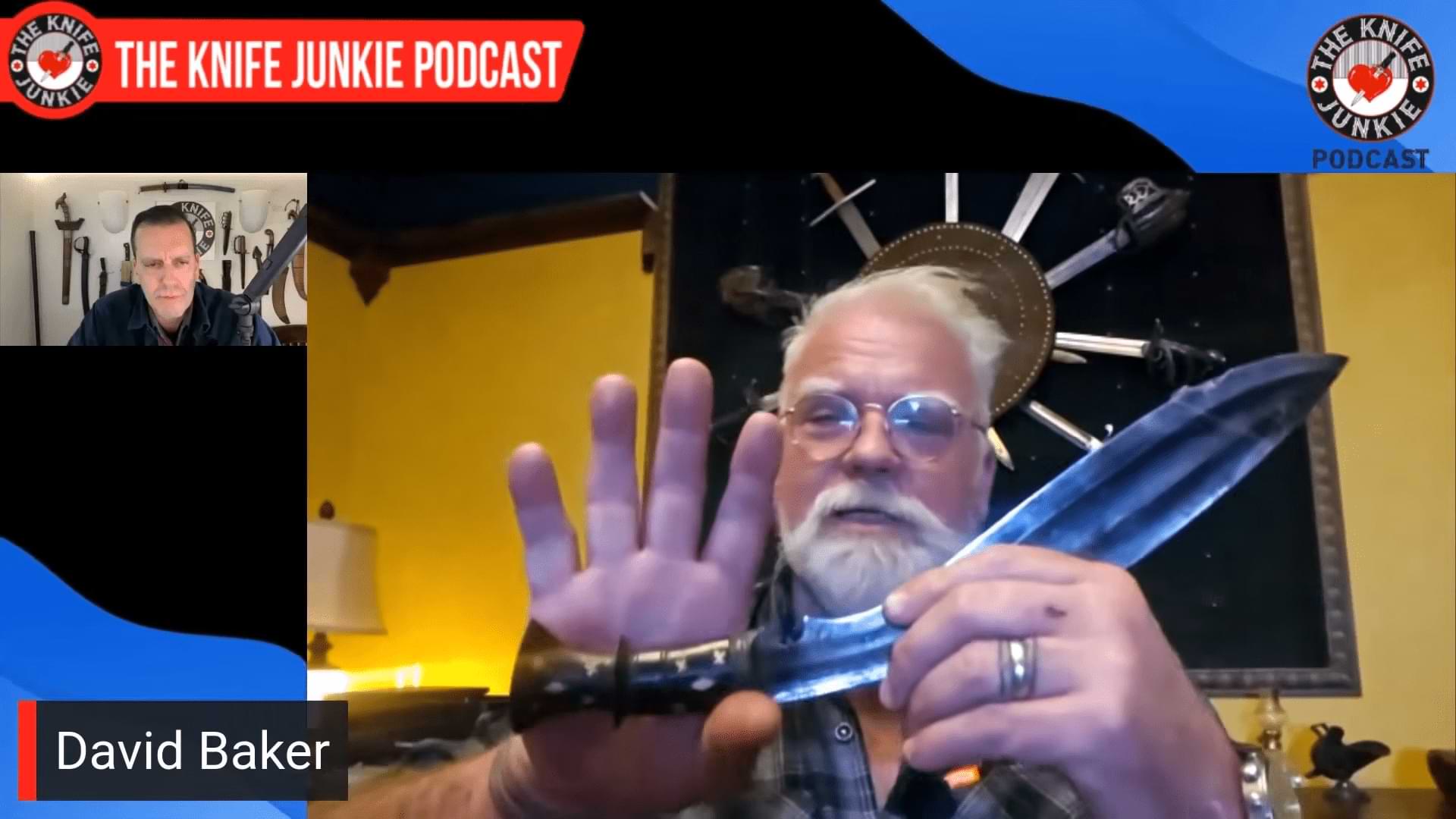
David Baker: And again, there's a lot of times once you start handling something that's a historic piece, scale is what comes up to me. My four big things are weight, scale, edge geometry, and balance. Those are my four biggies. But like, okay, here, for instance. So this is a kukri that was purchased by my cousin's great grandfather in 1900 in India.
Bob DeMarco: So is it original?
David Baker: Yes, it's original. Well, look at the size of the handle. I mean, my hand eats that entire handle up. Now this is not a World War II military Gurkha kukri, this is something that, you know, it's beautiful. I mean, it's got the double fuller on there and everything else. But you know, the scale... honestly it's comfortable. I would need to be really comfortable, I'd need another 3/8 of an inch, a half an inch to really have that fit my hand right.
David Baker: I have a tulwar upstairs, same thing, teeny tiny handle. Another sword that I just came in contact with, the hilt is a lot smaller than I expected it to be from the pictures. And a lot of the Scottish basket hilts that I've handled, they're not, you know, the ones you see now, the ones you can pick up from whoever you're buying from whatever company, they're just big. They're large. And the originals that I've handled, they put your hand in there, there's room for your hand and a glove. And everything is, it's not rubbing on you, but you don't have a lot of extra room. You can still move your hand everywhere you need to move it, but there's no extras.
Bob DeMarco: And things like that, that bag in there, right? Like a liner.
David Baker: Sometimes there's a liner in there, but yeah, again, that's probably just to keep your hands from scraping on stuff. If you weren't wearing a glove, you've got the liner in there to protect your knuckles. But it's those little things, those little things inside the guard or where your finger might loop over something or the distance that's inside a guard that just allows your hand to move but doesn't rub on your knuckles. If you had big hands, it probably would.
David Baker: Yeah, so it's, I think I just find it really fascinating the things you can learn by both seeing and if you have the opportunity, handling. I know a lot of the museums in Europe, if you call ahead and make a plan, they'll pull some stuff out of the drawers so you can do a handling. I wish we had more of that going on here. I have a feeling it's just because they have bigger collections and more access. Whereas a lot of our collections in museums here are maybe privately owned and on loan to the museum, and the last thing you really want to do is have a bunch of people handling it. And they deteriorate. I mean, you know, you've got a wire-wrapped handle, and you've got 100 people grabbing it a year, that wire handle's probably going to wind up coming unraveled.
Bob DeMarco: Well, tell us a little bit more about the show. You said you just finished wrapping. How did you, did you go on the road for this?
David Baker: Yeah, we went to a number of different locations, some right here in Yorktown. I live really close to Yorktown. We filmed down in Yorktown, we filmed up at the National Museum of the United States Army. Really great people, it's a fabulous museum, if you haven't been there, it's a beautiful museum with a great collection. And then shot some stuff in my shop, doing the rebuild, the build. And you know, we did it, we shot it as you would see... I mean, it's not like a YouTube thing shot on my phone. We had a crew, lighting and all kinds of fun things. You know, this has been a dream for a long time. And having the idea and having the support of my wife, who believes in the idea and knows production, because I'm a scatterbrain. That's my brain. And she's super organized and knows production and knows how to put all this stuff together, which is fantastic.
David Baker: But one of the reasons we're doing this, it's sort of a pilot episode, so we can try to draw some sponsors. I mean, we'd love to keep doing this. It's not something that can be self-funded. So it's definitely about getting some sponsors on board so we can have another adventure, and there's a number that I mean... Mystic Seaport is one of my favorite places. And there's a sword that's involved, and it's the Sword of Mystic, I would love to do one for their museum up there. I would love to get into, you know, head down to New Orleans and do something on the Bowie knives. You know, there's so much myth and stories that are there to tell.
David Baker: Living where I live, I mean, this is the center of the Revolution, and this is the center of the Civil War. History's been part of my life forever in that my family has a really long genealogy in the United States or in the Americas. My mother's side of the family goes back to the Rhode Island Compact in the 1640s, and my dad's side of the family also goes back to the 1640s. So growing up with that kind of stuff, and then my cousin is sort of the family genealogist, so she did the Baker side of the family, and got a lot of really interesting information on that. My grandfather was so jealous that he actually wrote a book about his family. Yeah, and it's, I mean, it's called The Ballous in America, it's a book that's this thick. It's, unfortunately, it was terribly damaged in a fire that happened at my house in California. Yeah, I haven't had it rebound yet, or I'd pick it up and bring it over here and show it to you.
David Baker: But yeah, so growing up with that kind of stuff, and having that information and having these characters through history, I mean, there's a... I have a coat of arms on my wall here that one of my great aunts did, and it has a very well-pruned family tree on it. But yeah, so it's just, having that information makes you kind of start thinking about history and where it was, so it's fun to... it's fun to know that these historical characters through time, I can kind of say, oh yeah, I had a family member there at that. I had a family member here at that, and that's what this is about. We're doing a short for YouTube right now on this, this is a project I call The Swords of my Fathers, and each one of those swords represents a family member in history.
Bob DeMarco: Wow, that's cool.
David Baker: Yeah, I mean, people that I've looked up or, there's a lot of assumption as in, did they carry that sword? Who knows? It's an appropriate sword for the period.
Bob DeMarco: Right, right, right. And if they carried a sword, it might be that one. Let me ask you, I have a couple of sort of philosophical questions I want to ask you about knives in general, but also back to your career as a maker, in particular of the first tool ever in this day and age. You are at the tip of the spear of a continuum of knife makers or makers of this very valuable tool that stretches back to the beginning of humanity. You know, I guess you could say that about everyone and everything, but knives go all the way back, you know? You might work in sanitation or you might be a game coder or you might be a lawyer, none of that stuff was around at the beginning of humanity, knives were. What's that like?
David Baker: Someone asked me, "If you were born in a different period, what would you do?" The same thing I'm doing now. I might have a propane forge, but you know, or a power hammer, but... well, I might have a power hammer, a water wheel. Yeah, and somebody asked me, "What would you do in the apocalypse, what would you do?" Well, when the bullets run out, my prices go up.
David Baker: I came at this in a weird way in that I didn't come at it as a knife maker. I started out making swords. Philosophically, when you get into swords, you have to realize that the thing that you're making was created for one purpose and one purpose only, and that's killing another human being. Knives are tools, you know, you use them for skinning, you use them for eating, you use them for building and working. Spears, same thing, arrows, same thing. The swords, they're, you know, certainly there are hunting swords, but that's not why swords were made.
David Baker: The symbolism that goes with the sword, you know, justice, the double edge, there's so many things that are applied to swords. So I think there's a legacy to building swords that goes back, there's something I read a number of years ago that talks about a smith imbuing... it was written by a monk or a friar... but he was imbuing the spirit of God into the swords he was making. Well, when you read it, it's kind of, to me, I'm pretty sure that you know, he draws the blade from the fire and dips it into the water and says an Ave Maria, and then pulls it out and says three Hail Marys, and then an Ave Maria... Well, I think it's just timing his quench!
Bob DeMarco: Yes, that's interesting.
David Baker: And there's the poetry, the Village Smithy, and the Anvil song, and there's just so many things about it. Yeah, I think there is a connection, and I think a lot of blade makers, knife makers, feel that connection. Whether it's just because we want to be part of some kind of history or that I'm not Mr. Spiritual, I'm kind of super pragmatic and practical. To me, it's an art form that artisans do. I mean, sure, we're artists in that we create, we try to create things that are beautiful, but it's practical. And some of my favorite pieces aren't that pretty. But they're practical, and they will do that job better than the pretty one. You know, they've got to balance the weight, the dimensions, the edge geometry that you want, plus the hand protection and comfortable handle, even though it's just wrapped in leather or carved out of wood, as opposed to having, you know, beautiful wire wrap and everything else. And some of the ones that I've seen or some pieces that I've handled are the last thing you want to use because it's going to tear your hand up. Oh, look how pretty this handle is. Well, until you put it in your hand...
Bob DeMarco: How do you account for the success of Forged in Fire and just the general popularity of knives, and how the knife industry has kind of... I mean, I've been collecting knives for a long time, and it is an opportune time to be into knife collecting.
David Baker: Yeah.
Bob DeMarco: Why is such a fertile field right now?
David Baker: I think that when Forged in Fire first came out, I guess it's like 10 years ago now, almost 11 years ago, I know people were constantly saying, "Oh, you do a lost art." Well, that's not a lost art. People have constantly been making knives. But I think that the vast majority of people didn't realize that you could find somebody to make you a custom knife. That a handmade chef's knife was something that you could get. I mean, we live in a disposable world where everything's cranked out by machines and thrown in a box, and everything's the same. "Oh great, look, there's an... I did work for Cold Steel for a number of years, designing and prototyping knives for them. Enjoyed it, learned a ton, made some beautiful stuff, I think I did over 30 pieces for them. And you got to do a search for like the mortuary sword... well, what comes up? My mortuary sword for Cold Steel. And hundreds of them.
David Baker: It's owning that one-of-a-kind thing, that one-of-a-kind piece that I think inspired a lot of people to start going... well the growth of the Blade Show, you know, between before Forged in Fire and after... quadrupled in size. Um, blade shows around the country, you know, became a thing. To me, what I always tried to do was say, look, anybody can do it. Doesn't mean you're going to be good at it, doesn't mean you're going to make a living at it, doesn't mean you can turn it into a business. That's not what I'm saying. But anybody can do it, anybody can get some fire bricks and a propane torch and heat a piece of decent steel up and bang it on a piece of railroad track with a hammer and shape something. Whether it's a railroad spike or an old lawnmower blade or whatever. And have something when they're done that they created, that's useful. It might not be good. But so what?
David Baker: I remember running into somebody, this is going back probably almost 20 years, but I'd made a sword for them back in the 80s. And they still had that sword. Oh, it was a piece of trash. And I told them, I needed to have it back and that I would make them a new one. Get it out of the world. Oh yeah, I didn't want my name on that thing. But I think the show inspired a number of people to try something. Whether it was making knives or leatherwork or whatever they turned it into, it was that idea that you could go out and do something and make something. I think the pandemic pushed that even further, in that so many people were just kind of stuck at home and they had time and they started picking up craft skills. And knife making is one of those things once you start doing it, it gets a little bit addictive.
Bob DeMarco: To say the least.
David Baker: And through that, I mean, I've come in contact with a number of groups that do rehab for military and first responders. One of the experiences I had is watching somebody take so much anger and hate and pound it into a piece of metal, make something beautiful, and create something with that anger, that tension, that upset, and have something when they're done that... that's anger, hate, or any of those things. It's a piece of art that they've created. That's kind of magical when you see it happen.
Bob DeMarco: Let me ask you this, what haven't you made in all of these years? What haven't you made that you want to make?
David Baker: There will always be something. I'll always, I go down these sort of historic rabbit holes that oftentimes it has to do with whatever I'm reading. I'll be reading fiction, a period fiction. I read a bunch of Viking stuff a while back, and I started doing... what's a what's a fighting seax really feel like? Do we have so many seax blade types, from Viking seaxes, Norse stuff, Anglo-Saxon stuff. Most of them don't have handles or hardware still on them, so there's a lot of assumptions made. And just started experimenting with that and pattern welding Viking blades. Ben actually, Ben worked with the Sutton Hoo sword that he made, phenomenal, phenomenal work. So I'm looking to do some more of that.
David Baker: But then halfway through that, I was reading some stuff on the English Civil War period, so the mid-1600s, did a deep dive on that, fell in love with the basket hilts, the Walloons, the mortuary hilts. So, you know, a lot of those are on the wall behind me. You know, while reading that, got into the age of piracy, the golden age of piracy, and of course then it's hunting hangers and cutlasses and dudgeons and things like that. So, you just kind of...
Bob DeMarco: There's so many rabbit holes to go down.
David Baker: Yes. Yes. And the East Indian weapons have always been something, and I read... there's a wonderful set of books, Swordsmen of the Time of the Raj, and British Swordsmen in India, and it's all contemporary accounts of sword fighting throughout India in the time of the Raj. And the tulwars and things like that, and then, okay, head a little bit west. Now you're into the pulwars, the Afghan swords, head a little further west. Now you're into the Turkish stuff with the yataghans and the... it's just endless. I've gone down so many different rabbit holes. I can see the collection behind you.
Bob DeMarco: And it's gotta be one of the coolest things in the world as a knife junkie, or as someone who loves blades, to be able to just go into your shop, fire up your forge and start, and, "What are you making?" "Well, I read about this yesterday." What could you do? Let everybody know where they can see Baker's Blades and remind them about that.
David Baker: YouTube, @BakersBlades. Plural, altogether. And we're really excited. So anybody who would like to go and subscribe, eventually we'll get to the point where we're doing shorts and things like that just for subscribers. At this point, we're just trying to build up the base so when we do release this, it gets a wider viewing. Again, we're trying to attract sponsors so we can continue to do this. It's just kind of a new TV model. But one of the things that I'm trying to do with the show is show people that, one, we live in an amazing country surrounded by so much history, and yes, we do have a blade culture in America, swords and everything. And when you get out there in it, you get to see it. Watching it on TV, watching somebody else do it. Go limit yourself. I'll show you, I'll show you cool places to stop, I'll show you fun things to see, but then you should go see them. Don't live vicariously through somebody else.
Bob DeMarco: Absolutely. David Baker, thank you so much, man. It is such a pleasure having you on. And it was great catching up with you.
David Baker: Well, yeah, good to talk to you too. And we will, we'll probably catch up again, well, not make it several years between next time.
Bob DeMarco: Sounds great. Take care, sir.
David Baker: You too, take care.
Announcer: Adventure delivered. Your monthly subscription for handpicked outdoor survival EDC and other cool gear from our expert team of outdoor professionals, theknifejunkie.com/battlebox.
Bob DeMarco: There he goes, ladies and gentlemen, sword making and knife making phenom David Baker. I cannot wait to check out his new show, Baker's Blades. It looks really cool from that sizzle reel, as I mentioned, and just the concept floats my boat. What can I say? I'm sure it will yours too. All right, for Jim working his magic behind the switcher, I'm Bob DeMarco, saying until next time, don't take dull for an answer.
Announcer: Thanks for listening to the Knife Junkie podcast. If you enjoyed the show, please rate and review at reviewthepodcast.com. For show notes for today's episode, additional resources, and to listen to past episodes, visit our website, theknifejunkie.com. You can also watch our latest videos on YouTube at theknifejunkie.com/youtube. Check out some great knife photos on theknifejunkie.com/instagram and join our Facebook group at theknifejunkie.com/facebook. And if you have a question or comment, email them to bob@theknifejunkie.com, or call our 24-7 listener line at 724-466-4487, and you may hear your comment or question answered on an upcoming episode of the Knife Junkie podcast.
Share This With a Friend >>>
For early access to The Knife Junkie podcasts and YouTube videos, receive Knife Junkie stickers and be entered into the monthly knife drawing giveaway, join The Knife Junkie’s Patreon group of awesome supporters.
Let us know what you thought about this episode. Please leave a rating and/or a review in whatever podcast player app you’re listening to. Your feedback is much appreciated. Email theknifejunkie@gmail.com with any comments, feedback, or suggestions on the show, and let us know who you’d like to hear interviewed on an upcoming edition of The Knife Junkie Podcast.
To listen to past episodes of the podcast, visit theknifejunkie.com/listen.

Shopping for a Knife?
Support The Knife Junkie Podcast and YouTube Channel by Buying Through My Affiliate Links
 3 Dog Knife (25% off hardcore Alaskan-made knives with coupon code “knifejunkie”)
Angle Pro Knife Sharpener
Artisan Cutlery
Bamba Forge
Civivi Knives
eBay
Jack Wolf Knives
James Brand
Knives Ship Free
Off-Grid Knives
Sencut
Smoky Mountain Knife Works
Tiger Edge
T.Kell Knives (Get 10% OFF with coupon code: “knifejunkie”)
Vosteed Knives
WE Knives
Other Products and Services
1Password
16-in-1 Multipliers
Dark Age Defense
Podcast Hosting
Groove (Replace 17 Apps and Services in Your Business)
Groove.ai (All-in-one AI solution)
Knife Books
Rakuten (Cash Back for Shopping Purchases)
Shockwave Tactical Torch
StreamYard
Upside App (Cash Back for Gas Purchases)
SOS Emergency Sleeping Bag
Survival Saw
Wilderness Survival Skills Course
Work Sharp
Work Sharp Rolling Knife Sharpener
“The Essential Skills of Wilderness Survival” Book
Follow The Knife Junkie
Visit The Knife Junkie website
Email The Knife Junkie
Follow The Knife Junkie on YouTube
Follow The Knife Junkie on Instagram
Follow The Knife Junkie on Twitter
Join The Knife Junkie Facebook Group

Affiliate Disclosure
In the name of full transparency, please be aware that this website contains affiliate links, and any purchases made through such links will result in a small commission for The Knife Junkie channel (at no extra cost to you). If you use these links to make a purchase, TKJ will be rewarded with credit or a small commission on the sale. If you don’t want to use these links, no problem. But know that I truly do appreciate your support.