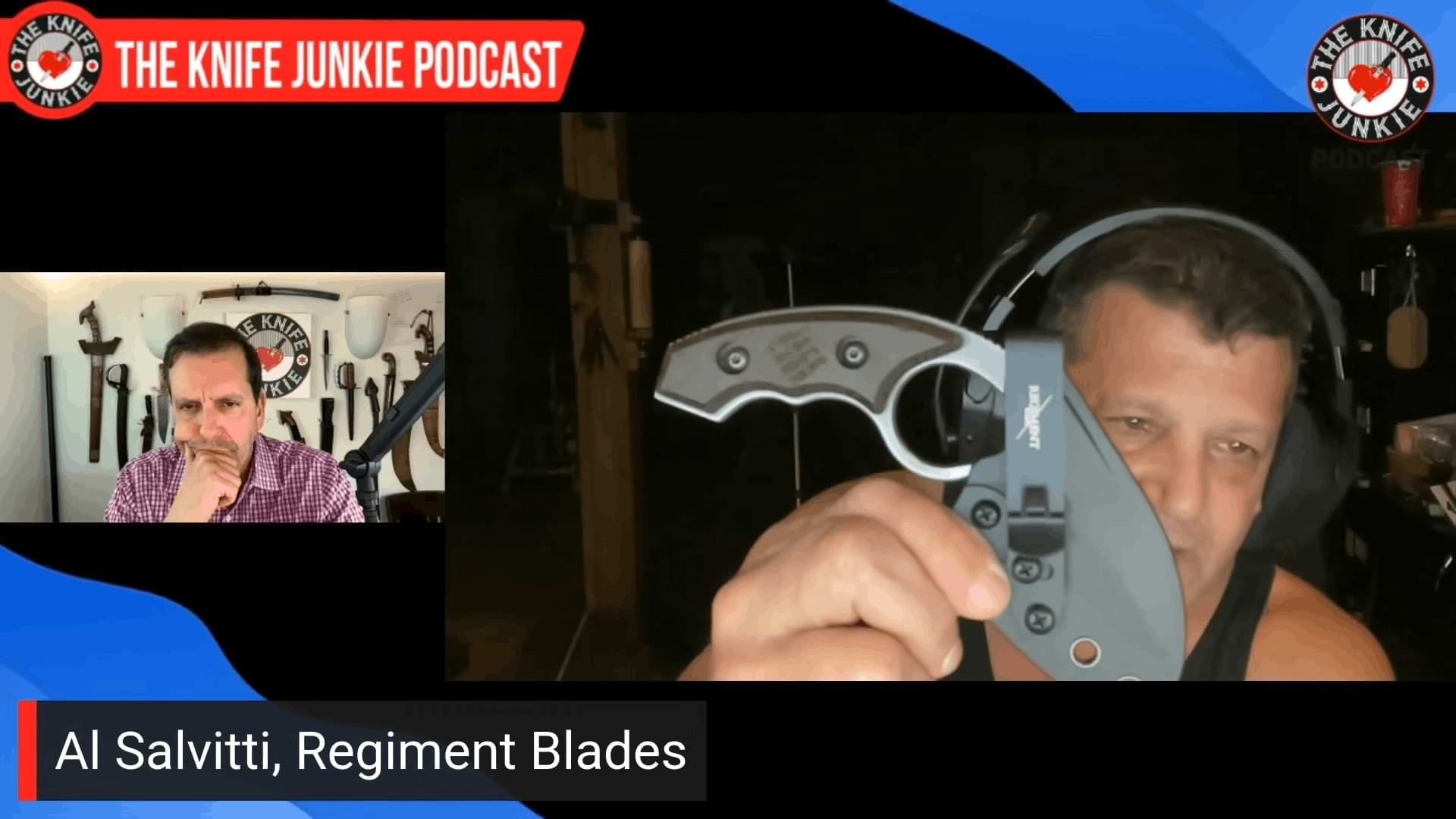
Al Salvitti, Regiment Blades: The Knife Junkie Podcast (Episode 673)
In Episode 673 of The Knife Junkie Podcast, host Bob DeMarco sits down with Al Salvitti, the Philadelphia-area martial artist, self-defense instructor, and founder of Regiment Blades. Salvitti brings over 50 years of martial arts experience and 15 years of real bar-fight bouncing to the table, and it shows in every word he says.
The conversation covers three main areas: how Salvitti developed his power-striking system, how those experiences led directly to the design of the LowViz punch blade, and the exciting news that bestselling thriller author Jack Carr featured the Regiment Blade in his new novel, “The Fourth Option.”
 The Fighting Background
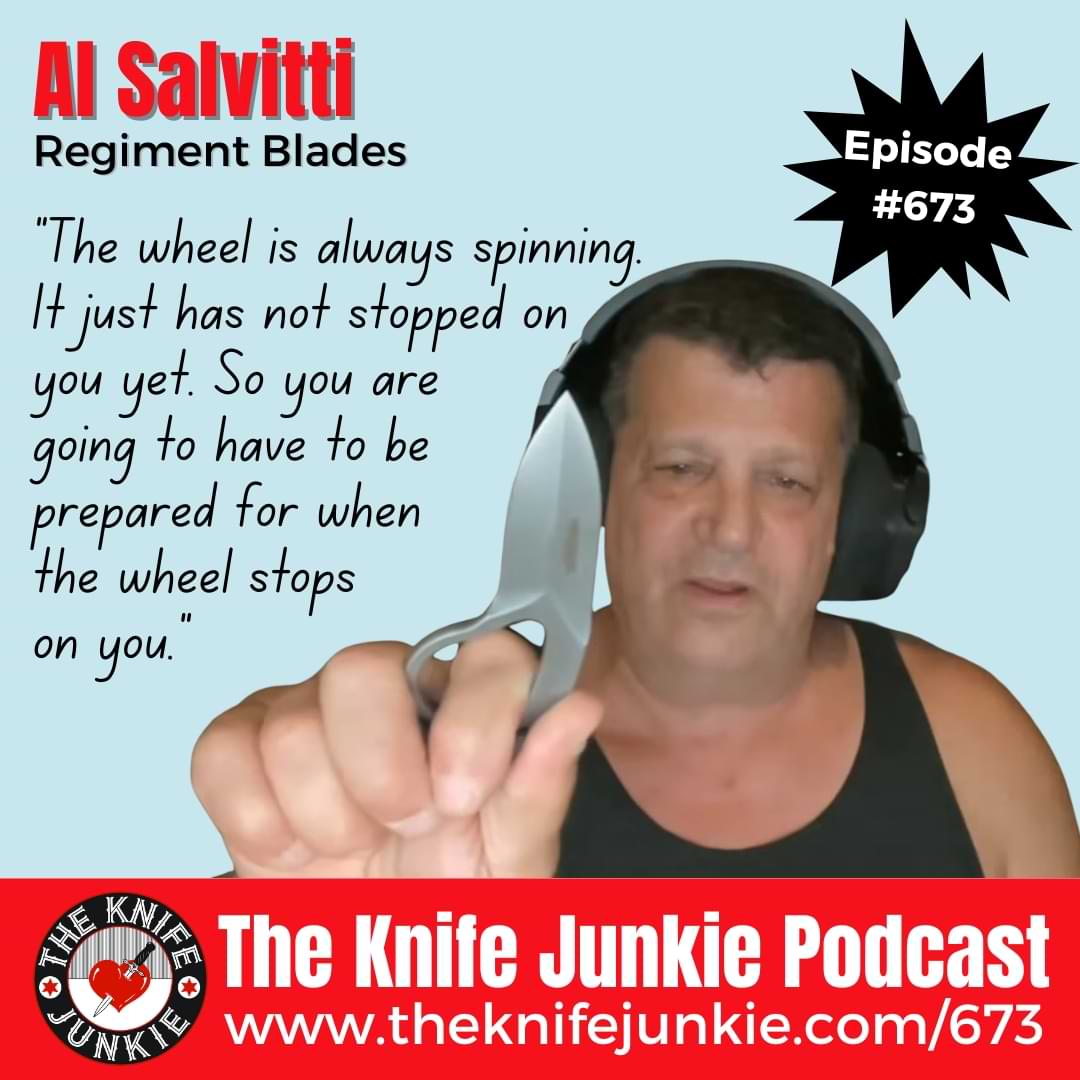
Salvitti started in taekwondo at 15, earned a black belt by 19, and almost immediately started bouncing at bars across South Jersey and Philadelphia. He quickly found that tournament techniques did not hold up under real violence in packed rooms. He learned boxing at Marty Feldman’s gym — the same gym tied to bare-knuckle boxing promoter David Feldman — and cross-trained in Sayoc Kali for 15 years under Tuhon Chris Sayoc, reaching instructor level.
His power-striking method is built on a simple physical truth: both feet on the ground equals maximum power. He demonstrates this with a wall drill that has stopped pro boxers mid-session and made them rethink everything they thought they knew.
He also trained Navy SEALs, Marine units at Camp Pendleton, and Border Patrol agents, bringing his open-hand striking system and blade methodology to some of the country’s most elite fighters.
The LowViz Knife
The LowViz was born out of frustration with every other blade Salvitti tried to use with his striking method. The design keeps the knife flush against the fist so it deploys and strikes in the same motion. The grip is held with the same two-finger anchor used on a pistol. The sheath rolls flat on the belt, invisible under a shirt.
A folding version features an auto-locking secondary that engages on the draw, so there is no extra step when speed matters. Salvitti demonstrates both versions regularly on the Regiment Blades Instagram page, where slow-motion video shows just how fast and natural the deployment is.
The Jack Carr Connection
The biggest story of the episode is the Regiment Blade landing in Jack Carr’s new novel, “The Fourth Option.” Carr—author of The Terminal List—received a custom LowViz from Salvitti and eventually wrote the knife into the book, specifically naming Salvitti as the designer. The main character, James Reece, carries the blade, and a full chapter of the book covers a knife fight in the dark with it.
Salvitti and maker John Gray produced 175 custom Fourth Option editions with acid-etched finishes, pinned wood handles, and hand-finished hardware in time for the book launch. A production version of the Fourth Option LowViz is coming soon.
Regiment Blades Online
To see the LowViz in action, training videos, and real-world situational awareness content, follow Regiment Blades on Instagram and check out the full lineup at regimentblades.com.

Be sure to support The Knife Junkie and get in on the perks of being a Patron, including early access to the podcast and exclusive bonus content. You can also support the Knife Junkie channel with your next knife purchase. Find our affiliate links at theknifejunkie.com/knives.
52 years of martial arts. 15 years bouncing in Philly bars. Now Jack Carr wrote his knife into a bestselling novel. Al Salvitti of Regiment Blades on The Knife Junkie Podcast Episode 673. Share on XThe Knife Junkie Podcast is the place for knife newbies and knife junkies to learn about knives and knife collecting. Twice per week Bob DeMarco talks knives. Email Bob at theknifejunkie@gmail.com; visit https://theknifejunkie.com.
©2025, Bob DeMarco
The Knife Junkie Podcast
https://theknifejunkie.com
Transcribe Your Podcasts and Videos: https://theknifejunkie.com/magic (affiliate link)
The Knife Junkie Podcast (Episode 673)
Announcer: Welcome to the Knife Junkie Podcast, your weekly dose of knife news and information about knives and knife collecting. Here's your host, Bob "The Knife Junkie" DeMarco.
Bob: Welcome to the Knife Junkie Podcast. I'm your host, Bob DeMarco. On this edition of the show, I'm speaking with Al Salvitti of Regiment Blades. Al is a martial artist, practitioner, instructor, and innovator who used his extensive experience in real-world street violence to create a methodology for power striking and up-close-and-personal self-defense. Mr. Salvitti also has a very unique and famous tactical knife design to his name and a seemingly foolproof way to deploy it and fight with it.
I also hear he's got some other exciting news related to that blade. We'll talk about that and all things Regiment Blades. But first, be sure to like, comment, subscribe, hit the notification bell, and download the show to your favorite podcast app. Also, if you want to help support the show, the quickest way to do that is head on over to theknifejunkie.com/patreon and check out what we have to offer there. When you sign up for an entire year at once, you receive 12% off and all the other benefits that go with being a patron. So go to theknifejunkie.com/patreon and check it out. That's theknifejunkie.com/patreon.
Announcer: Adventure delivered. Your monthly subscription for hand-picked outdoor, survival, EDC, and other cool gear from our expert team of outdoor professionals: theknifejunkie.com/battlebox.
Bob: Al, welcome back to the show, sir.
Al: Ah good, good to be here. Nice to see you.
Bob: Yeah, good to see you too. You're coming to me from Philadelphia, where I used to live in the '90s—in the good old '90s. I haven't been to Philly in a long time. I miss it and love it. So, how is everything down there?
Al: No, it's good. It's a good town. I live right near the airport, so I'm right outside the city in Media. It's pretty close. I can still see the city from my house, so I'm still close.
Bob: Yeah, I'm familiar with driving down that way, going down to the airport. Anyway, so you have, as I mentioned up front, a history in martial arts. You've got a very famous blade, which we'll get to, but you've got a background in martial arts that's pretty interesting, and in boxing. You developed a very interesting way to harness the power of striking. Let's go back to the beginning. Tell us about that.
Al: All right. So I've been training 50 years. When I started, I was 16, actually it's 52 [years]. I started pretty early, 15 or 16, just martial arts, taekwondo. Then you get up and get a black belt. I was about 19. Back then, it took four or five years to get a black belt, not like today. But anyway, I get a black belt, and my uncle runs a bar in New Jersey. I'm 5'7", 140, and I'm like, "Man, I can work the door here. I mean, I think I can do it." And he's like, "Yeah, you're too small," and stuff. "Ah, I think I can do it."
So anyway, I start bouncing, and first night I'm there, here's the boss's nephews here. They're all looking, all giants, the meanest people I ever met in New Jersey. The drinking age was 18, so it was wild back then. Oh yeah, they lowered it for whatever reason to 18, and in the bars, it was insane.
So walking around the first night, of course, nothing's happening. Usually there's fights all night long. And everybody's like, "Oh, this is the boss's nephew," and they're all looking at me like, you know, giving me a minor girl handshake. Man, this is not going good because they look at me, I'm a flyweight.
So at the end of the night, something happens right outside. You're not supposed to fight outside, but we fought outside anyway. So I get outside, and there was the head bouncer had a guy, and then somebody was going to jump in, and then I cut him off. And this was the first time for real. I mean for real, for real. You freeze for half a second, and then you shake it off, and then you just go. Nothing that you practice you're going to do anyway.
So I get the guy, and I do a couple things. I knee him a couple times, and then I knee him once, and he was gone. I knee'd myself in the chest because the head bouncer had pulled him off of me and threw him up against a car. And he was holding him. And this is the only time I ever did this in the whole time. And I kicked the guy in the face over his shoulder, which was just—he was just like, "Oh," and just dropped him. And then that was it. I was in after that. Everybody was like, "Woah," like Bruce Lee.
I really shouldn't have done it because the rules in the party, you don't kick over the knee. But anyway, we had the room when I was young and stupid, 21. Oh man, I got that back. Well, I shook for an hour and a half on the way home. I had to pull over on the way home because the adrenaline rush was just—it was the first time, and I'm shaking. Because it was the closing night, and then we all got in our cars and left. I'm like, "Yeah, I got to pull over." It's the first time. It's like, "Oh." Well then, then I got the taste for it after that, so.
But the thing that I found out is that I was a highly trained black belt at the time, and won all these tournaments and stuff like that. Almost everything I learned, I couldn't even use in the bar because there's no time, there's too many people around. It's wall-to-wall people. When you start to fight, the best thing to work was a two-handed choke and bang their head against a doorframe, and that's it.
Bob: Because they're so packed in.
Al: It's so packed in. But then everybody spreads a little circle, but you never go to the ground. Ever, never. You never go on the bar. They always said, "Kid, don't go to the ground. You'll never get up because the other people just will kick you from the side." You always have to watch out. Never go to the ground in a bar, okay.
So I was working with a guy that was a Navy boxer, and he was knocking people out. I mean, so fast, just pop, pop, pop, boom, done. Man, this guy is just awesome. It's taking me so long to do what I need to do with them, get control of somebody, because it has to be fast. But he was just crushing them. Man, I got to do this.
So I go in the city, and I'm in Philly, big boxing town back then. I know a guy. I go to Marty Feldman's gym. Now, David Feldman is the bare-knuckle guy. You know the bare-knuckle fights like David Feldman? Well, that's him. This is his father's gym. So he's from here, so I know him. But anyway, we go to Marty Feldman's gym, and it's on the second floor. There's an L train right outside the window, and you look like you're going to fall through the floor. Downstairs it says like, "Trespassers will be killed." You know, I'm like, "Oh, I'm in a tough neighborhood."
Anyway, I started boxing there. Now, 140 pounds, and I'm thinking, "Oh, I'm a black belt. I'll be able to take this." And one day a guy says, "Hey, you want to spar?" I'm like, "Okay, yeah. How much you weigh?" I'm like, "135, 140." "Hey, you want to spar this guy here?" "Okay, how much does he weigh?" "Oh, he's 117." 117? Yeah, my sister weighs that. Yeah, well, I'll spar this guy.
This guy beat the balls off of me for four rounds. I mean, I couldn't touch him. It was a life-changing experience. They didn't tell me he was the number one contender in the world to fight for the championship, right? Unbelievable. It was like fighting a ghost. I don't even think I glove-touched him. Wow. He hit me so much, I thought people were punching me from the side ropes. I mean, it was amazing.
So it was like, I got to get to this because whatever I just learned for four years is—now maybe if I kicked him a little, but the hand, it was amazing. And movement, I couldn't touch him. It was embarrassing for me. So it changed me. And when I was done sparring with him, I couldn't leave the gym for 45 minutes because my head was ringing. So I had to sit down 45 minutes. I can't drive. He beat the hell out of me. He never knocked me down or knocked me out, but I just refused to go down like a dope, I guess. But in a Philly gym, you don't go taking a knee and you don't go down. And I'm the only white guy in the gym, so it doesn't matter. You know, you ain't knocking me down, not here, and I'm not taking a knee. So it was going. I couldn't even punch back by the time I got to the sixth or seventh round. Name was Johnny Carter. He fought Joltin' Jeff Chandler for the championship. And at that weight, the pace of the fight is incredible. It's just like a racehorse because he's so light.
I mean, if you look them up on YouTube and watch Joltin' Jeff Chandler and Johnny Carter, the pace of that fight is incredible. So I started boxing there, though. And I learned more from him of getting beat up for six months than I ever did in any school. So, and I brought that into the bars with me, and the hands, and then that was it.
But then I met a guy that he was doing a lot of open-hand stuff. He was a kung fu guy. He did a lot of open-hand stuff. I'm like, "Wow." And he did some hooks. Kung fu, they got a little bit of hooks. And I just incorporated it into the boxing moves because it's really the same thing, but the kung fu guys are more fancy with it. Because I was breaking my hands up on people. I would tape my hands at the bar because we're fighting five times a night, really, every night. Every night, I mean, drinking age was 18. Yeah, they came in to drink and fight, and then that was it. 800 people, and then they would have a keg and four bucks to get in, and all you can drink nights. It really was before—I mean, we would throw 50 people out in a night, you know. And then we'd have to fight in the parking lot because half of them would be waiting for us when we get outside to go home. It was crazy, right?
So Bruce Willis used to go there before he was famous. It was wild. Imagine having people just like that, you know, it was a wild bar. So I started doing a lot of open-hand stuff to save my hands from busting on people's heads and faces. Because you're hitting bones all the time. And that's how I developed it, really. I just went open hand, and elbows and knees, and then everything worked out.
But then I got a job—
Bob: I'm sorry, when you say open hand now, you meant—
Al: It's a palm. I hit with my palm. Instead of my knuckles, I'll let you see my hands are busted up. You see that ridge in my hand? That's from punching people in the head. Right? And you know, they say, "Oh, hit with your two knuckles." Yeah, that's okay because it's smashing these bones here, right? That lump right there, that's from that.
So I wore one of my knees out, so I had to switch to my left knee because I used my right knee so much. And then I hit a closed jaw one night, so I got—now I got to switch to my left knee. I mean, it was constant fighting every night, five times. Five times a night.
Bob: So you're a—presumably, you're putting on a little more muscle over time and getting a little bit larger, but you're still a young, young and light. What did you learn from all of that fighting? What was the number one lesson?
Al: Number one lesson is, you can learn all the moves that you want. You can learn these arts and all these complicated moves, but you're not going to do any of it when the time comes. When you get hit in the face, you're going to forget everything, and you're just going to—whatever God gave you and whatever little skills you can keep, that's what you're going to do.
Because I've seen, I've seen black belts, supposed black belts come in the bar and fight, and they get humiliated because, well, that guy doesn't know you're a black belt. If he knew, he'd be all, "Oh, give you respect." See, but they don't know I was a black belt or they don't know he's a black belt, so it's like, "Hey, there's another dude," and they—and it's always more than one.
One-on-one, yeah, that's great. Look, Brazilian [Jiu-Jitsu] is the best one-on-one. They got a counter to every move, they got—you can't beat a Brazilian Jiu-Jitsu guy one-on-one if you're not skilled. But two guys? Well, he's not going to beat two guys rolling, because I never see him roll with two guys. And usually one guy's going to be kicking his head off while he's rolling. So once there's another guy comes into play, that's out the window. And it's always going to be two guys. It's never going to be—rare it's going to be one-on-one, rare. You got to hit and knock them out quick. That's the only way to do it.
I mean, you have to go first. You can't wait. And what I learned is that if I didn't go first, I was always behind, right? So when I worked at—I got a job in the same uncle, the nightclub was an all-black nightclub in Philadelphia. And I'm the only white bouncer there. So I got tested more there than I did in the other bars because I'm white, you know, enough of it. Yeah, it's normal. But what I learned there is, they respected me because they were scared of me, only because they didn't know what I was going to do. And that's just how you got to keep it.
I would pace up and down, and they called me a tiger. When somebody came in, you know, a tiger's in a cage at the zoo, he's walking back and forth, he's—as I'm walking back and forth, because I'm young and stupid, because I don't know what's going to happen. And I'm thinking in my mind, and a lot of fighters do, it's like, "I'm going to be ready for anything. I'm going to, if he does this, I'm going to do that. If he does this, I'm going to do that." And that never happens, right? [laughter]
So when I finally figured it out, and I'm the tiger now, I make it happen, and I go first. So when I make it happen, well, I don't have to worry about what he's going to do. He's got to worry about what I'm going to do. There's no more waiting. I go first. It's my turn all the time. You can't get a turn.
Bob: Most people will say, "How do you know when to go if you're going first?"
Al: Going first is not always hitting first. Because people always mistake that, it's like, "Go for it, boom," you know. It's like, "Hey, what time is it?" and you're like, "Oh, I hit that guy, I was going to drop." No, that's not it. So going first, it's a mental state of, "I'm training." Number one, you train with blades and weapons, you're going first already, right now. You prepare in your ancient, in your capable fight. Okay? Now you're going to go like, "Should I go?" When you're inexperienced, like doing this, you go, "Should I go now? Am I going now?" Well, he'll tell you when he wants to.
Like when I told the young guys, we'd be like, well, I said, "Go talk to that guy, tell him, you know, he's got to leave." He said, "Well, how do I know if he, you know, I'm going to have to fight?" I said, "Well, he's going to tell you if he wants to fight. He's going to say, 'Okay, all right, I'm good,' or he's going to say, 'Kiss my ass, I'm not doing nothing,' or he's got—" So he's going to tell you what he wants, right? So they're going to tell you, just pay attention.
So it's going first with means, well, I'm not going to be in the gap, right? I'm not going to be too close where I can't stop him. And then I'm already going to know where I—always the same thing. Step to the right, I walk him, and then I step in. Because I already know he's going. The guy's going to go. Now, it's a circle move, right? I just step to the right, and I make him turn. And then one foot comes off the ground, and then—step in. But if he follows me a certain way, then I know that he's been trained. But most people don't, they box and this guy knows nothing. Okay, good. Right? And that's how you test them.
But on the street, it's different. Going first, people, they hesitate, and once they hesitate, that's where—that's where it lags, because then they forget everything. Everything they learned. Because tactics stop when the fight begins. Let's face it. Now it's execute. You have to execute, you got to go. Now, it could be wrong, well, you're not going to shoot him, you know, where you say, "I'm going first." But I give the impression that this is not going to be easy. And for me to stop him, I have to make him want to stop. Not, I defend myself and make a move, like karate-chop him or whatever. I already have to give it to him like, "You know what? This is going to be hard. And if this is probably on, maybe I might want to do this." That's how I stop most people. With the attitude and the confidence, like, "Yeah, I've been waiting for this dude. Well, I'm not backing down. We're going to go."
So, and once I give that impression, I probably back more people down, and I've been in fights, and I've been in hundreds of encounters. 15 years bouncing, who does that? Nobody, right? I was there to fight. I was—I don't care what the cover charge is, I don't care about that. I'm there to fight. And I, and then I would learn, by the time I was older, I'd be standing there half asleep, going, "Yeah, we're going to throw these dudes out." And they're like, "How can you—"
So this young black belt that I used to spar with come in, and he could beat me on the, on the—on the mat all the time sparring. He was quicker, he was faster, and he was like—and he comes in with his guys one night and standing there, like, "Yeah, well, why don't you stick around? Because these guys right here, yeah, we're going to throw these guys out in a little bit." He's, "Really?" I said, "Yeah, just stay near me and practice some of your stuff, you know." And I know he's never been in a real fight.
And uh, he said, "How can you just sit there so calm?" like that. I said, "Because I've done it hundreds of times." He left, right? He just—he was like me, tiger-pacing. He took—boom, gone. And everybody's like, "Hey, where'd he go?" He left because he knew he was never in that situation, and he's not in his surroundings. And they, they don't know he's a master black belt, so they're going to treat him like normal. So you have to get in there and get punched in the face a little bit. Now, I know that's hard for people to get, but once you get punched in the face, you get lit up and you see the white little stars on a back blackground, you know, "Oh, oh, that was tough, you know." So, but that's the only way you're going to be able to really get the feel of it.
Bob: So what did you learn about escalation of force?
Al: Oh, well, yeah. Okay. So I go to escalation, I go to the Border Patrol, and they have the whole escalation move: "He does this, you do that. He does this, you do that." I'm like, look, that all sounds good, but—and it's always like a—I didn't have the escalation of force when I was at Philly. I just did whatever I wanted. But when you work for an agency, they tell you that. And I said, so picture this: it's easier to de-escalate. So I'm already there. I'm at the top of the escalator now. I'm, let's go. I'm all ready to go, and if you don't, then that's easy. So if I'm standing at the top of the escalator, looking down on you and you're coming up, well, you're going to have a hard time, right? So it's easier already be there at the top of the escalator. And then I can just step on the escalator and go down easy, because I can de-escalate way easier than I can escalate. Because then I have to think, "Oh, he did this. Oh, now I can do that." No, we're not doing that.
And they would hate when I would go teach them, but that's the best way of doing it. Why would you want to—he goes, you go, he go. Well, he's—you're second all the time. So now we're not at the first thing anymore, right? Got to, "Oh, wait, he's got a gun, I got to get a knife. He's got this, he's got that." No. Just stay at the top. Once you start at the top, they know it. I'll project that. I'm already here. There's no getting up there. The only way we're not doing this is to go down. So once you do that, it's a lot easier on you.
Bob: Well, how did the knife come in the picture? The reason I ask about escalation of force—
Al: All right, so that's a huge escalation, right? Right. So in 2000, I joined Sayoc. Now, how lucky am I that the head of Sayoc lived five miles away? Sayoc Kali. Tuhon, Tuhon Chris Sayoc. He was the Tuhon. Now, when I say Tuhon, there's only one Tuhon to me, that's Chris Sayoc. He was the originator of Sayoc Kali. Pekiti-Tirsia's like you guys did some of that?
Bob: Yeah.
Al: It's kind of the same thing. Pekiti-Tirsia says Sayoc stole all his stuff, and Sayoc says that. Yeah, it's, you know, it's a Philippine thing. Yeah, yeah, yeah. Right. So now, I'm taking my son to just start to get trained in some karate, some move around. And there's, I see a Sayoc sign over there. I didn't even know what it was till I got there. So I went, and we both started going. He started when he was 10, and I started in 2000, right? Maybe 2001. So we did Sayoc for 15 years. We're instructor levels, eighth or ninth. The tenth level is a full instructor. So he only taught people that were going to be instructors. Well, I was his plumber, too. So the Tuhon needed a plumber like he needed a doctor. I was always over his house, and we were always at instructor meetings, and we're in all the videos from the Sama Samas from the early 2000s and all. So we got into blade heavy because they lived so close. So we started doing that.
So then, I had the open-hand thing going with Sayoc, and then one time they asked me to go on one of the trips down to the beach, which is down at Damn Neck, and then we would go train some SEALS. Well, I'll go and show them my stuff, you know. And um, and that's what I was there for. Now, I did the blade, and my son did the blade, and we both went down with the Sayoc tactical. And um, we were there for my stuff, which was uh, that the open-hand power hitting.
The first time that we go, no one ever has ever seen any of this stuff. And so, I'm coming to tell these guys you're doing it wrong, basically, because that's how men take it. It's like, "No, it's just a little different. You just put your foot down." So we get there, and we're in the fight room. I look up, and there's like two pictures in the fight room of somebody training people, and it's Bas Rutten. Oh, I got to follow Bas Rutten? [laughter] You've got to be kidding me. Oh, okay.
So we got 25 guys, and this is different from a regular class because there's no gaps. It's straight attention. I mean, you walk with you there, they call you, "Show me again. Show me again." Then this one, "Show me again. Show me again." I was so—I was so tired from that, and it was intimidating at first because these are the best warriors we have in the country, right? At the time, when I'm showing them my stuff, and they'll—they'll just tell you right off the bat if it sucks or not, you know. So we're showing them, and my son's helping me. Okay, well, of course they loved it because the warrior, just anyway to hit harder and how to move just a little bit more, you know. So they liked that, and we went back there a few times.
But the first few times for me was intimidating because I never got that amount of attention from regular people at the gym. Now, I did the Marines at Pendleton, and they were throwing knives around and playing sword fights. You know, that kind of thing. It was like a kindergarten class. I lost control of them, so I beat their arms after that. So there's an arm-training thing. I said, "You know what we're going to do now, because you guys aren't paying attention at all? We're going to do some arm conditioning." And I beat their arms for an hour to two hours. Half of them didn't come back the next day. [laughter] But that's because of lack of attention, you know. This is way different. SEALS, big brain, and they want to know everything, and they want to do it again and again and again.
So I'm watching them with the blade now. I would help out with the blade a little bit on Sayoc. Now, Sayoc is a complicated system, Pekiti-Tirsia. They have their templates and the 36 count drills and that. And so they would have like a military template, and they probably still teach it. And it's good for people that are into blade as part of their train regimen. You know, they know the lines. You know the 1 to 5 and 1 to 12 lines and you know what—all talk. So, but at the end of the week, the people that I would show, as soon as they—they weren't getting it because they only done it a couple hours by the end of the week and maybe five or six hours. And whatever they would do with the drills, they couldn't remember anything because they're punching each other in the face. That was tough. Some of them would throw their blade down and just start punching each other in the face. Like, wow. Now, that's telling me something there, like whatever I'm telling them is not sticking in his head because he actually throws his blade away, right? And he starts punching. So, why don't we just make a blade they can punch with? Because they're pretty good at it. You know, they're like, "Well, I don't know," you know. Tuhon loved the blade, but it only takes two hours to see somebody. Not even two hours. That's what he said. He said, "Well, there's no defense for it." He said, "Yeah, I know. It's all to boxing moves. You really can't defend it because the lines have changed."
Bob: This is the knife we're talking about, the LowViz.
Al: So now, and now when I say the lines have changed, I change the lines from this, this, this, and you know, the 12 cuts. We've been with all this sweeping stuff to this. So these lines have changed. I know you can go this or you can go, but there's still—all you see is a fist and a blade. This way, if I go number one, you got my whole arm. Number two, you got the whole arm. You know the deal. You know the whole thing, right?
So once I change the lines, they don't know what—they don't know the lines. You know the whole thing. If you know the lines of Pekiti-Tirsia, you know what the guy's going to do. "Oh yeah, number one." But this is just sewing machine.
Bob: That's so hard to see, too, because it's—
Al: It's hard to see because I'm going to face and neck, right? So when I put it at your face, what happens is, you know how when you touch people's eyes they go like this? Well, people think, "Oh, well, they're protecting their eyes." It's like, "Well, yeah." But at the same time, once it gets here, now there's two blades in front of you. They move their head back, so it goes back to one, right? That's why they do it. And we're not one, that's all I want. I want that move back there because they can't judge which one. When you do it to yourself, you put your—now there's two right here that I see, right? It just splits. Yeah, yeah. So that's why they do it, okay? That, "Oh, your instincts are protecting you." Yeah, probably, but most of the time, when I do it, even a touch, all like that because they can't see it.
So once I get that where they can't see, it's hard. It's like, you know, the guys that would shoot arrows and they would catch them? Well, the guy never catches an arrow coming straight at his eyeball. He always catches it over here where he can see it, right? And you'll see on the thing, it's like, "Oh yeah, oh, he snatches it over here." But if it comes here, he'll never get it because once it gets about 18 inches, it splits in two, and he'll never be able to judge which one. So that's what I want. I want it straight on your face. I want this kind of a thing on the belly. So, and I can do it much faster than the ones that you use, you know, right there or two-handed. I mean, it's so easy for people to learn.
Bob: I once sparred with a friend of my mine, and me with my two kali sticks and him with his foil. And I thought for sure—he was a fencer—I thought for sure I was going to be savage on him. And he kept me at a distance the entire time because I couldn't see where that—
Al: You couldn't see that point.
Bob: The range just was, and it was always right at my face and—
Al: Right. Yeah, and it's like you're trying to get out of the way. So, because the lines are better, and it was so much easier. I designed this blade for when somebody picks it up, "Oh yeah, I know what to do with this." Yeah. I know what to do. One line straight in. No cutting, not anything. And everybody that picks it up says the same thing, "Yeah, I know." So we're halfway there teaching them, you know. I'm lazy.
Bob: I want to back up a little bit to your power striking. Tell us how the power striking is a little bit different and then how it led into the design of the LowViz.
Al: Okay. So the power striking, there's an old book by this guy called Champ Thomas. And he would—he would want to keep both feet down on the ground when you hit, and he rotated his hips. I'm like, "Yeah, that's, that's the key." Because you see with a lot of people, they get up on the ball of the foot or they turn one heel and they put the cigarette out. Well, okay, well, that's good for trained fighters. I mean, the guys that I box with, the pros, they're good at that because that's all they do. But if you're not a pro and you're lifting your leg up and letting it drag, it's like you don't have a lot of power in your shoulder.
So the easiest way for me to teach that was, I would go to the wall and I put my—"Go put your fist on the wall, raise your front foot, and raise your back foot." That's it. Right there, tells him right there, "I got, I don't have any power." Wait a minute, say that all again. So if you go to the wall, yeah, right, and you get in your fighting stance and you go to the wall, you say you put your left fist on the wall, and you raise your front foot and you just press. So your back foot pushes. And so now, just put your foot down, raise your back foot. Your whole skeletal frame changes. Once you know, put your right foot, raise your front foot. Yeah, up, raise your back. And they all—I've had pro boxers in here standing there and going, "Let me do that again." Like, "Yeah, raise it." "I've been doing it wrong." Well, no, you just—it's different. You get more power with both feet down.
Which is just normal. I mean, that's how we're built. You can't push a car off of one foot. And you, you know.
Bob: Yeah.
Al: Yeah, you move. You get down there, what do you do? You sit down, you bend your knees, and you push off of both feet. And if you just do that, the power escalation is incredible because you use all of it instead of just your shoulder and your rotation of that. Well, that's okay, but in the bars, I'm hitting people that are 100 pounds heavier than me. You know, at first they weren't feeling it. You know, so I had to make them feel it. So I came with that.
And then with the blade, it's the same thing. I put the blade up, and I'm like, okay. I got this whole system of power hitting on the thing. Now we got to change the blade thing because I can't access my blade and punch with it like I want to because the blade, a straight blade is just going to get in the way of the things I want to do, you know. And I pick a blade up and I'm like, "Oh, this is—I can't even want to do that. All right, we'll go reverse grip." All right, well here and then, "Once I do this, I'm going to want to do that." So it's going to mess up this, this. I just saw a video guy tonight, which is okay, he stabs this way, punches that. Well, that's two different things, right? Your hands are doing two different things. No.
People think that your hands are brothers, okay? They do the same thing. No, they're not, they're cousins, right? This one looks like this one, right? A little bit, and maybe he's a little different, and he does different things. So when I'm using my straight-out punch, this way I want to do this. I don't want to do this or slash and punch, because that takes—I'm never going to do that. It just takes too much to think. I mean, one time, then when I found out, I was like, okay, I'm going to fight stick-fighting left-handed. Oh, okay. So I'm going to train left-handed. I trained for a month left-handed. I'm like, "Oh, this is, this is easy. Just like, now I'm hitting left-handed, right?" I get out there. Oh, all of a sudden, it's in my right hand again because I was so bad when it came to real, man. Now it's real, left-handed. I felt like somebody—that's it. I'm back on the right hand. I'm never going to do that again. So I don't flip back and forth.
Now I can use this blade right or left-handed. I'll see the video. No one can even tell if I'm right or left-handed with two blades because I can box with both of them and make it look easy. But I can't do that with two knives, or even Sayoc. Well, that's all—that's just tapping. I'm not going to do anything with that. I can land and slug these down to my fist on both. I'm like, that's it. That's what we're going to use now. Going to draw it like a pistol and straight out.
Bob: So with the way you use the LowViz, it's—it's self-preservation and self-perfection in one exercise? Or in one, you know, as opposed to, well, some of the, some of the really great drills you do in Pekiti-Tirsia or whatever kind of kali, or whatever kind of martial art. Those drills are great, and they're for building attributes and, and that kind of thing. And they feel good, they make you feel cool, they're great. But—
Al: Yeah, they do. I did them all.
Bob: No fight is going to be a palasut cut drill.
Al: Never like you're going to do it. I did for 15 years. I just say after 15 years, we know all the templates and all the things. And when I would go to Tuhon, Tuhon loved the blade. He passed away before—if he lived a few more years, there would be Sayoc on this blade because it was made for 3 and 9. Now, when they would say on, on, on with the Sayoc, their most popular one was 3 and 9, right? And there was never a 2 of 9 or 1 of 9.
Bob: What's 3 of 9? What's 3—
Al: 3 of 9 is the tapping drill down like this, so you did two things. So with the straight blade, you're doing this, 3 and 9 is like this. And Tuhon would say, "Well, it's really with the tip." Like, "Well, I can't get the tip in from here." So they tap with the side of the blade, and they slash and cut. He says, "No, the, the abdomen is called the blue worm, so you're supposed to cut in, stab in and cut through it. The chest, you're supposed to push in and go down." I said, "Well, I got a blade for that." Well, that's it. Straight in, straight in, straight on the cuts. And he said, "Yeah, that's exactly designed for Sayoc Kali."
Bob: So you have, you have developed this, this blade beyond just—this is the LowViz with the great sheath. By the way, this is one of my favorite to carry like a pistol in appendix, you know. It just fits there great. And I've, I've lost a bit of my paunch, but when I had more here, it was—this was very forgiving. This was an easy knife to carry there. And some, you know, some straight blades up front if you're carrying them, they stick up in your chest and—
Al: Yeah, yeah.
Bob: Just, yeah.
Al: Now, when you roll that, I got a way where you roll the clip and that thing is horizontal. I mean, on my Instagram, the thing is showing you, even if you want to drill one more hole and roll it, man, it's so flat across your belt line, doesn't stick up at all. I'll send you some stuff when we're off of there.
Bob: Okay.
Al: Then, nobody'll be able to do it because the best way to carry it, look, if you can carry it and you can't hold it, it's useless. Yeah. So the grip, with the grip we went a lot on, went a lot on like how the grip, as the pinky wants to keep the grip in, right? Just like a pistol, it's these two fingers that keep the grip. These right here, right? Right there. I can even hold the blade. I don't have to put my finger in the hole, right? It's this is just going to hold it. This finger pulls the blade out. Okay? This is really what it's for. And if I want to put my finger on top, I can because look, look how close they are.
Bob: Yeah.
Al: On a straight blade, I don't want to do that. But I don't really need my thumb on top, but a lot of people will do it because it feels good. But it's this closeness right here, it's okay. But on a straight blade, I wouldn't have that. Right? I wouldn't have this, so you don't want to do that, right? But right here, you make a fist, and I mean, this is it. I, I can really put this in fast, straight in and straight out. Now, mind you, a push dagger, love a push dagger, but push dagger, you have to be on. One little tilt that—ah. One, you know, one little—if it catches on, it rolls right out of your hand.
Bob: It's this way you're talking about, side to side.
Al: Right out of your—that's the worst. Yeah. You can't hook with it, you can't uppercut because you hit and it rolls up, and so. But I love them, but I don't carry them.
Bob: Yeah, they're, they're cool for when you're riding the riverboat and doing some gambling.
Al: Yeah, they look good and they, you know, and they go, but the handle, they can just never make it where it doesn't roll. Yeah. So, like, "Okay, we're going to make one that doesn't roll now."
Bob: So you also did a folding version of the knife.
Al: Right. Yep. Oh, a lot of people like folding. I like folding, too. But the, the other folding that we had was— the design was bad. We made it an auto-lock folder, that the button goes on and the secondary lock goes on automatic. Because most blades, when you put them out, you got to put the lock on, the self-secondary. Well, that—well, if you're really going to use, that takes too long. I'm all about time, right? Like, after you start training, time becomes a big issue because before, you'd be like, "Oh, you have time, it's not a real—" Time's not a—managing time and seeing time, it was not a big deal when it, when it—but when there's trained, when you're a trained fighter, time is like, you, you got to be a little quicker than normal. So I got to get this but—if I can't get this blade out in a timely manner, well then it's no good to me. If I can't grip it where it's not going to slide down my hand, it's not good to me. If the sheath sucks and I hate to carry it, well then it's not good to me at all.
So I made the sheath where you can roll it. You see how this thing is, this is here? See how that lies flat on your belt? So all we had—so we made it right there. This goes right above your belt line. You'll never see, it'll never stick in you. Right? So that's why—if you can't, like I said, if you can't carry it, it sucks, it'll be on the table here. What good is it? And I got a bunch of straight knives that I love, and I still carry a straight knife here and there because I still got, you know, I still want to do the reverse grip. But when it comes time for the real stuff, it's, it's going to be LowViz, it's going to be a punch blade because that's what I'm good at, and that's what I've trained at.
Bob: You've, you've got some really great videos on your Instagram of you training different, uh, you know, in, in different on different surfaces, you know, that you have attached to your heavy bag and and just—
Al: Oh, yeah, yeah.
Bob: Different drills are, are awesome. But you were just holding up, oh wait, wait, before we get to the knife you were just holding up, I want to talk about this one first. Uh, this is—
Al: Oh yeah, the slap.
Bob: I love the, the slap movement. Um, so this, this secondary lock is, is pretty great on this knife. Um, and the action is really nice as a, as a, either as a flipper, but to slap it out and, and—
Al: Yeah, the slap. Yeah, the flip takes too long if you're going to do it. But the slap is so fast, and that click is out, and it always keeps me where I got, well, both hands because I want to keep both hands on it, and I'll stop. I don't have to keep both hands on it, but it still does. In the forward grip, that's the fastest folder out. I don't—reverse grip, Emerson has the wave, and that comes out quick. Yeah. What forward grip, well, click out and then hit, nah, too much. This is right, and you'll see on the videos on Instagram, I get that thing out quick.
Bob: Yes.
Al: And the slap, right there.
Bob: You're going like this. I'm going to do a slow motion because that's a right drawing out and, and just all in one motion, kind of like a samurai draws the sword and cuts all in one.
Al: Yeah, and with some practice, you know yourself. At first, when I told you the first time, you're like, "Well, I don't know." And then the slap gets you, because it's like, "Oh yeah, yeah, I like the slap."
Bob: And once you realize, I mean once you get over the psychological barrier, like there's—you're not going to damage—
Al: There's no way you're cutting anything. Nah, you're not going to cut it.
Bob: So, you were holding up a very special LowViz just a second ago. Um, hold that up and tell us about this and the origin of this.
Al: Let me roll it where it says the fourth option is on this. I got to roll that right there. I sent Jack Carr a, a knife like this with wood handles that was custom-made, and they were pinned. The handles were pinned, not screws. Last July, right, and I was like, "Oh, you know what, Jack Carr, I know people that know Jack Carr, and he's a gear guy, and he, he likes his stuff." And he's had them when it was way back when we first put them out as the colonel, and then when all that went to put them back at Regiment. So, you know what, I'm going to send Jack one. I send him a folder, and I send him a regular. But I, I didn't hear anything. That's how, first, thank you through the guy, "Oh, knife's great." And I sent him a custom holster. He said, "I can't even feel this thing. It moves with you so perfect." Well, yeah, well, I wouldn't carry it if it didn't, because every, you know, it's just—it's in your gear box. You got 20 knives and you don't carry because the sheath sucks, I go, anyway, anyway.
So I didn't hear anything till last January. I got—I call my guy Mick, carry trainer, I don't know if you guys know him. Anyway, I said, "Hey, did Jack say anything?" He, "No, not with me." "Okay, he's probably still, you know, busy." Because Jack Carr is all over the place now. I mean, that, that man's everywhere.
Bob: He's the author of The Terminal List, if anyone's trying to remember.
Al: The Terminal List author, yeah, right. So, he, he posts something on Instagram, and somebody sends me this picture of the blade I sent him next to a, uh, Staccato.
Bob: Oh, yeah.
Al: Pistol. The Staccato, right? And I'm like, "What, what's this? Wow, what's going on, right?" And no one knows. So I'm like, "Mick, what's, what's going on?" Nothing, okay. Five days later, there's another picture, the same blade. I'm like, look at that, okay. All right, well, I'll, I'll find out. Somebody's going to contact me somewhere, so. So anyway, he, he wrote the, the blade into the book.
Bob: That's so cool. Oh, there it is on the top, top right picture there. And oh—
Al: Yeah, all these pictures, right? Yeah, you see all the pictures. Into The Fourth Option. And this is the first picture right there where the, the pistol and that one.
Bob: Oh, yeah.
Al: And I was like, "What?" I don't even know what he's doing, right. So but anyway, somebody, "Oh, he wrote it into the book." Yeah, I don't, I don't know anything. So before all this, and the reason we made, made this, I get in contact with him through email, and they were at the SHOT Show. And he's like, "Oh, good, you know, I love the blade, just love this thing." And like, "Okay, good, that's good." And then he says, "I'm going to—I got it in the book, and you got a starring role in the book." Like, I don't even know what that means, right? I don't even know what. So, okay, great. Your guy carries, James Reece carries the blade. All right, that's, that's cool because I saw Terminal List and, you know, especially with the tomahawks and all that, and that's like, yeah, that's pretty cool.
So he um, says, "Look, we're going to launch this book. But, um, I want to—" He wanted to put his name on it, so I'm like, "That's even better." Okay, Jack Carr was going to put his name on a blade. He says, "Well, we need some to launch the book." I like, "Okay." Like, "How many do you need? Because they take a long time, though, because the, the production ones we get from overseas, that's why they're 100 bucks and everybody can buy them."
Bob: Yeah.
Al: I said, "That takes four months." He says, "Oh, well, you have two months." And he needed 175 of them. I'm like, "Oh, 175, huh?" Yeah, well, you know, I'm going to say, "Yeah, okay. We'll make them, we'll make them." So I get John Gray, I don't know if you know John Gray Knives.
Bob: Yeah.
Al: That's my buddy, right? I go, John, I'm—John Gray, crazy savant maker, but you know, you know him, right? So, I call John, "Can we make 175 blades?" "Yeah, we, yeah, we're going to make for Jack Carr. Oh yeah, okay." So we, we turned in the um, we had 175 already that had the black finish on it.
Bob: Mhm.
Al: So we stripped it, acid-etched, wood handles, we bought the wood in Michigan, and we every, every screw on here had to be shined up. We got we, we acid-dipped it, we everything, right? So sandblasted everyone, we got them all sandblasted, the finish off. So we stripped it down to nothing, and then we made the wood, we did the thing. Every screw had to be shortened by hand, everything had to be by hand. Well, we made 175 so they could send them out and do what they did with all the boxing.
Bob: Yes.
Al: So what they did is they sent them a, um, a knife a week before in a box, a Regiment blade, and said, "Keep this, and then when the next box comes, open that box with this blade." So it's pretty cool, right?
Bob: Yeah, that is cool.
Al: Okay, yeah, yeah, yeah, and they do, and then he did all the unboxing and all, so. Well, we're making right now, we're in the middle of making a production run of uh, Fourth Option blades, you know, just like this one, but it'll be pinned, it'll be the same thing. It'll be look almost exactly like the one that's on the book cover. So that's coming soon. And then—
Bob: Oh, wait a second. I didn't realize he was putting it on the book cover. Was that, was that illustration on the book cover?
Al: Yeah, well yeah, that's the first one of the first book, right? This is—so then, so then I get the book, right? So in the book, well, he sends me the book with the—he sent my own knife back to, to cut it and all, but I got it, the knife was here two months, a month ago, so. I got it. So anyway, as in the book, though, he actually put in the book, which I'm drove off the road because I'm, you know, audio book, and it's like, "Yeah," you know how he describes all his gear, and.
Bob: Yeah.
Al: And then he has um, um, Al Salvitti-designed Regiment Blade in a LowViz rider sheath. Yeah, yeah, ah, now. Well, right, they never do that. Man, that's pretty cool, right?
Bob: That's more than cool, man.
Al: It's pretty good, I got recognition, you know, stuff like that.
Bob: He really does go deep in describing the—you know, he is obviously a gear lover.
Al: He's a gear guy, man. He is.
Bob: Great author, and his stories are great. It's not like—it doesn't seem weird or a wasted time when he, when he goes off on that, because—
Al: Right, because, yeah. People like to listen to that, what he has and all the things. And my guy JD called me, he said, "That load-up that he described in the book," he said, "I have that in my car. That's exactly my load-out right in the car." So people get it, you know?
Bob: Yeah.
Al: And he goes into it, and he obviously asked people, you know, "What do you carry? or what do you do, and what do you got?" so. And I got that mention. Then another part in the book, they used the blade on a couple people. Then another part, a whole chapter's in the book, with just the blade and—so, what there's a whole chapter in the book on fighting with the blade in the dark at one time. So that's pretty cool.
Bob: Ah, that's cool. Fight with—okay. I, I can't wait to see that. That sounds so awesome.
Al: Well, he got it down exactly how I would use it, too. That's what got me. Just exactly. And then describe, "Oh, the Regiment Blade is designed to be an extension of your hand." Right in the middle of the whole fight scene, you know, it's like, "Oh, right," and I'm like, "Yes, exactly. That's it. That's exactly it. I can't add anything to it." So,
Bob: That's cool. Well, con—
Al: But, now I'm pretty sure they're going to—thank you.
Bob: Yeah.
Al: I'm pretty sure they're going to make an Amazon thing like The Terminal List movie of it, so. It'll—the visuals will be a lot better.
Bob: So this is a whole another, uh, character, right? A whole another, uh—
Al: A whole new guy, yeah. Chris Walker, he says, but yeah.
Bob: Chris Walker. So it's, it's—yeah, pretty cool. So we have—we got a, a couple minutes here left, uh, left, Al, and uh, uh, some, something that I think this is probably what drew me to you in the first place, before the first time we spoke, but I really liked your Instagram, uh, page for how you sort of curate all of these nasty videos. Videos that—
Al: Oh, yeah, yeah, yeah, yeah.
Bob: I don't want—I don't want to—I don't want to search for, because I don't need a whole flood of all this. Uh, but, but it's sobering, uh, they're sobering videos always taken from the street of street fights and, and how they end. Um, what, what is the value in seeing some of these ghastly videos? I'm talking about people dying in front of your eyes.
Al: Okay. Right. Now, when I put that up, and I'm like seeing it, it's hard to look at, you know. But people, they have to know that this stuff goes on, and that it may happen to them. It's just like, I know a lot of people that don't train at all, right? Their kids, they don't train at all. And they're like, they want to spend their whole life avoiding that. And my philosophy is, look, the wheel is always spinning. It just hasn't stopped on you yet.
Bob: Mhm.
Al: So you're going to have to be prepared for when the wheel stops on you. And if you're not, this is what those videos are for, the people that have not prepared at all. And some of them, you can see, it's like, "Oh man, look at that guy. That guy's going to do that." And you can—you can tell. You, you just have to pay attention what your surroundings are here, what's going on. It's like when I was in the bar, I would always look for hard eyes and, you know, like I said, you're going to fight.
One night, a guy walked by me, and another guy walked by, and I told the young guy, "Follow that guy, he's going to hit him with that bottle." And he looked at me, "Yeah, right." He cracked this dude right across the face with his bottle. He said, "How'd you know?" I said, "I could tell just by the way he looked that he was going to hit him with that bottle." And that kid was—yeah, he learned a lot that night. He was like, "Did he walk right by you, too? You, you, you noticed." So, you got to pay attention.
And you could see that in all those videos, you never see any martial arts. Yeah. You never see no flying kicks, no jumping, no fancy blade work. [laughter] That's all you see, pure violence. Well, so your violence has to be greater. The only way to beat violence is with greater violence. That's it. There—because once you pass that threshold, the talking's over with. The tactics are done because no tactics are even in your head at that time. You're going to just do maybe a little bit if you train, maybe. And you'll be—you'll surprise yourself on, on what you do and what you remember, because it's going to happen so fast.
Firstly, the first few times, you can't even believe it's happening in front of you. The first time I saw a shooting inside a bar, like the dudes were shooting each other, and the people panicked. Okay? They're throwing chairs out the wind—through windows, and they're rushing people and knocking them over, because it— they're just crazy.
Bob: Pandemonium.
Al: A pandemonium. And so, uh, I've seen that probably two or three times. So by the third time, I'm used to it, you know. One guy shot a urinal in a bathroom, and I can hear it.
Bob: As one does. [laughter] Right.
Al: Right, so I—you could always hear it. And you know, when you're in the bar and you hear a gun shot, everybody stops. As crazy as—like a movie. And I'm like—the guy just do something in the bathroom. Now, like, being young and stupid, I went into that bathroom. Yeah, I'm—"Okay, I got a gun." I went right in, and I'm like, "All right," and it was just some dope mad at his girlfriend, shooting it. But it could have been the other way, you know, that this dude's waiting for some dopey doorman with a pistol to come in, you know, that has a family at home. Well, anyway, but, but you know, but when that happens, you don't think, because if you think you're—you're not going to go in. You're not going to go in there. So you're just going to do.
And in most cases, they're not going to do because they, they've never been in that situation before. But by that time, it was like, you know, 13 or 14 years in.
Bob: Yeah.
Al: Like, you know, well, I'm used to everything by that. But that doesn't happen to a lot of people. So the first few times are the hardest times because you don't know if you're doing the right thing, you're having to—
Bob: You're overdoing it, you know.
Al: You're going to overdo it, yeah. But then when you get punched in the face, all that goes away, because you just go. You know, and that's really basically what you need. You need a little more incentive, right? And it's all about incentive.
Bob: Well, well, you're, you're caught between—the average person is caught between—
Al: Yes.
Bob: —the fear of doing nothing and, and dying, getting killed, or, or, or punching the guy, he drops, hits his head on the— on the curb, and that's it, you go to jail.
Al: Yeah, he goes, he falls, it happens in Philly all the time. Guy got—two on ya, oh, he fell, and, and he died. Like, oh man. Yeah, well that's another thing, learning to walk away over stupid stuff. Yes. But at the same time, it— getting involved, when you want to get involved, you got to get—if you want to get involved, you can't go in halfway. You got to— there's no half measure, you got to go full. If you're going half measure, well then you're going to get right into that, that mess, and then you're going to be part of it, so. Yeah. So you go all the way, or you go nothing. And if you got your family with you, well, that's, that's another thing.
Okay. Guys that say, train just uh, ground-fighting and all that Jiu-Jitsu and all that Jiu-Jitsu, I said, "Well, look, you're walking with your wife 2:00 in the morning between two park cars in the rain, and you're rolling around with some people. What, what's your wife going to do? What, what do you think she's doing?" And there's another person, you, you're going to get tied up with one person, and there's two people, and you—"No, you're not going to do it. But you've only been training Jiu-Jitsu. I get it. Why don't you just make stand-up Jiu-Jitsu? How about that?" Stand-up Jiu-Jitsu, don't go on the ground, and use a wall and the car, and that would be awesome.
But once you go to the ground—
Bob: Yeah.
Al: —you're out of the fight. You're out. So if I'm with a guy and there's people there, he goes to the ground, he's out of the fight. Well, there's no more help from him because he's all tied up. So then things are going to escalate, so. I'd stay up. Jiu-Jitsu's awesome. Algebra's awesome, too, but nobody uses it. [laughter] Okay? It is, but it's the truth. Only because I can probably add one and one while you're punching me in the face, but I can't do an algebra problem while you're punching me in the face. Or, or you bring a blade out. And you know, once they bring that blade out, every focus is on that blade. Right? And for real, you're gone. It's like, shit, I didn't see that, or son, you know. And I've done slow-motion stuff, craziness, and it does get you tunnel vision. Get car on fire, golf club swinging, I've got tunnel vision. I can see—got—I heard somebody throw a cinder block at me. Now, right? Like you heard—yeah, because I'm looking at—I get out of the car, my buddy's getting stabbed with a broken piece of golf club that went through the window, and I see smoke coming out of the windshield, I'm like in this frame of a second, like, "Where did smoke come from?" I had no idea they threw a smoke bomb in the car. So, they were following us. But, that's a whole other— [laughter] But anyway, I'm looking, so I'm looking at the broken windshield, like stood up. You know how you stand up, you get out of your car and you look at the windshield, there's a guy hitting the windshield with a golf club and there's smoke coming out of it. And I'm talking to myself, going, "How did smoke get in my car to come out of the windshield?" and I hear, "Uh!" And uh, in, in my brain, I said, "Somebody just threw something at you that's heavy." And I turned around, I sat down in the car, and I got hit with a cinder block.
Bob: Oh, shit.
Al: Right? In the knee. Right in my knee, because he couldn't throw it far. It's a good thing he couldn't throw it far, he would have hit me in the head, right? So my buddy's trying to get out of the, the passenger side. He's about 250, 6'4", we're in a Volkswagen Scirocco. So, because he's getting stabbed through the broken window. Jeez. He needs to get out, right? And I'm back sitting there, and he's starting to push, and this dude's in front of me, and I came out of that car like one of those wrestlers off the ropes on the corner, and he starts running. And in my head again, I'm like, "You just hit me with a cinder block and you're running." Pissed me off more than anything.
Anyway, I got about 15 feet, and I got my senses back, and I'm thinking there's a guy behind me with a golf club. So I had— I had a buttonhook off, and my buddy was behind me, and there was nobody with a golf club. So then we just ran down the street somewhere because the car's going down backwards in the street, full of smoke. Oh, it was a—oh, my. My gun was in the car, in a bag, in the middle. It's a good—now, it's a good thing I didn't get my gun out because I would have shot people and I'd probably be in jail.
Bob: It's just a Tuesday night in Philadelphia, right?
Al: Oh, yeah, it was a— yeah, it's just another night.
Bob: Al, I want to continue this conversation for our patrons, if we could do another 10 minutes after this?
Al: Yeah, well, I'm down.
Bob: Uh, so, so if you're a patron, we got some more, uh, story time with Al Salvitti. Um, you said Salvitti. It's Salvitti?
Al: Salvitti, yeah, it's Salvitti.
Bob: Sorry, I say Vitti. I said that all—
Al: Yeah, some people say Vitti, yeah. It's okay.
Bob: Just like I'm DeMarco, not DeMarqui, so.
Al: Yeah, DeMarco, yeah, yeah, yeah.
Bob: Al, thank you so much for being on the Knife Junkie Podcast. Um, we're going to do a couple more minutes on the other side of this.
Al: Yeah, sure.
Bob: Uh, so I look forward to that. Uh, but for now, thank you so much, sir.
Al: Thank you.
Announcer: Why pay full price for gas and food? With the Upside app, you don't have to. Just open Upside, find near-by offers, and earn cash back when you buy gas or eat out. Pay like normal and get real money back in the app. No coupons, no hassle. Just easy savings on things you already buy. Download Upside today and start putting money back in your pocket. Learn more at theknifejunkie.com/saveongas.
Bob: There he goes, ladies and gentlemen, Al Salvitti of Regiment Blades. Uh, great guy, and I love hearing the fight stories. I got to say, I could listen to them all night. Uh, so if you're a patron, uh, maybe we'll get him to tell us one more and, uh, and we'll talk more about training with the LowViz knife. All right, for Jim working his magic behind the switcher, I'm Bob DeMarco saying until next time, and don't take dull for an answer.
Announcer: Thanks for listening to the Knife Junkie Podcast. If you enjoyed the show, please rate and review it at reviewthepodcast.com. For show notes for today's episode, additional resources, and to listen to past episodes, visit our website: theknifejunkie.com. You can also watch our latest videos on YouTube at theknifejunkie.com/youtube. Check out some great knife photos on theknifejunkie.com/instagram and join our Facebook group at theknifejunkie.com/facebook. And if you have a question or comment, email them to bob@theknifejunkie.com or call our 24/7 listener line at 724-466-4487 and you may hear your comment or question answered on an upcoming episode of the Knife Junkie Podcast.
[outro music]
Share This With a Friend >>>
For early access to The Knife Junkie podcasts and YouTube videos, receive Knife Junkie stickers and be entered into the monthly knife drawing giveaway, join The Knife Junkie’s Patreon group of awesome supporters.
Let us know what you thought about this episode. Please leave a rating and/or a review in whatever podcast player app you’re listening to. Your feedback is much appreciated. Email theknifejunkie@gmail.com with any comments, feedback, or suggestions on the show, and let us know who you’d like to hear interviewed on an upcoming edition of The Knife Junkie Podcast.
To listen to past episodes of the podcast, visit theknifejunkie.com/listen.

Shopping for a Knife?
Support The Knife Junkie Podcast and YouTube Channel by Buying Through My Affiliate Links
 3 Dog Knife (25% off hardcore Alaskan-made knives with coupon code “knifejunkie”)
Angle Pro Knife Sharpener
Artisan Cutlery
Bamba Forge
Civivi Knives
eBay
Jack Wolf Knives
James Brand
Knives Ship Free
Off-Grid Knives
Sencut
Smoky Mountain Knife Works
Tiger Edge
T.Kell Knives (Get 10% OFF with coupon code: “knifejunkie”)
Vosteed Knives
WE Knives
Other Products and Services
1Password
16-in-1 Multipliers
Dark Age Defense
Podcast Hosting
Groove (Replace 17 Apps and Services in Your Business)
Groove.ai (All-in-one AI solution)
Knife Books
Rakuten (Cash Back for Shopping Purchases)
Shockwave Tactical Torch
StreamYard
Upside App (Cash Back for Gas Purchases)
SOS Emergency Sleeping Bag
Survival Saw
Wilderness Survival Skills Course
Work Sharp
Work Sharp Rolling Knife Sharpener
“The Essential Skills of Wilderness Survival” Book
Follow The Knife Junkie
Visit The Knife Junkie website
Email The Knife Junkie
Follow The Knife Junkie on YouTube
Follow The Knife Junkie on Instagram
Follow The Knife Junkie on Twitter
Join The Knife Junkie Facebook Group

Affiliate Disclosure
In the name of full transparency, please be aware that this website contains affiliate links, and any purchases made through such links will result in a small commission for The Knife Junkie channel (at no extra cost to you). If you use these links to make a purchase, TKJ will be rewarded with credit or a small commission on the sale. If you don’t want to use these links, no problem. But know that I truly do appreciate your support.